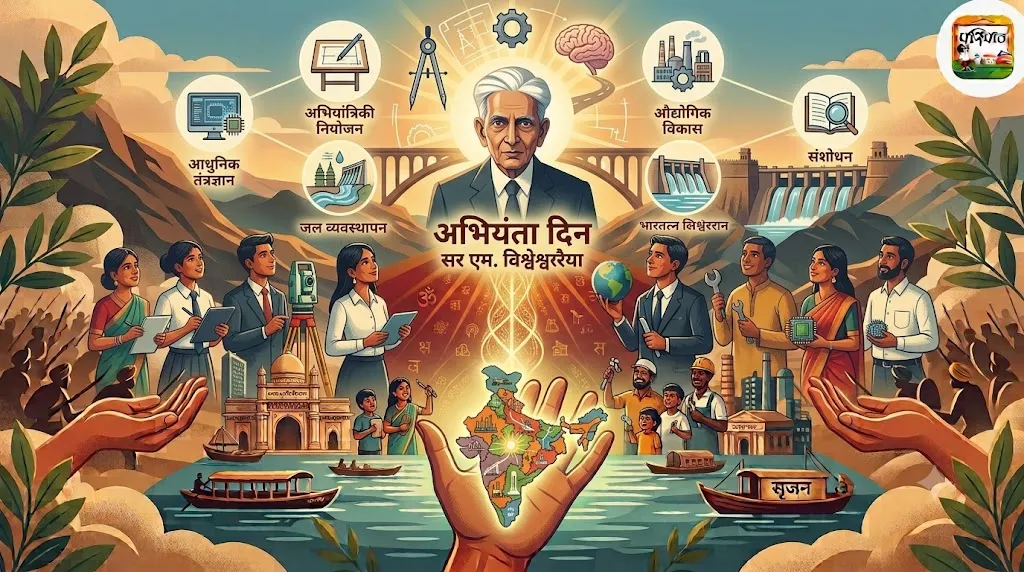
September 15, 2026: Celebrating Engineer's Day and a Visionary's Legacy
Today, September 15, 2026, marks 'Engineer's Day' in India, a day dedicated to celebrating the immense contributions of engineers to nation-building. This significant day also commemorates the birth anniversary of one of India's greatest visionaries, Bharat Ratna Sir M. Visvesvaraya, born on September 15, 1861. His life and work serve as a beacon of inspiration, reminding us of the power of engineering, innovation, and dedicated public service. While today also marks other important events like Rishi Panchami, International Day of Democracy, and World Lymphoma Awareness Day, it is Sir M. Visvesvaraya's unparalleled legacy in shaping modern India that truly defines this day for us.
Sir M. Visvesvaraya was far more than just an engineer; he was a brilliant administrator, an astute educationist, and a true nation-builder. His pioneering work in water management, industrial development, and educational reforms revolutionized various parts of India, laying the groundwork for the modern nation we see today. His journey exemplifies the values of hard work, integrity, and an unwavering commitment to national progress. Join us as we delve into the extraordinary life and monumental contributions of this remarkable personality.
Early Life and Education: The Genesis of a Vision
Mokshagundam Visvesvaraya was born into a humble Telugu Brahmin family in Muddenahalli, a small village in what is now Chikkaballapur district, Karnataka. His father, Srinivasa Sastry, was a renowned Sanskrit scholar and an expert in Ayurveda, and his mother, Venkatalakshmi, was a devout homemaker. Tragedy struck early in Visvesvaraya's life when his father passed away when he was just twelve years old, plunging the family into financial hardship. Despite these challenges, his mother ensured that his education did not suffer.
Visvesvaraya completed his primary education in his village. He then moved to Bangalore, where he lived with his maternal uncle, H. Ramaiah, who provided crucial support for his studies. He earned a Bachelor of Arts (B.A.) degree with distinction from Central College, Bangalore. His exceptional intelligence and diligent nature were evident from his early academic years. In 1881, he received a scholarship from the then Maharaja of Mysore, enabling him to pursue higher education in engineering at the College of Science in Pune. In 1884, he graduated with a Licentiate in Civil Engineering (L.C.E.) with top honors, standing first in his class. This period not only honed his technical skills but also instilled in him a deep understanding of engineering principles and their practical applications.
The Master Engineer: Architect of Water Management and Infrastructure
Upon completing his education, Sir M. Visvesvaraya joined the Public Works Department (PWD) of the Bombay Presidency in 1884 as an Assistant Engineer. His first significant assignment involved designing and implementing a water supply scheme for the town of Sukkur in the Sindh province. His innovative approach and efficiency in this project earned him accolades from his superiors.
The 'Block System' - Revolutionizing Irrigation
One of Visvesvaraya's most notable contributions was the development of the 'Block System' of irrigation for the Deccan canals. This ingenious system ensured equitable distribution of water by allowing water supply to specific areas for fixed durations, minimizing wastage and maximizing the irrigated land. This method, still in use in several regions, stands as a testament to his foresight and practical engineering prowess.
Krishna Raja Sagara (KRS) Dam: A Lifeline for Mysore
In 1909, he was appointed Chief Engineer of the Mysore State. During his tenure, he embarked on a monumental project: the construction of the Krishna Raja Sagara (KRS) Dam across the Kaveri River. This dam was designed not only for irrigation but also to provide drinking water to the cities of Mysore and Bangalore and to generate hydroelectric power. At the time, it was one of the largest dams in India. Securing funding for this ambitious project was a significant challenge, but Visvesvaraya, with the support of the Maharaja, meticulously planned and executed it. The KRS Dam significantly boosted agricultural and industrial development in Mysore State and remains a grand monument to his engineering genius.
Hyderabad Flood Protection System
Following the devastating Musi River floods in Hyderabad in 1908, the Nizam of Hyderabad invited Visvesvaraya to devise a flood protection system. He meticulously crafted a comprehensive plan that included the construction of two large reservoirs (Osman Sagar and Himayat Sagar) and an efficient drainage system for the city. His plan successfully safeguarded Hyderabad from future floods, bringing immense relief to its citizens.
Patented Automatic Sluice Gates
He designed and patented a set of 'Automatic Sluice Gates' for the Khadakwasla Dam near Pune. These gates would automatically open and close based on the water level, ensuring proper discharge and maintaining the dam's safety. This inventive creation was a significant engineering milestone, showcasing his ingenuity and forward-thinking approach.
Dewan of Mysore: Administrative Reforms and Industrial Revolution
In 1912, Maharaja Krishna Raja Wadiyar IV appointed Sir M. Visvesvaraya as the Dewan (Chief Minister) of Mysore State. He accepted the position on the condition that he would be granted complete autonomy in his work. During his tenure as Dewan, Mysore State experienced unprecedented progress and became a model state in India. He expanded his focus beyond engineering projects to encompass administrative reforms, industrial development, education, and social upliftment.
Catalyst for Industrialization
Visvesvaraya envisioned Mysore as an industrial hub. He encouraged the establishment of numerous industries, including the Mysore Sandal Oil Factory, Mysore Soap Factory, Mysore Iron and Steel Works (now Visvesvaraya Iron and Steel Plant, Bhadravati), and played a crucial role in establishing Hindustan Aeronautics Limited (HAL) in Bangalore. These industries created employment opportunities and strengthened the state's economy. He established the 'Industrial Conference' to formulate policies for industrial growth.
Revolutionizing Education
Understanding the critical importance of education, he founded the University of Mysore, which was the first university in India to be established outside the British administration. He championed technical and vocational education, recognizing the need for a skilled workforce for national progress. He implemented various schemes to promote primary education and advocated for 'Free and Compulsory Education.' His efforts led to the opening of many schools and colleges across Mysore.
Banking and Economic Reforms
Recognizing the importance of a robust banking sector for economic stability, he established the Bank of Mysore (now merged with the State Bank of India). This bank facilitated savings and provided capital for industries, contributing significantly to the state's economic stability. He introduced several financial reforms to bolster the state's economy.
Democratic Governance and Public Service
He promoted local self-governance through village panchayats and made the Mysore Representative Assembly more effective. He implemented several administrative reforms to bring efficiency to public services. Under his leadership, Mysore became renowned as a well-governed and progressive state.
“Work, work, work – and keep your country’s interest always in mind.”
- Sir M. Visvesvaraya
A Nation Builder's Legacy: Inspiring Generations
Sir M. Visvesvaraya's contributions extended far beyond the borders of Mysore State; he provided invaluable guidance for the development of India as a whole. He is widely regarded as the father of India's economic planning. In 1934, he authored a groundbreaking book titled 'Planned Economy for India,' in which he laid out a detailed blueprint for India's economic development, conceptually similar to the Five-Year Plans adopted after independence. His ideas profoundly influenced India's post-independence economic policies.
He served on numerous important committees, leveraging his vast knowledge to steer the nation towards progress. His integrity, diligence, and passionate desire to contribute to his country were defining characteristics of his personality. He often emphasized the importance of punctuality and efficient use of time. His life itself was an example of how one individual's vision and dedication can transform an entire society.
In 1955, in recognition of his unparalleled contributions, the Government of India bestowed upon him the 'Bharat Ratna,' India's highest civilian honor. He was the first engineer to receive this prestigious award. He passed away in 1962, at the remarkable age of 101, leaving behind a legacy that continues to inspire and guide us.
An Ideal for Engineering and Public Service
Sir M. Visvesvaraya's life is an exemplary model for every student, especially those aspiring to careers in engineering and public service. We can learn invaluable lessons from him:
- Visionary Leadership: He always looked to the future, conceiving and executing long-term plans.
- Hard Work and Integrity: Every task he undertook was performed with utmost honesty and dedication.
- Problem-Solving Aptitude: He consistently sought innovative solutions to challenges, whether in water management or industrial development.
- Importance of Education: He considered education the cornerstone of development and tirelessly worked for its promotion.
- Public Service: He dedicated his entire life to the service of his nation.
In today's technological age, where new discoveries and innovations are made daily, Sir Visvesvaraya's work remains incredibly relevant. The solutions he pioneered in his time serve as an ideal for the current generation, demonstrating how intelligence, creativity, and determination can bring about monumental change. Celebrating his birthday as 'Engineer's Day' is a true tribute to his work. On this day, we not only remember him but also pledge to follow his ideals and contribute to the nation's progress as good citizens and responsible engineers.
Did You Know?
- Sir M. Visvesvaraya designed and patented his 'Automatic Sluice Gates,' a testament to his innovative engineering skills.
- He was the first engineer to be awarded the Bharat Ratna, India's highest civilian honor, for his pivotal role in developing India's infrastructure.
- He lived for over 101 years, remaining actively involved in India's development until his last days.
- Mahatma Gandhi once described him as a 'man with a vast ocean of knowledge who dedicated his life to the service of the nation.'
- In his honor, his birthday, September 15, is celebrated as 'Engineer's Day' across India.
Conclusion
Bharat Ratna Sir M. Visvesvaraya was a true architect of modern India. His life symbolizes vision, relentless hard work, unwavering integrity, and dedicated public service. As an engineer, he revolutionized water management and infrastructure, and as an administrator, he led Mysore State to the pinnacles of industrial and educational progress. His book 'Planned Economy for India' provided a crucial direction for India's economic planning. As we celebrate Engineer's Day on September 15th, we remember his monumental contributions and draw inspiration from his ideals. For students, learning from his life and striving to contribute to the nation's progress would be the most fitting tribute to this great engineer.