Hello students and esteemed educators!
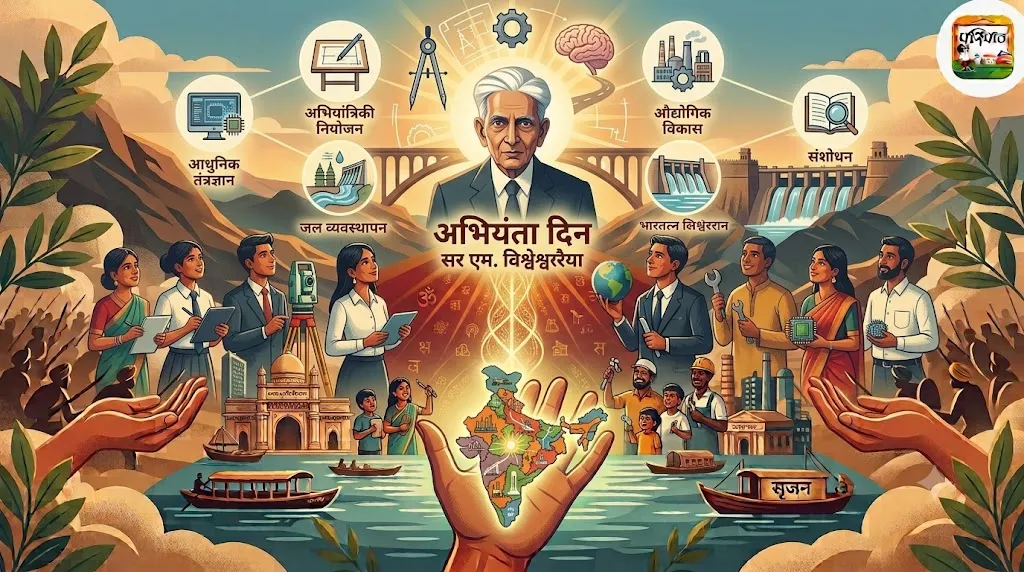
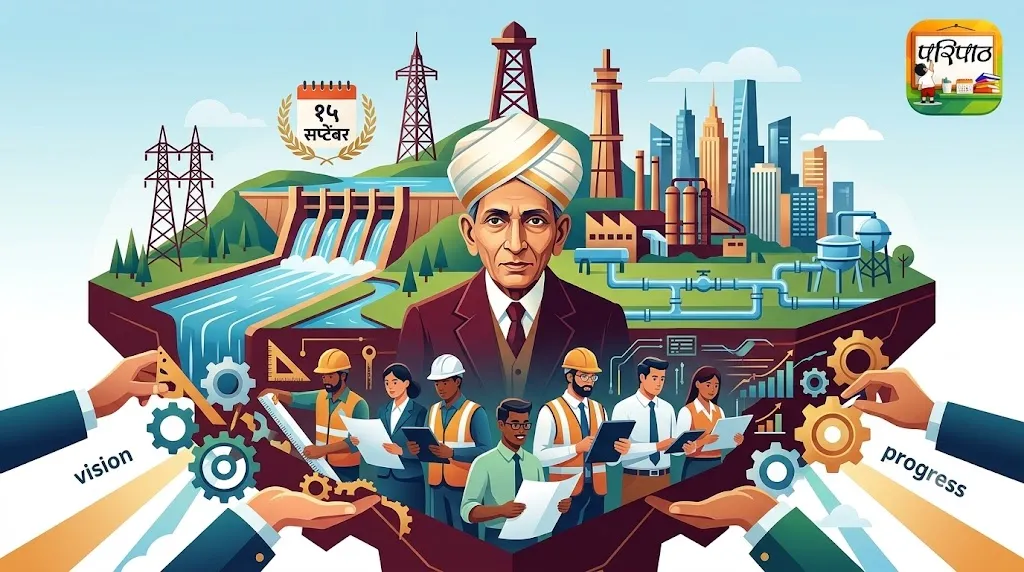
Today, we pay tribute to an extraordinary personality who, with his intellect, foresight, and tireless efforts, laid the groundwork for modern India. We are talking about Bharat Ratna Sir M. Visvesvaraya. September 15th, his birth anniversary, is celebrated as 'Engineer's Day'. Engineering is not merely about constructing buildings or bridges; it's about problem-solving, innovation, and envisioning the future. Sir M. Visvesvaraya exemplified this. His vision, dedication to work, and ethical values continue to inspire us even today.
Let's embark on an inspiring journey through the life of this great architect of modern India.
Early Life and Education: The Genesis of a Genius
Sir M. Visvesvaraya was born on September 15, 1861, in Muddenahalli, a small village in the Kolar district of Karnataka (then Mysore State). His father, Srinivasa Sastry, was a Sanskrit scholar, and his mother, Venkachalamma, was a dutiful homemaker. The untimely demise of his father plunged the family into financial hardship. However, these challenges did not deter young Visvesvaraya's zeal for education.
He completed his primary education in his village. Later, he moved to Bangalore to live with his maternal uncle for further studies. He earned his Bachelor of Arts (B.A.) degree from Central College, Bangalore, in 1881, notably securing the top position. His passion for engineering then led him to Pune, Maharashtra. In 1884, he obtained a degree in Civil Engineering from the 'College of Science' in Pune, now known as the 'College of Engineering Pune' (COEP). Here too, he showcased his brilliant intellect, graduating with first-class honors and winning a gold medal. His academic journey highlights his determination, hard work, and exceptional intelligence.
A Visionary Engineer: Shaping India's Infrastructure
After graduating, Sir M. Visvesvaraya began his career in 1884 as an Assistant Engineer in the Public Works Department of the Bombay Government. His initial work was in the Sinnar taluka of Nashik district, where he developed an innovative water management solution called the 'Block System' to improve irrigation on the Deccan plateau. This system significantly conserved water and brought vast tracts of agricultural land under irrigation. Its success was widely acknowledged, even by the British government.
"I like to solve problems that nobody else knows the answers to." - Sir M. Visvesvaraya
Numerous examples attest to his engineering prowess and foresight:
- Automatic Sluice Gates for Khadakwasla Dam: In Pune, he oversaw the installation of automatic sluice gates at the Khadakwasla Dam. These gates automatically open and close when the water reaches a specific level, enhancing the dam's storage capacity and aiding in flood control. This technology was considered highly advanced and revolutionary at the time. While now widely adopted globally, Sir M. Visvesvaraya was a pioneer in its application.
- Hyderabad Flood Protection Scheme: In 1908, the city of Hyderabad suffered immense damage due to a devastating flood in the Musi River. The Nizam's government invited Sir Visvesvaraya to devise a flood control plan. He designed and implemented a system that involved constructing two large reservoirs (Osman Sagar and Himayat Sagar) on the Musi River, providing permanent flood protection to the city. These reservoirs continue to supply water to Hyderabad and protect it from floods to this day.
- Krishnaraja Sagar (KRS) Dam: Both before and during his tenure as Diwan of Mysore, he played a pivotal role in the construction of the Krishnaraja Sagar Dam. Built on the Kaveri River, this dam was crucial not only for irrigation but also for hydroelectric power generation and providing drinking water. It was the largest dam in India at the time, and its construction presented numerous engineering challenges, which he successfully overcame. The electricity generated from this dam boosted industrial development in the Mysore state.
Diwan of Mysore: Architect of Progressive Governance
In 1908, he voluntarily retired from the British government service. Subsequently, in 1909, he was appointed Chief Engineer of the Public Works Department of the Mysore State. Impressed by his work quality and vision, the then Maharaja of Mysore, Krishna Raja Wadiyar IV, appointed him as the Diwan (Prime Minister) of the Mysore State in 1912. His tenure as Diwan (1912-1919) is often regarded as a 'Golden Age' in Mysore's history.
As Diwan, he did not merely focus on engineering projects but brought about a revolution in various sectors such as education, industry, banking, and social reforms:
- Educational Reforms: Recognizing the importance of education, he established the University of Mysore in 1916. This was the first university in British India that was not under government control. He promoted technical and vocational education, which helped make young people employable. 'A school in every village' was his dream.
- Industrial Development: He understood that no country could progress without industrial development. He established the famous 'Mysore Iron & Steel Works' (now Visvesvaraya Iron & Steel Plant) at Bhadravati. Additionally, he laid the foundation for the Mysore Sandalwood Oil Factory, a soap factory, a glass factory, a cement factory, and even an aircraft manufacturing plant (the precursor to today's Hindustan Aeronautics Limited - HAL). His efforts transformed Mysore into a hub of industrial development.
- Contributions to Banking: Recognizing the importance of a banking system for economic stability and development, he established the 'Bank of Mysore' (now State Bank of Mysore) in 1913. This provided financial assistance to local entrepreneurs and farmers.
- Social Reforms: He also emphasized poverty alleviation, improving healthcare services, and social equality. He implemented numerous schemes to bring sanitation and health facilities to rural areas.
- Mysore Economic Conference: In 1911, he established the Mysore Economic Conference, which was tasked with formulating policies for the state's economic development.
Epitome of Ethical Leadership: Integrity and Dedication
Sir M. Visvesvaraya was not just a great engineer or administrator; he was a symbol of integrity, honesty, and ethical values. His life was an exemplary model of public service. Some characteristics of his character:
- Strict Discipline and Punctuality: He was extremely punctual and disciplined. There was never any delay in his work, and he expected the same from himself and his colleagues.
- Honesty and Integrity: Throughout his career, he never compromised on ethical values. Once, while traveling by train, an unauthorized passenger boarded his compartment. Visvesvaraya insisted that the passenger buy a ticket, as he did not condone the violation of government rules. Another anecdote recounts that while he was the Diwan of Mysore, he was invited to inaugurate a major project. Upon arriving at the venue, he noticed that his chair was labeled 'Sir M. Visvesvaraya – Diwan,' while other ministers' chairs only had their names. He found this special treatment unacceptable and immediately asked for the 'Diwan' title to be removed from his chair, believing that everyone at the event was equal.
- Simplicity and Selfless Service: He always lived a simple life and dedicated all his efforts to the welfare of the public. He was never swayed by the allure of position or prestige.
- Unwavering Work Ethic: Even after the age of 90, he remained active, contributing his knowledge and experience to the nation's development. In 1955, when he was 94 years old, he was awarded India's highest civilian honor, the 'Bharat Ratna,' which he accepted with humility.
Engineer's Day: A Legacy of Inspiration
The celebration of 'Engineer's Day' on September 15th, Sir M. Visvesvaraya's birth anniversary, has a profound purpose. This day is not just to commemorate his work but to honor all engineers who work with his vision and dedicated spirit. Moreover, the main objective of this day is to inspire future generations, especially students, to pursue engineering and contribute to nation-building.
For today's youth, Sir M. Visvesvaraya's life is inspiring in many ways:
- Problem-Solving Attitude: He always viewed problems as challenges and sought innovative solutions. Students should also strive to think about the issues around them and find scientific and technical solutions.
- Innovation and Research: He constantly adopted new technologies and methods. Even today, the importance of new ideas and research is invaluable.
- Public Service and Patriotism: All his work was for the development of the country and the welfare of its people. Students should consider how they can use their knowledge for the betterment of society.
- Ethics and Integrity: Learning from leaders like him, students should prioritize values such as honesty, discipline, and hard work in their lives.
Today's India is rapidly progressing on the path of technology and development. The contribution of engineers to this progress is invaluable. From roads, bridges, buildings, power projects, information technology, space research, defense, to everyday mobile phones and the internet, the skill and intelligence of engineers are at work everywhere. The visionary sapling planted by Sir M. Visvesvaraya has now grown into a mighty tree.
Did You Know?
- Sir M. Visvesvaraya voluntarily retired from British government service in 1909, reportedly due to experiencing racial discrimination from British officers.
- In 1915, the British government knighted him as a 'Knight Commander of the Order of the Indian Empire' (KCIE), after which the prefix 'Sir' was added to his name.
- While he was the Diwan of Mysore, he installed 'Time Recorders' in all government offices to ensure punctuality and work discipline among employees.
- He authored a book titled 'Planned Economy for India,' in which he presented a systematic approach to India's economic development.
- In 1955, he was awarded India's highest civilian honor, the 'Bharat Ratna,' when he was 94 years old, accepting it with characteristic humility.
Conclusion
Sir M. Visvesvaraya's life is a prime example of determination, foresight, integrity, and selfless service. He was not just an engineer but a visionary leader, an astute administrator, an educationist, and a true architect of modern India. His engineering projects remain pillars of India's development, and his administrative and industrial ideas continue to guide us. By celebrating Engineer's Day, we not only commemorate an individual but also honor the power of science, technology, and innovative thinking. Inspired by his life's work, let us remain committed to the progress of our nation. Jai Hind!