Introduction: The Flame of 1857
Every year on June 18th, India pauses to remember one of its most valiant daughters: Rani Lakshmibai of Jhansi. Her name is synonymous with courage, defiance, and the indomitable spirit of Indian independence. Known as the 'Manikarnika' of her childhood and the 'Chhabili' of her youth, she evolved into the 'Jhansi ki Rani' who shook the very foundations of the British Empire. This blog post delves deep into her life, her struggles, and her ultimate sacrifice at the altar of freedom.
Historical Context: The Rise of a Warrior
Born into a Marathi Karhade Brahmin family in the holy city of Varanasi, Manikarnika Tambe was no ordinary girl. While other girls her age were restricted to household chores, she was trained in martial arts, horse riding, and archery under the guidance of her father, Moropant Tambe, and her mentor, Peshwa Baji Rao II.
The Political Landscape of the 1850s
The mid-19th century was a period of aggressive expansion by the British East India Company. Under the leadership of Lord Dalhousie, the infamous 'Doctrine of Lapse' was implemented. This policy allowed the British to annex any princely state if its ruler died without a natural male heir.
| Policy Aspect | British Viewpoint | Indian Viewpoint |
|---|---|---|
| Succession | Only biological heirs recognized | Adopted sons have full rights |
| Governance | Inefficient local rule justified annexation | British rule was exploitative |
| Sovereignty | The Company is the Paramount Power | Princely states had inherent rights |
The Turning Point: The Annexation of Jhansi
Lakshmibai was married to Raja Gangadhar Rao Newalkar of Jhansi in 1842. In 1851, she gave birth to a son who died within four months. Subsequently, the couple adopted Damodar Rao. However, upon the Raja's death in 1853, Dalhousie rejected the adoption and annexed Jhansi. It was then that the Rani uttered her legendary words: "Main apni Jhansi nahi doongi!" (I will not give up my Jhansi!)
The Great Revolt of 1857
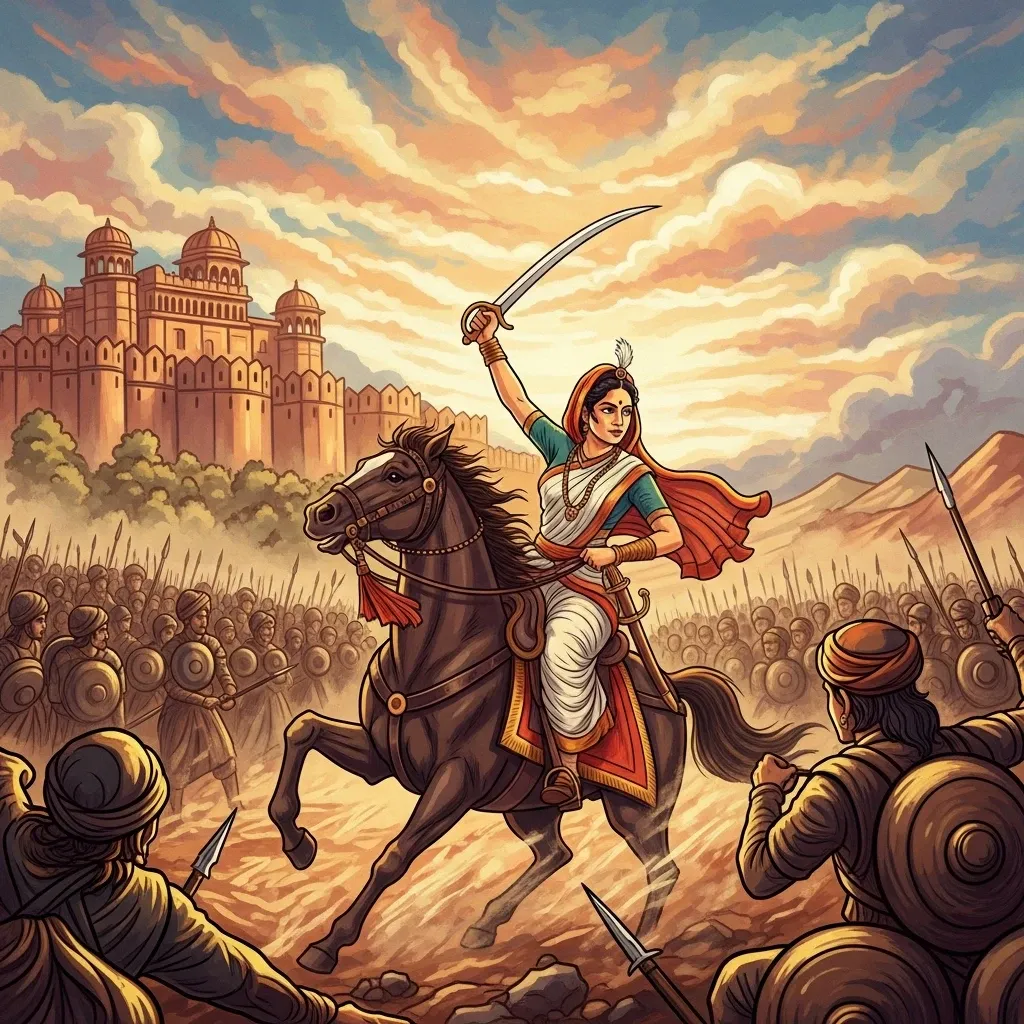
When the 1857 uprising broke out in Meerut and Delhi, it provided the spark the Rani needed. She took command of Jhansi, not just as a queen, but as a general. The siege of Jhansi by British forces led by Sir Hugh Rose in 1858 remains one of the most intense battles in military history.
"If defeated and killed on the field of battle, we shall surely earn eternal glory and salvation." — Rani Lakshmibai
The bravery she showed while jumping from the fort walls with her son strapped to her back is etched in the memory of every Indian. She escaped to Kalpi, joined forces with Tatya Tope, and eventually captured the Gwalior fort in a strategic masterstroke.
The Final Stand at Kotah-ki-Serai
On June 18, 1858, at Kotah-ki-Serai near Gwalior, Rani Lakshmibai fought her final battle. Dressed as a man and wielding two swords, she charged into the British hussars. Even when mortally wounded, she ensured that her body would not fall into the hands of the British, ordering her followers to cremate her immediately.
Frequently Asked Questions (FAQs)
Conclusion: An Everlasting Inspiration
Rani Lakshmibai's legacy transcends history books. She is the archetype of the modern Indian woman—strong, educated, and fearless. Her life teaches us that when justice is denied, resistance becomes a duty. On her death anniversary, let us resolve to uphold the values of courage and patriotism that she lived and died for.