
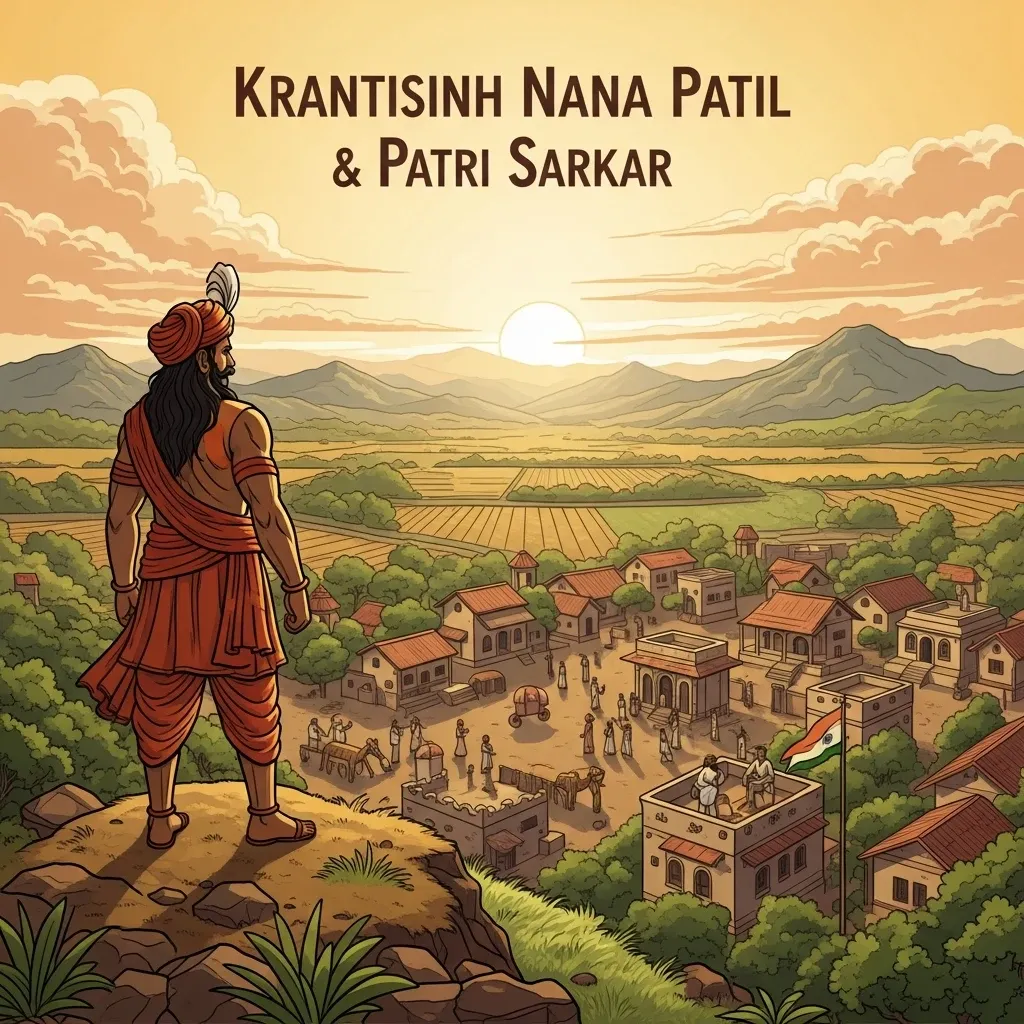
Introduction: The Lion of Satara
In the annals of India's freedom struggle, while the mainstream narrative often focuses on the non-violent movements led by the urban elite, a fierce and parallel saga of rebellion was being scripted in the heartland of Maharashtra. At the center of this storm was Krantisinh Nana Patil, a man whose name struck terror into the hearts of British officials and instilled hope in the downtrodden peasantry. Nana Patil was not just a freedom fighter; he was a visionary who established the 'Patri Sarkar' or the Parallel Government in Satara, effectively ending British rule in the region for nearly three years during the mid-1940s.
Early Life and Formative Years
Born on August 3, 1900, in the village of Yedemachindra, Sangli district (then part of the Satara district), Nana Ramachandra Patil grew up in an environment charged with social reform movements. His early life was heavily influenced by the teachings of Mahatma Jotirao Phule and the Satyashodhak Samaj (Truth Seekers' Society). This ideological foundation was crucial; it taught him that political freedom from the British was meaningless without social equality and the emancipation of the peasantry.
The Influence of Satyashodhak Ideology
Nana Patil realized early on that the British Raj survived not just on its military might but on the compliance of local landowners and the ignorance of the masses. He began his career as a government employee but soon resigned, realizing that he could not serve the masters who oppressed his people. He turned his attention to social work, fighting against superstitions, alcoholism, and the crippling debt cycles that trapped farmers. He used to say, "Our struggle is not just against the white-skinned foreigners, but against every element that sucks the blood of the poor."
The 1942 Quit India Movement and the Birth of Rebellion
When Mahatma Gandhi gave the call of "Do or Die" in August 1942, most senior Congress leaders were immediately arrested. This left a vacuum in leadership. While the movement in cities was being suppressed, Nana Patil saw an opportunity in the rural landscapes of Satara. He went underground, evading the police for years. It was during this period that the idea of a Prati Sarkar (Parallel Government) was conceived.
Structure of the Patri Sarkar
The Patri Sarkar was not a chaotic mob; it was a highly organized administrative machine. It had its own:
- Nyaydan Mandals: People's courts that settled disputes without the need for British intervention.
- Toofan Sena: A specialized military wing of young volunteers who conducted raids and maintained security.
- Revenue System: Instead of paying taxes to the British, farmers contributed to the local government for community welfare.
- Education & Social Reform: The government promoted schools and prohibited liquor consumption.
The Legend of 'Patri': Why the Name?
The name 'Patri' (which refers to a wooden plank or the method of applying force to the feet) became synonymous with Nana Patil's brand of justice. He was known for punishing British informers and village bullies who exploited the poor. The punishment often involved striking the soles of the culprits' feet with a wooden stick (Patri). This physical reminder ensured that those who betrayed their own people for British favors thought twice before doing so again.
"True independence is when the village is self-sufficient and the common man does not fear the police or the landlord." - Krantisinh Nana Patil
Social Reforms and Women's Empowerment
Nana Patil's government was revolutionary in its social outlook. At a time when caste discrimination was rampant, he organized 'inter-caste community dinners' (Sahabhojan). He was a staunch advocate for women's rights, encouraging them to join the Toofan Sena and fight alongside men. He simplified marriage rituals to reduce the financial burden on the bride's family, leading to the concept of 'Gandhi Vivah' or simple weddings.
| Aspect | British Administration | Patri Sarkar (Nana Patil) |
|---|---|---|
| Justice | Expensive, delayed, and biased towards the elite. | Immediate, local, and focused on equity. |
| Economy | Extractive; focused on sending wealth to Britain. | Distributive; focused on local village development. |
| Social Status | Maintained the status quo of caste and hierarchy. | Active promotion of social equality and reform. |
Post-Independence and Political Legacy
After India gained independence in 1947, Nana Patil did not retire into the shadows. He continued to fight for the rights of the farmers. He joined the Peasants and Workers Party of India (PWP) and later the Communist Party of India (CPI). He served as a Member of Parliament (Lok Sabha) from the Satara constituency and later from Beed. His speeches in the Parliament were legendary for their raw honesty and focus on the agrarian crisis.
Conclusion
Krantisinh Nana Patil remains an immortal figure in Indian history. He proved that true power lies in the mobilization of the rural masses. His life is a testament to the fact that revolution is not just about changing the flag at the top of a building, but about changing the lives of those at the bottom of the social ladder. Today, as we discuss grassroots democracy and decentralization, Nana Patil's 'Patri Sarkar' stands as the ultimate historical model for 'Gram Swaraj'.
