
Introduction: The Unshakeable Marvel of the Kaveri
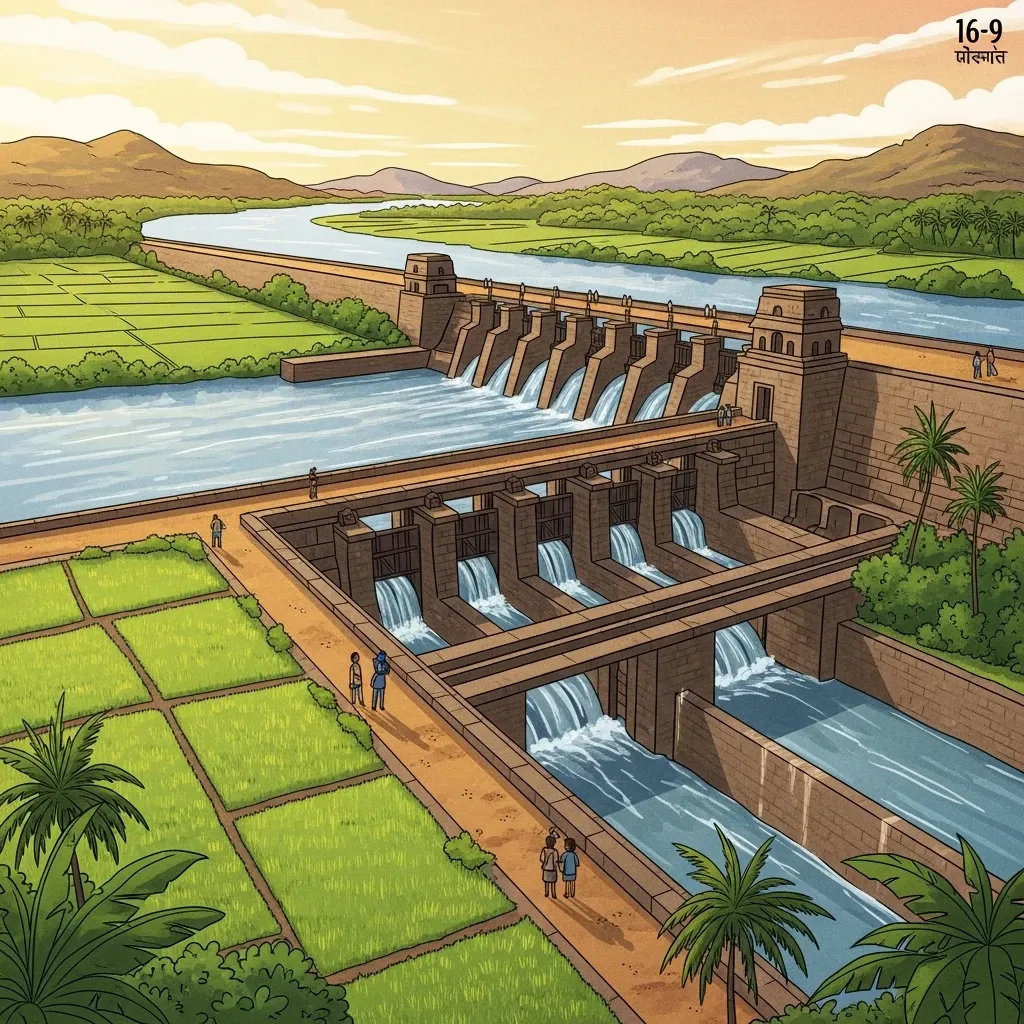
In an era where modern infrastructure often struggles to last a century, there exists a monument in southern India that has defied the ravages of time, floods, and history for nearly two millennia. The Grand Anicut, locally known as Kallanai, stands as a testament to the unparalleled engineering prowess of the Chola Dynasty. Built across the mighty Kaveri River in Tamil Nadu, this structure is not just a dam; it is a living blueprint of ancient hydraulic engineering that continues to irrigate over a million acres of land today.
The Visionary: Karikala Chola
Constructed around 150 AD by the legendary King Karikala Chola, the dam was born out of a desperate need to manage the erratic flow of the Kaveri. During the monsoons, the river would overflow, causing devastating floods, while in the summers, the delta would face acute water shortages. Karikala Chola, a ruler known for his military conquests and his patronage of arts, realized that the prosperity of his empire depended on the stability of agriculture.
The Strategic Location
The dam was built at a point where the Kaveri splits into four streams: the Kollidam, Kaveri, Vennaaru, and Puthu Aaru. By constructing the Kallanai at this crucial junction, the Chola engineers managed to divert water into the fertile delta regions, effectively turning the 'Rice Bowl of India' into a perennial green zone.
The Engineering Masterclass: Building on Sand
The most staggering aspect of the Kallanai is its foundation. Modern engineers are often baffled by how a structure of this magnitude was built on a sandy riverbed without the use of cement or reinforced concrete. The Chola engineers used a technique that involved placing massive, unhewn stones across the stream.
The Sinking Stone Technique
- Large boulders were transported to the riverbed.
- Due to the force of the water and the shifting nature of the sand, these stones would gradually sink.
- New layers of stones were piled on top until a stable, impenetrable base was formed.
- The stones were joined together using a primitive but effective mortar of clay and lime.
"The Kallanai is a masterpiece of hydraulic engineering. It proves that ancient Indians understood the dynamics of water pressure and soil mechanics long before these became formal sciences." - Historical Research Archive
Comparative Analysis: Ancient vs. Modern Irrigation
| Feature | Kallanai (Chola Era) | Modern Concrete Dams |
|---|---|---|
| Foundation | Sand-based with Sinking Stones | Rock-drilled Pile Foundations |
| Material | Unhewn Stone, Clay, Lime | Steel, High-Grade Concrete |
| Longevity | 2000+ Years (Active) | 50 - 100 Years (Estimated) |
| Environmental Impact | Low (Natural Diversion) | High (Large Reservoirs) |
Sir Arthur Cotton and the British Recognition
In the 19th century, during the British Raj, the dam had faced some neglect and silting issues. Sir Arthur Cotton, often called the 'Father of Irrigation' in India, was tasked with repairing it. He was so awestruck by the original Chola design that he called it the 'Grand Anicut'. He modeled his own designs for the Godavari and Krishna barrages based on the principles he learned from this 2,000-year-old structure.
Historical and Cultural Significance
Beyond engineering, the Kallanai represents the administrative brilliance of the Cholas. It allowed the Tanjore region to become the economic backbone of the empire. The surplus food produced led to the funding of massive temples like the Brihadeeswarar Temple and the flourishing of Tamil literature and art. It wasn't just a dam; it was the foundation of a civilization.
Frequently Asked Questions
[accordion title="Why is it called the 'Grand Anicut'?"]The term 'Anicut' is derived from the Tamil word 'Anaikattu', which means 'to build a dam' or 'to block the flow'. Sir Arthur Cotton added the prefix 'Grand' to signify its magnificence.[/accordion]Conclusion: Lessons for the Future
The Grand Anicut is more than a historical site; it is a lesson in sustainability. As we face global water crises, the ancient Indian philosophy of working with nature rather than trying to conquer it offers a path forward. The Cholas didn't just build a dam; they built a legacy that feeds millions even today. For students and engineers alike, the Kallanai remains an eternal classroom.
