In an age overflowing with information, where every click brings a deluge of data, the ability to simply consume information is no longer sufficient. What truly sets successful individuals apart is the capacity to critically analyze, evaluate, and synthesize that information to form logical conclusions. This is where Critical Thinking emerges as an indispensable 'superpower' for every student.
Have you ever paused to question why things are the way they are? Instead of accepting everything at face value, do you wonder, 'What's the evidence?', 'Are there other perspectives?', or 'What are the implications of this idea?' This process of questioning, exploring, and understanding beneath the surface is the essence of critical thinking. It's not just about thinking; it's about thinking clearly, rationally, and independently. Let's explore how this vital skill can transform your academic journey, daily life, and future prospects.
Decoding Critical Thinking: More Than Just Thinking
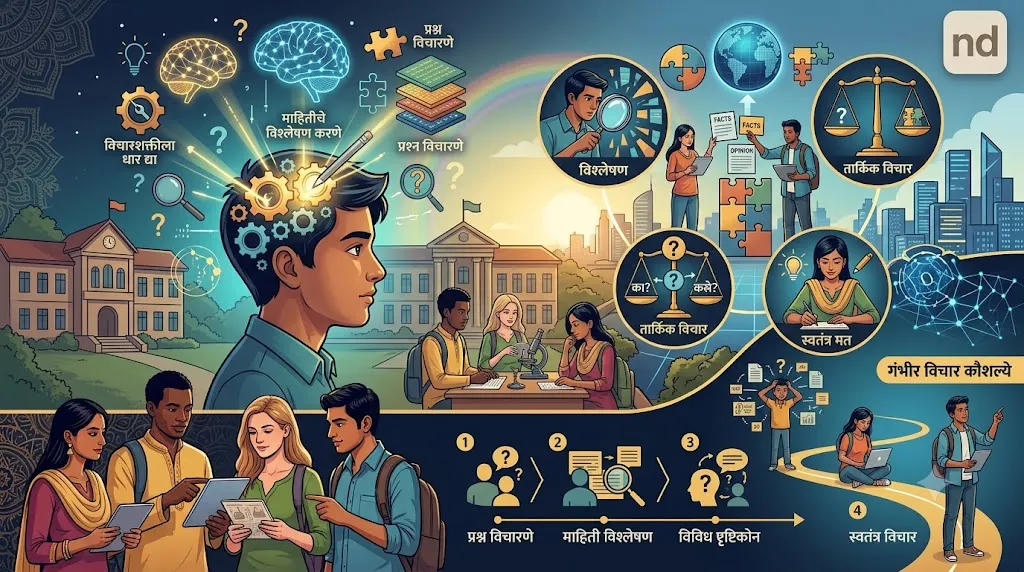
Critical thinking is a sophisticated mental process that involves active, objective, and systematic evaluation of information to form a judgment. It's not about being negative or finding fault; it's about being discerning and constructive. Key components include:
- Analysis: Breaking down complex information into smaller parts to understand their individual components and how they relate. For instance, dissecting a news report to distinguish facts from opinions.
- Evaluation: Assessing the credibility, relevance, and accuracy of information sources. Is the source trustworthy? Is there any bias?
- Inference: Drawing logical conclusions based on the evidence and reasoning after thorough analysis and evaluation.
- Problem-Solving: Utilizing critical thinking to identify the root causes of problems and devise effective, innovative solutions.
- Decision-Making: Weighing various options, considering their pros and cons, and selecting the most appropriate course of action.
In essence, critical thinking means 'always asking questions, digging deeper, and forming your own well-reasoned conclusions.'
“The function of education is to teach one to think intensively and to think critically. Intelligence plus character – that is the goal of true education.” – Martin Luther King Jr.
Core Elements of Critical Thinking:
- Clarity: Expressing thoughts and ideas clearly and precisely.
- Accuracy: Ensuring the information used is factually correct.
- Logic: Ensuring thoughts flow coherently and are logically connected.
- Depth: Moving beyond superficial understanding to explore the complexities of an issue.
- Breadth: Considering multiple perspectives and viewpoints.
- Relevance: Focusing on information that is pertinent to the issue at hand.
Why Critical Thinking is Your Ultimate Superpower in the 21st Century
The world is constantly evolving, driven by technology and an unprecedented flow of information. In such an environment, critical thinking is not just a desirable skill; it’s a survival tool. Here’s why it’s crucial for you:
1. Academic Excellence:
- Deeper Learning: It moves you beyond rote memorization to truly understand concepts, analyze them from different angles, and apply them creatively. This leads to a richer learning experience and better retention.
- Higher Grades: Exams, especially at higher levels, increasingly demand analytical and evaluative skills. Critical thinking helps you tackle complex problems, construct well-reasoned arguments, and articulate your understanding effectively.
- Research and Projects: From gathering reliable sources to synthesizing information and presenting your findings, critical thinking is the backbone of successful academic projects and presentations.
2. Navigating Daily Life and Making Informed Decisions:
- Smart Choices: Whether it's choosing a new gadget, deciding on a hobby, or managing your time, critical thinking helps you weigh options, assess potential outcomes, and make choices that align with your goals and values.
- Conflict Resolution: In interactions with friends or family, critical thinking helps you understand different viewpoints, identify the core of a problem, and work towards fair and effective solutions.
3. Battling Information Overload and Misinformation:
- Spotting Fake News: The digital age is rife with misinformation and fake news. Critical thinking equips you with the tools to question sources, cross-reference facts, and identify biases, preventing you from being misled.
- Digital Literacy: It's the ability to not just consume digital content but to evaluate its credibility, understand its purpose, and use it responsibly. This is paramount for staying safe and informed online.
4. Future Career Success:
- In-Demand Skill: Employers consistently rank critical thinking among the top skills they seek in new hires. Companies need individuals who can solve problems, innovate, make sound decisions, and adapt to new challenges. A survey by the World Economic Forum consistently places critical thinking as one of the top 10 skills for the future workforce.
- Innovation and Adaptability: Critical thinkers are often innovators. They question the status quo, identify gaps, and come up with creative solutions, making them invaluable assets in any profession.
Practical Steps to Sharpen Your Critical Mind
Critical thinking isn't an innate talent; it's a skill that can be developed and refined with practice. Here are some actionable tips you can start using today:
1. Ask Probing Questions:
Don't just accept information at face value. Cultivate a habit of asking 'Why?', 'How?', 'What if?', 'What's the evidence?', 'Who benefits from this?', and 'Is there another way to look at this?' This inquisitiveness fuels deeper understanding.
2. Analyze Information Actively:
When you encounter new information (a news article, a textbook chapter, a social media post), don't just skim it. Break it down. What are the main arguments? What evidence is presented? Is there any missing information? What are the underlying assumptions?
3. Consider Diverse Perspectives:
Before forming an opinion, try to understand an issue from multiple angles. Talk to people with different viewpoints, read different sources, and challenge your own assumptions. This broadens your understanding and helps you form more balanced conclusions.
4. Use Logic and Reasoning:
Train yourself to think logically. If A is true, and B is a consequence of A, then what does that imply? Understand cause and effect relationships. Avoid making decisions based purely on emotion or gut feeling; back them up with sound reasoning.
5. Examine Your Own Biases:
Everyone has biases, shaped by their experiences, upbringing, and beliefs. A crucial part of critical thinking is to acknowledge your own biases and consciously try to mitigate their influence on your judgment. Ask yourself, 'Is this truly objective, or am I letting my personal feelings influence my view?'
6. Practice Active Listening:
When someone is speaking, truly listen to understand their message, not just to formulate your reply. Pay attention to their arguments, their evidence, and their underlying assumptions. This helps you grasp the full context and respond more thoughtfully.
Fun Exercises to Boost Your Brainpower
Developing critical thinking can be an enjoyable process! Here are some simple exercises you can incorporate into your routine:
- The 'Five Whys' Game: For any problem or observation, ask 'Why?' five times. For example, 'Why did my plant wilt?' (Lack of water). 'Why was there no water?' (I forgot to water it). 'Why did I forget?' (I was busy with homework). 'Why was I so busy?' (I procrastinated). 'Why did I procrastinate?' (I find the subject difficult). This helps uncover root causes.
- Debates and Discussions: Engage in friendly debates with friends or family on topics like 'Should homework be abolished?' or 'Are video games good for you?'. This forces you to articulate your stance, listen to counter-arguments, and defend your position logically.
- News Article Analysis: Pick a news article daily. Identify the source. Is it reputable? What are the facts presented? What are the opinions? Are there any biases? What information is missing? Don't just read; dissect.
- Puzzles and Strategy Games: Sudoku, chess, riddles, and logic puzzles are excellent for stimulating your brain and improving your problem-solving and logical reasoning skills.
- 'What If...' Scenarios: Imagine hypothetical situations. 'What if I were the principal of my school, what changes would I make?' 'What if I could travel back in time, what would I do?' This encourages creative problem-solving and considering different outcomes.
- Book and Movie Reviews: After reading a book or watching a movie, don't just think about the plot. Analyze the characters' motivations, the author's message, the symbolism, and the underlying themes.
The Lifelong Rewards of Thinking Critically
The benefits of critical thinking extend far beyond the classroom, impacting every aspect of your life:
- Better Decision-Making: From choosing a career path to making significant life choices, critical thinking enables you to make informed, well-considered decisions.
- Enhanced Creativity and Innovation: When you think critically, you challenge conventions and explore new possibilities, which often leads to innovative ideas and creative solutions.
- Increased Self-Confidence: The ability to form your own well-reasoned opinions builds confidence. You become less susceptible to peer pressure and more reliant on your own intellect.
- Improved Communication Skills: Critical thinking helps you organize your thoughts clearly and articulate them logically, leading to more effective and persuasive communication.
- Empowered Citizenship: Understanding complex societal issues, forming informed opinions, and participating constructively in discussions are hallmarks of a responsible and engaged citizen.
Did You Know?
- The ancient Greek philosopher Socrates is often considered the father of critical thinking, known for his method of questioning to stimulate intellectual inquiry.
- A Stanford University study found that over 90% of students struggle to identify fake news, highlighting the urgent need for critical thinking skills in the digital age.
- The World Economic Forum consistently lists critical thinking and problem-solving among the top 10 skills required for future jobs.
- Studies suggest that individuals who regularly engage in critical thinking tend to have better memory and cognitive function as they age.
- Critical thinkers are often more adaptable and resilient, as they can analyze challenging situations and devise effective strategies to overcome them.
Conclusion
Critical thinking is not just an academic skill; it’s a life skill, a mindset, and indeed, a superpower. In an era where information is abundant but wisdom is scarce, the ability to think critically is your most valuable asset. It empowers you not just to succeed in school, but to thrive in your career, make wise personal choices, and contribute meaningfully to society.
So, start today. Question everything, analyze information, consider diverse perspectives, and draw your own logical conclusions. This superpower, once honed, will equip you to face any challenge, navigate any complexity, and forge a truly brilliant future. Remember, every great discovery, every significant breakthrough, is a product of critical thought. Are you ready to unleash your inner critical thinker?