Hello students and esteemed parents!
In our fast-paced world, where a deluge of new information bombards us every second, merely accumulating facts is insufficient. It has become paramount to analyze the information you hear, read, or see, verify its authenticity, and form your own independent opinions. This very ability, which helps you process information and make sound decisions, is known as 'Critical Thinking'. In this special article from Paripath, we will delve into what critical thinking is, why it's crucial for students, and how you can develop these vital skills.
What Exactly is Critical Thinking?
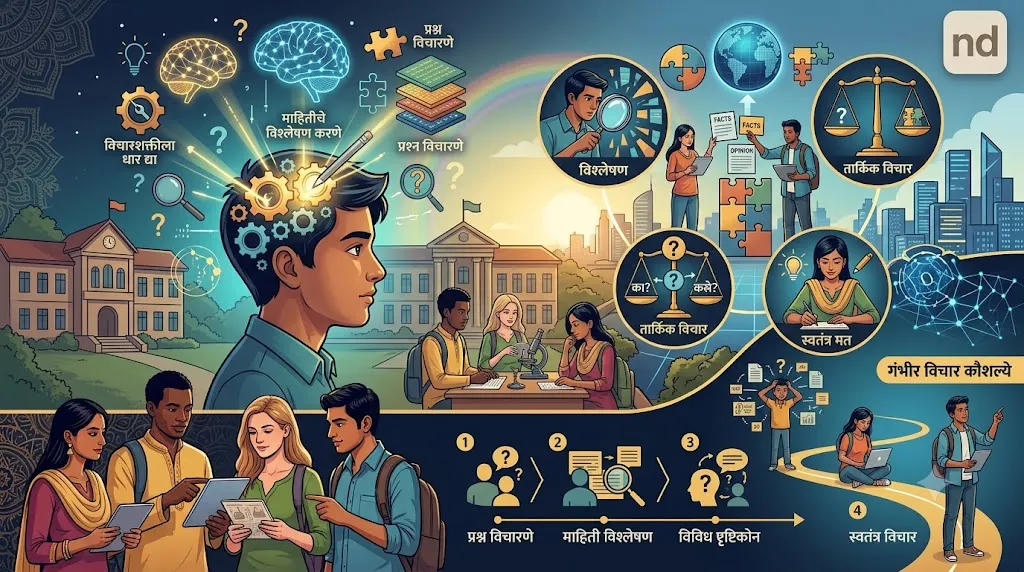
Critical thinking is the capacity to meticulously analyze, evaluate, and draw logical conclusions from any piece of information, idea, or problem, rather than simply accepting it at face value. It encompasses several key elements:
- Analysis: Breaking down information into smaller parts and understanding the meaning of each component.
- Evaluation: Assessing the credibility, relevance, and accuracy of the information.
- Inference: Drawing logical deductions or conclusions based on the available evidence.
- Explanation: Clearly articulating your thoughts and conclusions to others.
- Self-Regulation: Examining your own thoughts and opinions, and making necessary adjustments.
In essence, critical thinking means cultivating the habit of asking 'Why?', 'How?', 'For what purpose?', and 'What's behind this?'. This skill not only helps you comprehend textbook material but also equips you to tackle challenges in your daily life.
Why Are Critical Thinking Skills Crucial for Students?
Possessing critical thinking skills is more important today than ever before. Here are some primary reasons:
1. Navigating the Information Overload (Information Overload & Verification)
The internet and social media have unleashed an unprecedented flood of information. It's often challenging to discern what is true, what is false, what is useful, and what is misleading. Critical thinking skills help you analyze this information and verify its authenticity. For instance, when reading a news item on social media, it's crucial to ask questions like, 'Who posted this?', 'Is there any underlying agenda?', 'Is this information available on other credible sources?'
2. Achieving Academic Success (Academic Success)
Simply memorizing facts to pass exams is no longer enough. Critical thinking skills enable you to understand subjects in depth, solve complex problems, present effective arguments in essays, and draw conclusions from experiments. This improves your ability to answer exam questions more effectively and provides a significant advantage in higher education.
3. Enhancing Decision-Making Ability (Decision-Making Ability)
Students face numerous big and small decisions in their lives – choosing a career path, deciding which friends to spend time with, or prioritizing tasks. Critical thinking skills empower you to weigh the pros and cons of each option, leading to rational and appropriate decisions.
4. Boosting Problem-Solving Skills (Problem-Solving Skills)
Life is a journey filled with various problems. Critical thinking helps you get to the root of any problem, understand its various facets, and devise creative solutions. Great individuals like Steve Jobs, by critically analyzing problems, founded companies like Apple and created innovative products that transformed the world. The release of the Linux kernel 0.02 also stemmed from a collaborative problem-solving process born out of critical thinking among many programmers.
5. Fostering Independent Thought and Opinion (Independent Thought & Opinion Formation)
Instead of blindly believing what others say, it's vital to think for yourself and form your own opinions. Critical thinking teaches you to value your own thoughts and values while respecting others' viewpoints. This makes you a more responsible and aware citizen in society.
Practical Strategies for Developing Critical Thinking Skills
Critical thinking skills are not innate; they must be developed through practice. Here are some simple and practical methods you can incorporate into your daily life:
1. Ask 'Why?' and 'How?' Questions
- Question everything: For every piece of information you are taught or hear, ask 'Why is it so?', 'How does this work?', 'What is the evidence behind it?'. This will help you gain a deeper understanding of things.
- Engage with teachers: Never hesitate to ask questions in class. Asking teachers clarifies your doubts and brings greater clarity to the subject matter.
2. Verify Information from Multiple Sources
- Don't rely on a single source: After reading any information, cross-verify it with two or three other reliable sources. For example, if you see a news item on social media, check if the same news is available on reputable news channels or newspaper websites.
- Check credibility: Who is the source of the information? Is that person or organization an expert on the subject? Do they have any vested interest? Seek answers to such questions.
3. Participate in Debates and Discussions
- Express your thoughts: Engage in discussions on various topics with friends, family, or teachers. Present your views and listen to others' opinions.
- Understand different perspectives: Debates help you understand multiple viewpoints on the same topic. This broadens your thinking and allows you to form a more balanced opinion.
4. Play Problem-Solving Games
- Puzzles and Chess: Games like Sudoku, riddles, and chess stimulate your brain to think and enhance your problem-solving abilities.
- Project-based learning: Actively participate in school science fairs, model building, or group projects. These provide practical experience in solving real-world problems.
5. Examine Your Own Opinions
- Avoid biases: We all have certain preconceptions. Before forming an opinion, consider, 'From what perspective am I viewing this?', 'What influences my thoughts?'
- Be ready to change your mind: If you receive new information or understand a new perspective, be willing to change your opinion. This is a crucial characteristic of critical thinking.
6. Read and Write Regularly
- Read diverse literature: Beyond textbooks, read novels, newspapers, magazines, and informative articles. This exposes you to various subjects and expands your vocabulary.
- Write down your thoughts: Keeping a diary, writing essays, or blog posts helps clarify your thoughts and gives them direction.
Applying Critical Thinking in Daily Life
Critical thinking is not just useful in school or academics; it applies to every aspect of your daily life. Here are some examples:
- Using social media: Employ critical thinking when deciding what to share or believe. Ask yourself, 'Is this information true?', 'Will this cause harm to anyone?'
- Shopping: Before buying a product, compare its price, quality, and features with other products, and ask, 'Do I really need this?'
- Interacting with friends: In an argument, listen to both sides, understand their feelings, and only then present your opinion.
- Watching TV news: Instead of watching just one news channel, watch news from different channels and compare their reports. Remember that every news report might have a particular perspective.
- Reading about your favorite athlete or artist: Consider whether the information about them is just for publicity or if there's actual truth to it.
Did You Know?
- Apple co-founder Steve Jobs passed away on October 5, 2011. He was renowned for his 'thinking outside the box' and critical thinking skills, which revolutionized the technology industry.
- Linus Torvalds released the Linux kernel 0.02 on October 5, 1991. This open-source software is one of the finest examples of critical thinking and collaborative problem-solving.
- October 5th is celebrated as World Teachers' Day. Teachers play a crucial role in developing critical thinking skills in students.
- Research indicates that students with strong critical thinking skills achieve greater success and satisfaction in life.
- The ancient Greek philosopher Socrates is considered the father of critical thinking. He used to prompt people to think for themselves by asking probing questions. On October 6, 1989, the Dalai Lama was awarded the Nobel Peace Prize. His philosophy and teachings embody a blend of critical thinking and compassion. Pursuing peace and non-violence also requires critical thought and ethical values.
Conclusion
Dear students, critical thinking skills are not just the key to your academic success; they are essential for making you a responsible, aware, and successful citizen. In today's complex world, where information is exploding and problems are becoming more intricate, the ability to think critically will guide you on the right path.
Remember, the process of critical thinking is continuous. It doesn't develop overnight. Through regular practice, cultivating the habit of asking questions, being open to understanding diverse perspectives, and the ability to examine your own opinions, you can master these skills. Paripath will always guide you on this journey. Sharpen your mind and move towards a bright future!