Happy Global Student Day: Unlocking Your Potential with Critical Thinking
Dear Students and Esteemed Parents,
October 15th is a special day! It marks not only the birth anniversary of India's Missile Man and former President, Dr. A.P.J. Abdul Kalam, but it's also celebrated as Global Student Day. Student life is a beautiful journey of seeking knowledge and developing skills. While many skills are important, one stands out as crucial for success in academics and every facet of life: Critical Thinking Skills.
We live in an age where an ocean of information is constantly at our fingertips. The internet, social media, news, books – the sources of information are limitless. But how do we distinguish between what's right and wrong, true and false, important and trivial amidst this deluge of data? This is where critical thinking comes into play.
This article will guide you through what critical thinking is, why it's so important for you, and provide simple, actionable tips and exercises to develop this vital skill. Let's embark on this journey to explore the power of critical thinking!
What Exactly is Critical Thinking?
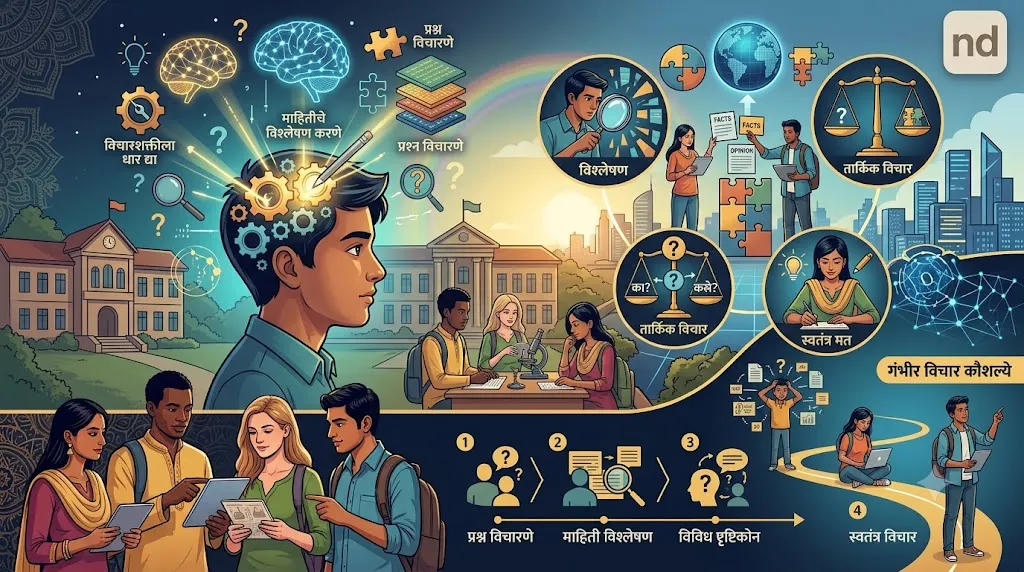
Critical thinking is more than just thinking; it's about thinking deeply, logically, and systematically. It involves analyzing, evaluating, and drawing sound conclusions from information, events, or problems from multiple perspectives. This skill prevents you from blindly accepting information and encourages you to think independently.
Key Components of Critical Thinking:
- Analysis: Breaking down complex information or problems into smaller, manageable parts to understand them better. For example, understanding what information is presented in a news report, who presented it, and what their agenda might be.
- Evaluation: Assessing the truthfulness, reliability, and relevance of information. Is the information accurate? Does it come from a credible source?
- Inference: Drawing logical conclusions based on available evidence and reasoning. If 'A' happened, why might 'B' have followed?
- Problem Solving: Identifying the root cause of a problem and devising effective solutions.
- Self-Regulation: Monitoring and evaluating your own thinking process and making adjustments as needed. Am I thinking clearly? Are there any biases influencing my thoughts?
In essence, critical thinking means approaching everything with an open mind, an attentive ear, and a questioning intellect. It's a process that teaches you not just to accept information, but to scrutinize it thoroughly.
Why is Critical Thinking a Superpower for Students?
You might wonder, why is this skill essential for achieving good grades in school? It offers numerous benefits that can revolutionize your academic and personal life.
1. For Academic Excellence:
- Deeper Understanding: Instead of rote memorization, critical thinking helps you understand the 'why' and 'how' behind concepts. This leads to a more profound understanding and better retention of subjects.
- Superior Problem Solving: Whether it's a challenging math problem or a science experiment, critical thinking teaches you to analyze the problem, explore various options, and choose the most effective solution.
- Effective Writing and Communication: When writing essays, presenting projects, or participating in group discussions, critical thinking is crucial for articulating clear, logical, and well-supported ideas.
- Better Exam Performance: Answers written with critical thought are often more insightful and well-structured, leading to higher scores.
2. For Making Informed Daily Decisions:
Beyond school, this skill is equally valuable. Should you follow your friend's advice? Is that news you saw on social media true? Which toy or gadget should you buy? Critical thinking helps you navigate these questions and make sound decisions in your daily life.
3. Navigating the Information Overload:
In today's digital age, misinformation and rumors spread rapidly. Critical thinking allows you to verify the authenticity of any information before accepting it. This prevents you from being misled and helps you embrace factual data.
4. For Future Success:
In the present and future job markets, success won't just belong to those who possess information, but to those who can use that information to generate new ideas, solve complex problems, and make decisive choices. According to the World Economic Forum, critical thinking will remain one of the most important skills by 2025.
“The aim of education is not to fill empty vessels, but to kindle a flame.”
– Plutarch
Simple Ways to Cultivate Critical Thinking and Practice It
Critical thinking isn't an innate ability; it's a skill that can be developed with practice. Here are some simple things you can incorporate into your daily life:
1. Develop a Habit of Asking Questions:
Don't immediately accept information presented to you. Ask yourself and others:
- What is it?
- How does it work?
- Why did it happen?
- What are the underlying reasons?
- What will be the consequences?
- What other perspectives might exist?
Question what teachers teach, what books state, or what friends tell you. This leads to a deeper understanding of subjects.
2. Evaluate Information Sources:
We are constantly bombarded with information. When you read news or any piece of information, check its source. Is it credible? Is it biased? For example, Wikipedia is a good starting point, but for in-depth information, you might refer to government websites, reputable research institutions, or books written by experts.
3. Understand Diverse Perspectives:
There can be many ways to look at the same thing. When discussing an issue, listen to different people's opinions. Try to think from their point of view. This broadens your thinking capacity.
4. Think Logically:
When reaching a conclusion, check if you have sufficient evidence and logic to support it. Don't let emotions dictate your decisions. Something isn't true just because 'you feel it is'; it needs solid reasoning.
5. Identify Your Own Biases:
Each of us has certain biases that influence our thoughts. For instance, we tend to believe what people we like tell us more readily. Examine your own thoughts and ensure your decisions aren't unduly influenced by your biases.
- White Hat: Facts and figures.
- Red Hat: Emotions and intuition.
- Black Hat: Negative aspects and risks.
- Yellow Hat: Positive aspects and benefits.
- Green Hat: Creative thinking and new ideas.
- Blue Hat: Managing the thinking process.
Practice using each hat to think about any problem or situation.
Simple Exercises to Sharpen Your Mind:
- Group Discussions and Debates: Organize group discussions or debates in school or with friends on various topics. Listen to each other's points and logically present counter-arguments.
- 'What if...?' Game: Imagine a hypothetical situation and explore its potential outcomes and solutions by asking 'What if...?' questions. For example, 'What if smartphones never existed?'
- Newspaper News Analysis: Choose one news article daily. Think about who wrote it, what its purpose is, what information is presented, and what might be omitted.
- Puzzles and Brain Games: Play Sudoku, chess, riddles, or logic games. These challenge your brain to think critically.
- Journaling: Write down your daily events, thoughts, and decisions in a diary. Reflect on why you made certain decisions and what their outcomes were.
Did You Know?
- The human brain is the most energy-consuming organ in the body, using about 20% of the body's total energy despite making up only 2% of its weight.
- The oldest university in the world, the University of Bologna in Italy, was founded in 1088.
- Legend has it that Sir Isaac Newton discovered the law of gravity when an apple fell on his head, but this is likely just a story. He developed his theory through years of observation and critical thought.
- Norodom Sihanouk, who passed away on October 15th, was the King of Cambodia and made many crucial political decisions throughout his country's history.
- Global Handwashing Day is also observed on October 15th, emphasizing the importance of hygiene – a simple yet critically observed health measure.
Conclusion: Critical Thinking – The Key to Success
Critical thinking is not just an academic skill; it's a fundamental life skill that touches every aspect of your existence. It empowers you to analyze information correctly, make informed decisions, solve problems effectively, and continuously learn. In today's rapidly changing world, where new technologies and information flows are constantly increasing, this skill will help you stay grounded and successful.
On this Global Student Day, let us all pledge that we will not merely be information-gathering machines. Instead, we will critically analyze information, form our own opinions, and better understand the world around us. Start practicing this skill today. Ask questions, verify information, understand diverse perspectives, and think logically. Your journey of critical thinking will undoubtedly lead you to the pinnacle of success!
Best wishes!