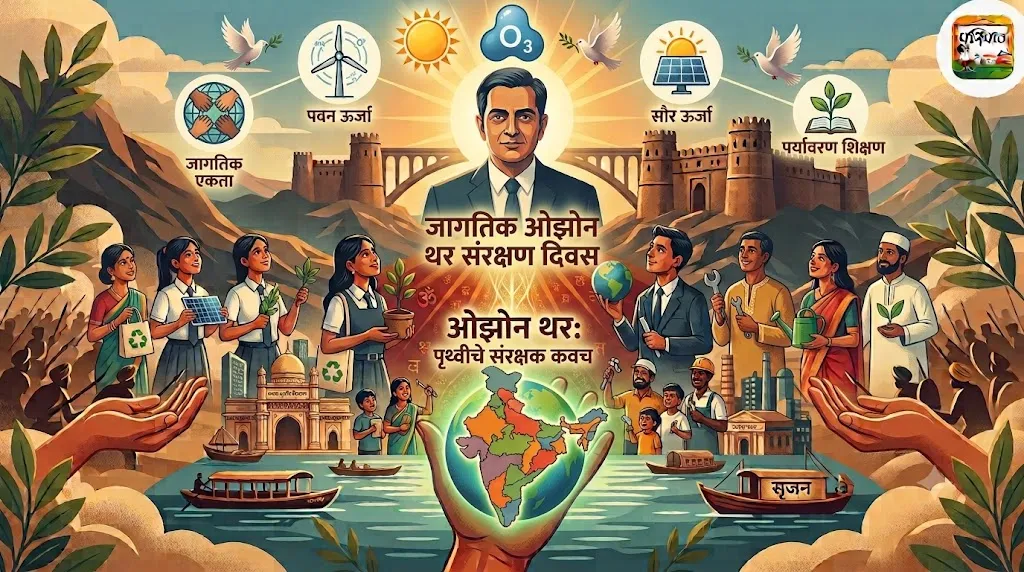
Hello, young learners!
Today, September 16th, is not just another date on the calendar; it's a day marked by several significant events. We observe 'World Ozone Day,' a global reminder of the crucial ozone layer that protects our planet. It was on this very day in 1987 that the historic 'Montreal Protocol' was signed. Additionally, in India, this day also marks the death anniversary of the legendary Air Marshal Arjan Singh, and for some, cultural celebrations like Gauri Avahan and Balram Jayanti. However, our primary focus today is on the ozone layer and its profound importance.
We all know that various natural elements are essential for life to thrive on Earth. Among these, one invisible yet incredibly vital component is the 'ozone layer.' This layer acts as a protective shield for us and all living beings, safeguarding life from the sun's harmful ultraviolet (UV) radiation. Let's dive deep into understanding this unseen hero and explore what we, as students, can do to contribute to its preservation.
What is the Ozone Layer?
Ozone (O3) is a gas composed of three oxygen atoms. Unlike ordinary oxygen (O2), which has two atoms, ozone has an extra oxygen atom. This gas is found primarily in the 'stratosphere,' a layer of Earth's atmosphere located approximately 15 to 35 kilometers (9 to 22 miles) above the Earth's surface.
The ozone layer is formed naturally. When the sun's ultraviolet rays strike oxygen molecules (O2) in the atmosphere, they split the oxygen molecules into two separate oxygen atoms (O). These free oxygen atoms then combine with other intact oxygen molecules (O2) to form ozone (O3) molecules. This continuous process creates and maintains the ozone layer in the stratosphere.
While ozone near the Earth's surface (in the troposphere) is considered a harmful pollutant, in the stratosphere, it is crucial for life. It functions like a natural filter, preventing the sun's most damaging rays from reaching the Earth.
The Ozone's Crucial Role: Earth's Invisible Protective Shield
The most critical function of the ozone layer is to absorb the harmful ultraviolet (UV) radiation emitted by the sun. The sun emits three types of UV radiation:
- UV-A Rays: These are the least harmful and reach the Earth's surface. They are primarily responsible for skin tanning.
- UV-B Rays: These are moderately harmful. The ozone layer absorbs most of these rays, but some can still reach the Earth's surface.
- UV-C Rays: These are the most dangerous and can be lethal to living organisms. Fortunately, the ozone layer completely absorbs all UV-C rays, preventing them from reaching the Earth.
Imagine if the ozone layer didn't exist, or if it became too thin. Here are the potential consequences:
Impact on Human Health:
- Skin Cancer: UV-B rays damage the DNA in skin cells, significantly increasing the risk of skin cancer, especially melanoma.
- Cataracts: Direct exposure to UV radiation can lead to an increase in cataracts, a clouding of the eye's lens that impairs vision.
- Weakened Immune System: UV radiation can suppress the human immune system, making the body more vulnerable to infectious diseases.
Impact on Environment and Ecosystems:
- Plants and Crops: UV-B radiation can inhibit plant growth, reduce photosynthesis, and decrease crop yields and quality. This could have severe implications for global food security.
- Marine Life: Phytoplankton, microscopic organisms at the base of the marine food web, are highly sensitive to UV radiation. Their destruction can disrupt entire marine ecosystems, affecting fish populations and other aquatic life.
- Climate Change: The ozone layer also plays a role in regulating atmospheric temperature. Its depletion can indirectly influence climate patterns.
The ozone layer is not just a mere atmospheric gas; it is an invisible shield safeguarding Earth's health and the future of all life. Without this shield, life on Earth as we know it would not be possible.
Ozone Depletion: A Global Crisis and Its Discovery
Despite its critical importance, the ozone layer began to thin significantly from the 1970s onwards, causing immense concern. In the 1980s, scientists discovered a large 'ozone hole' over Antarctica, a finding that sent shockwaves across the globe.
Causes of Ozone Depletion: Man-Made Chemicals
The primary cause of ozone depletion was a class of man-made chemicals known as 'Ozone Depleting Substances' (ODS). The most prominent of these chemicals included:
- Chlorofluorocarbons (CFCs): These were widely used in refrigerators, air conditioners, aerosol sprays (like perfumes and hairsprays), foam products, and fire extinguishers.
- Halons: Chemicals primarily used in fire suppression systems.
- Methyl Bromide: A chemical used as a pesticide.
Once released into the atmosphere, these chemicals slowly rise to the stratosphere. There, intense UV radiation from the sun breaks them down, releasing highly reactive chlorine or bromine atoms. These atoms act as catalysts, meaning a single chlorine atom can destroy thousands of ozone (O3) molecules by breaking them down into ordinary oxygen (O2).
This catalytic destruction significantly reduces the concentration of ozone, leading to the thinning of the ozone layer. The 'ozone hole' over Antarctica was a direct consequence of the widespread use of these destructive chemicals.
A Ray of Hope: The Success Story of the Montreal Protocol
When scientists presented the gravity of ozone depletion to the world, nations across the globe recognized the urgent need for action. This led to the signing of the historic 'Montreal Protocol on Substances that Deplete the Ozone Layer' on September 16, 1987. This day is now celebrated annually as 'World Ozone Day.'
Objectives and Success of the Montreal Protocol:
- Banning ODS: The Protocol mandated the phased elimination of the production and consumption of CFCs and other ozone-depleting substances.
- Global Cooperation: This agreement is widely regarded as the most successful environmental treaty in history, with all 198 United Nations member states ratifying and implementing it. Developed and developing nations came together to address this global challenge.
- Industry Innovation: The Protocol spurred industries to find alternatives to CFCs, such as hydrofluorocarbons (HFCs) and hydrochlorofluorocarbons (HCFCs), which are less harmful to the ozone layer (though some still contribute to global warming).
Results and Future Outlook:
Thanks to the successful implementation of the Montreal Protocol, the production and consumption of ozone-depleting substances have been reduced by over 99%. The positive effects are now visible: the ozone hole over Antarctica is gradually shrinking, and scientists project a full recovery of the ozone layer by around 2065.
The success story of the Montreal Protocol teaches us a powerful lesson: when science, international cooperation, and political will converge, even the most daunting global environmental challenges can be overcome. It stands as a beacon of hope and a model for addressing other pressing environmental issues, such as climate change.
What Can We Do? Actions for Students
While the ozone layer is on its way to recovery, our collective responsibility is far from over. As aware citizens and students, we can all contribute to this vital cause in our own ways. Here are some simple actions you can take:
- Spread Awareness: Talk to your friends, family, and neighbors about the importance of the ozone layer and how to protect it. Share accurate information.
- Conserve Energy: Electricity generation often relies on fossil fuels, which emit carbon into the atmosphere. Reducing energy consumption indirectly helps protect the ozone layer. Turn off lights when not needed, and use fans or ACs judiciously.
- Use Public Transport or Cycle: Whenever possible, cycle to school or nearby places, or opt for public transportation. This reduces vehicle emissions, which contribute to air pollution.
- Choose Eco-Friendly Products: Ensure proper disposal of old refrigerators or AC units. While new products no longer use ODS, older appliances might still contain them. When buying new products, try to choose those labeled as eco-friendly.
- Plant Trees: Planting trees helps absorb carbon dioxide from the atmosphere and releases oxygen. A healthy environment indirectly benefits the ozone layer.
Did You Know?
- If the entire ozone layer were brought down to Earth's surface, it would be only about 3 millimeters (about the thickness of a coin) thick! Such a thin layer protects us from harmful radiation.
- Ozone gas is toxic to breathe, but in the stratosphere, it's considered 'good ozone,' while ozone in the lower atmosphere is 'bad ozone,' acting as a pollutant.
- The Montreal Protocol is the first treaty in United Nations history to be ratified by every single member state.
- Due to the ozone hole, Australia and New Zealand experienced a significant increase in skin cancer rates because of their proximity to Antarctica.
Summary and Conclusion
The ozone layer is an invaluable natural protective shield for our Earth and all its life forms. Understanding its importance, learning about the causes of its depletion, and studying the success story of global efforts (especially the Montreal Protocol) to restore it is incredibly inspiring.
Today, September 16th, on World Ozone Day, let us all recognize the significance of this invisible hero and pledge to contribute to its protection. The small decisions and actions we take today can make a big difference in the future. Let us come together to keep Earth's protective shield safe and create a healthier, more secure world for future generations!
Thank you!