Introduction: The Priceless Treasure of Water
Dear students, today, September 24, 2026, we gather on the auspicious occasion of Guru Pradosh Vrat, a day that reminds us of purity and our connection to nature. As we reflect on this day, we also recall significant events: the successful Mangalyaan mission, a testament to our scientific prowess; the joyous memory of India's first T20 World Cup victory; and the legacies of Mansoor Ali Khan Pataudi, Padmini Ramachandran, and Dr. Raja Ramanna. These events collectively teach us about perseverance, vision, and how collective efforts can lead to monumental achievements.
Amidst these reflections, we delve into a topic of paramount importance – Water Conservation: Every Drop Counts! Water, the very essence of life, is something we often take for granted. While 71% of our planet is covered by water, only a tiny fraction is fresh and accessible for consumption. For a rapidly growing nation like India, water has become a critical concern. If we fail to manage our water resources wisely today, we risk facing severe consequences tomorrow.
In this article, we will explore the current state of India's water crisis, the urgent need for conservation, the rich heritage of traditional water management practices, the role of modern technology, and most importantly, what you, as students, can do in your daily lives to save water. Let’s embark on this journey together and commit to becoming true guardians of water!
India's Looming Water Crisis: Facts and Figures
India is the world's second-most populous country, home to 18% of the global population, yet possessing only 4% of the world's fresh water resources. These statistics alone underscore the severity of our water crisis. According to the Central Water Commission, India receives an average of 1,123 billion cubic meters (BCM) of water annually, but demand is rapidly escalating due to population growth and industrialization.
- The Global Hunger Index reports highlight how water scarcity severely impacts agriculture, leading to concerns about food security.
- A NITI Aayog report indicates that approximately 600 million people in India face acute water stress.
- 21 major cities in India, including Delhi, Bengaluru, Chennai, and Hyderabad, are experiencing alarming declines in groundwater levels, with projections suggesting they could run out of groundwater by 2030.
In urban areas, uncontrolled urbanization and over-extraction of groundwater have exacerbated the situation. In rural regions, unpredictable rainfall and inadequate irrigation facilities leave farmers in distress. Furthermore, many rivers are heavily polluted, further diminishing the availability of potable water.
“Water is life. By mismanaging it, we are jeopardizing our future and that of generations to come.”
Why Water Conservation is Not an Option, But a Necessity
The need for water conservation extends far beyond merely ensuring the availability of drinking water; it has profound long-term implications.
- Maintaining Ecological Balance: Water scarcity negatively impacts forests, wildlife, and ecosystems. Drying rivers, lakes, and reservoirs threaten biodiversity.
- Ensuring Food Security: Water is indispensable for agriculture. Scarcity leads to reduced crop yields, causing food shortages and inflation.
- Health and Hygiene: Lack of access to clean water contributes to the spread of diseases. Poor sanitation, especially in rural areas, leads to various health issues.
- Economic Development: Industries and businesses require water for operations. Water shortages can hinder industrial production, affecting economic growth.
- Social Stability: Water scarcity often sparks social conflicts, particularly in border regions where disputes over water resources are common.
For all these reasons, saving water is not just a good habit; it is a moral responsibility for all of us. Every drop saved today is an investment in a secure future.
Echoes of the Past: India's Traditional Water Wisdom
India boasts a rich heritage of water conservation practices dating back centuries. Our ancestors developed innovative and effective methods to save water, many of which remain relevant and valuable today. These practices were tailored to local conditions and needs.
1. Stepwells (Baori/Baoli) and Wells:
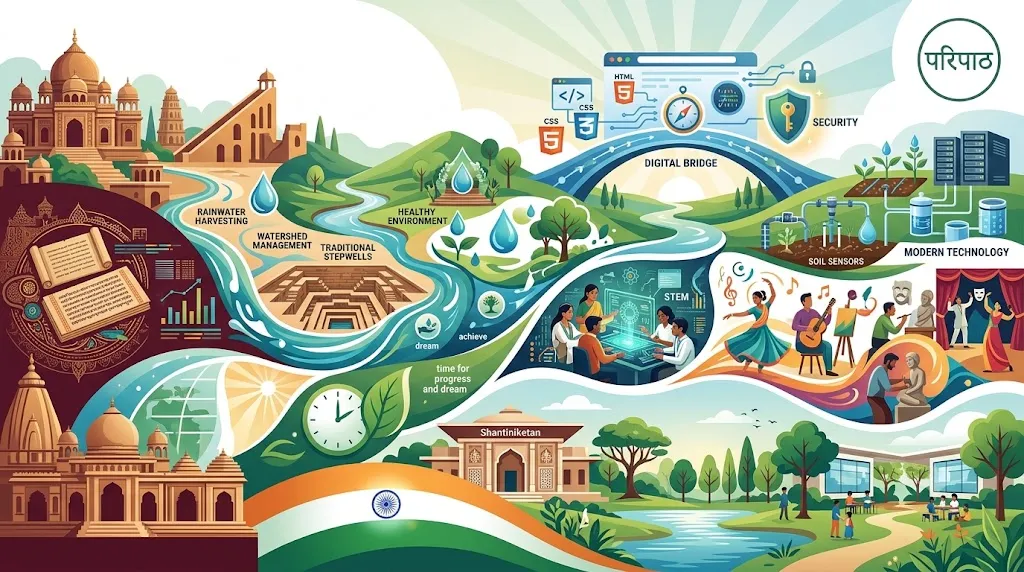
In arid regions like Rajasthan and Gujarat, stepwells are prime examples of traditional water conservation. These intricate structures collected rainwater and provided access to water even during dry seasons. They were not just water sources but also served as social and cultural hubs. Many old wells and stepwells are being revived today.
2. Tanks and Lakes:
It was customary for every village or town to have a large tank or lake nearby. These bodies of water collected rainwater, recharged groundwater, and served as vital water sources. Examples include the large lakes of Bhopal or numerous ancient tanks in Karnataka.
3. Johads:
Prevalent in Rajasthan, Johads are small earthen check dams that capture rainwater and facilitate its percolation into the ground. This helps raise the local water table and provides water for agriculture. Organizations like the Tarun Bharat Sangh, under the leadership of Rajendra Singh, have revitalized thousands of Johads in Rajasthan, sparking a water revolution.
4. Kunds and Tankas:
These are underground or semi-underground rainwater harvesting structures found in desert regions. Rainwater from rooftops is channeled through pipes into these kunds or tankas, where it is stored for drinking and other uses.
5. Other Methods:
- Bandaras: Small check dams built across rivers to impound water.
- Khadin: An ingenious system in Rajasthan where rainwater is collected in agricultural fields by earthen embankments for irrigation.
- Springs and Percolation Tanks: In hilly regions, natural springs are often tapped, and small tanks are created to collect water.
These traditional methods teach us that by living in harmony with nature and utilizing local resources effectively, we can overcome water scarcity.
Future Forward: Modern Solutions for Water Management
In the contemporary era, science and technology have paved the way for numerous modern water conservation methods. These approaches are efficient and capable of saving water on a larger scale.
1. Rainwater Harvesting:
This is a highly effective solution where rainwater falling on rooftops or other surfaces is collected and stored in tanks or directed to recharge groundwater. This saves potable water and raises groundwater levels. Many urban areas are now making rainwater harvesting mandatory.
2. Drip and Sprinkler Irrigation:
These technologies are crucial for preventing water wastage in agriculture. Drip irrigation delivers water directly to the plant roots drop by drop, saving up to 90% of water. Sprinkler irrigation sprays water evenly across fields, also leading to significant savings. Countries like Israel have transformed arid lands into fertile farms using these techniques.
3. Wastewater Treatment and Reuse:
Treating municipal wastewater and reusing it is a vital strategy. Treated water can be used for agriculture, industrial purposes, or flushing toilets. This conserves fresh drinking water and reduces river pollution.
4. Smart Water Management:
With the help of sensors and the Internet of Things (IoT), it's now possible to monitor water distribution systems, detect leaks, and control water usage efficiently. Smart meters measure water consumption, helping to prevent wastage.
5. Desalination:
While still an expensive technology, converting seawater into potable water could be a significant solution to water scarcity in the future. Many countries in the Middle East extensively use desalination plants.
Young Water Warriors: Steps Students Can Take
As students, you have a crucial role to play in water conservation. Your small efforts can collectively bring about a massive change.
At Home to Save Water:
- Check for Leaks: Promptly repair any leaky faucets or pipes at home or school. A single dripping faucet can waste thousands of liters of water annually.
- Use Less Water for Bathing: Opt for bucket baths over showers. Showers often consume significantly more water.
- Turn Off the Tap: Remember to turn off the tap while brushing your teeth, shaving, or washing dishes. Use water only when necessary.
- Reuse Vegetable Water: Don't discard water used for washing vegetables. Use it to water your plants.
- Wash Clothes Efficiently: When using a washing machine, ensure it's a full load. Avoid running it for just a few items.
- Use a Bucket for Car Washing: Instead of a hose, use a bucket and cloth to wash vehicles.
At School and in the Community:
- Raise Awareness: Educate your friends, family, and neighbors about the importance of water conservation. Create posters, perform street plays, and share information.
- Initiate School Water Projects: Suggest to your teachers or principal to install a rainwater harvesting system at school. Promote drip irrigation in the school garden.
- Conduct a Water Audit: Study how much water is used at your school and where wastage occurs. Suggest solutions.
- Participate in Community Clean-up Drives: Join efforts to clean up local lakes, rivers, or wells in your neighborhood.
- Promote Water-Saving Appliances: Encourage the use of low-flow faucet aerators or low-flush toilets.
Did You Know?
- Only 0.01% of the world's total water is available as fresh, potable water; the rest is saline or frozen in glaciers.
- A single toilet flush typically uses 5 to 7 liters of water.
- The United Nations predicts that by 2050, approximately 5 billion people worldwide could face water scarcity.
- India extracts more groundwater than any other country in the world.
- It takes about 7,500 liters of water to produce one pair of new jeans.
Conclusion: Let's Become Water Stewards for a Brighter Future!
Dear students, water is not just a natural resource; it is our life, our future. Today, on Guru Pradosh Vrat, let us pledge to protect this precious gift of nature. The success of Mangalyaan demonstrated that with proper planning and hard work, we can achieve any height. Similarly, the challenge of water conservation can also be overcome through collective efforts.
We've explored various methods, from traditional practices to modern technologies, that can help us save water. But above all, what matters most is your participation and your awareness. Resolve to use water judiciously at home, school, and in your community starting today. Inspire others to do the same. Every drop you save will contribute to a significant change.
Just as Mansoor Ali Khan Pataudi led on the cricket field, Padmini Ramachandran enriched society through art, and Dr. Raja Ramanna empowered the nation through science, you too can lead in water conservation and make an invaluable contribution to our country. India's first T20 World Cup victory was a symbol of teamwork. Similarly, saving water is a collective endeavor.
Remember, Every Drop Counts! Let us all become water stewards and build a safe and prosperous future for our India, for our Earth. Thank you!