Hello students and readers of Paripath!
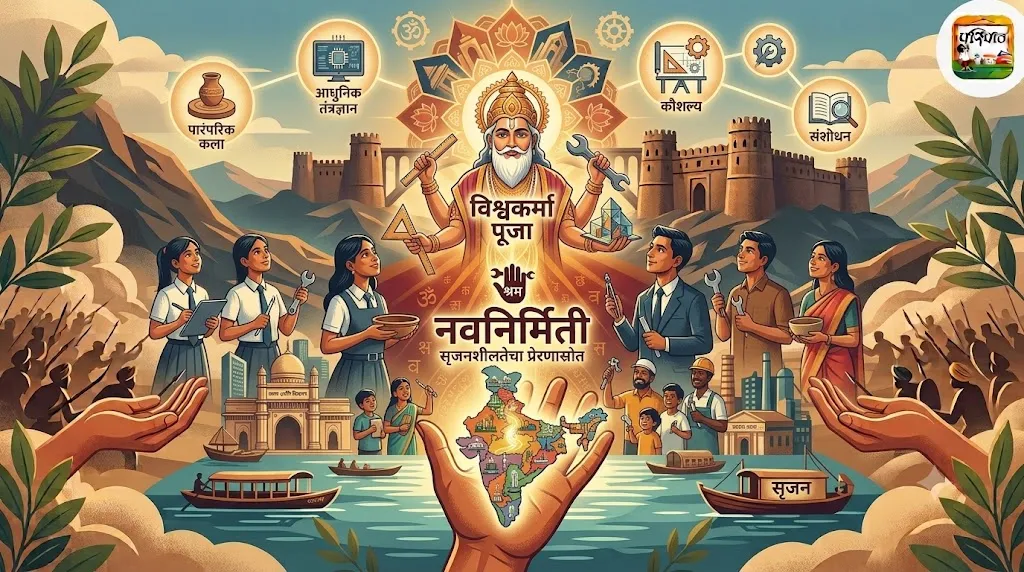
Today, September 17, 2026, marks the celebration of a deeply significant and inspiring festival: Vishwakarma Puja. This day is not merely about worshipping a mythological deity; it is a profound celebration of the spirit of skill, creativity, and relentless innovation embedded in our culture. Across India, particularly in industrial sectors, artisans, engineers, technicians, and labourers honour Lord Vishwakarma by performing puja (worship) of their tools, machinery, and workplaces.
This auspicious day coincides with Kanya Sankranti and is interwoven with several other important events. In Maharashtra, it's the fifth day of Ganesh Chaturthi, a period dedicated to the deity of wisdom and art. Globally, it's World Patient Safety Day. Historically, this date also marks the demise of literary giant Ravindra Kelekar, the withdrawal of the Russian army from Germany, and the entry of North and South Korea into the UN. Each of these events, in its own way, subtly celebrates human ingenuity, management, and skill.
In this blog post, we will explore the cultural and historical significance of Vishwakarma Puja. We will also delve into how this festival inspires students to value manual skills, creativity, and the spirit of innovation in all fields, from traditional crafts to modern technology and engineering.
Vishwakarma: The Divine Architect and Engineer of the Gods
In Hindu mythology, Lord Vishwakarma is revered as the chief architect, engineer, and divine craftsman of the gods. He is often referred to as 'Devashilpi' (the architect of the gods) or the 'Creator of the Universe,' believed to be a mind-born son of Lord Brahma, playing a crucial role in the creation of the cosmos.
Vishwakarma is credited with constructing not just magnificent structures but also numerous wondrous objects. Some of his most notable creations include:
- The City of Dwarka: He built the splendid and impregnable city of Dwarka in the middle of the ocean for Lord Krishna.
- Indraprastha: For the Pandavas, he designed and constructed the grand city of Indraprastha, including the illusory Mayasabha (hall of illusions).
- Lanka City: The golden city of Lanka, for the demon king Ravana, was also his creation.
- Divine Weapons: He forged many celestial weapons, including Lord Vishnu's Sudarshan Chakra, Lord Shiva's Trishul, and Lord Indra's Vajra.
- Swargaloka and Pushpak Vimana: The celestial abode of Swargaloka and Ravana's famous flying chariot, Pushpak Vimana, are also attributed to his divine craftsmanship.
These tales highlight Vishwakarma's immense imagination, foresight, and unparalleled engineering prowess. He was not just a builder but a visionary planner and innovator who could bring the seemingly impossible to life.
Honouring Craftsmanship and the Dignity of Labour
Vishwakarma Puja is more than just the worship of a deity; it is a festival that celebrates the dignity of labour and the importance of skill. This day reminds us that any nation or society thrives not just on intellectual pursuits but equally, if not more, on the hard work and skills of its artisans, labourers, and engineers.
Our society is built upon the contributions of countless traditional craftsmen—carpenters, blacksmiths, potters, weavers, masons, and sculptors. Through their skills and tireless efforts, they shape our world. The furniture crafted by a carpenter, the tools forged by a blacksmith, the earthen pots shaped by a potter—each object embodies the skill, effort, and artistry of its maker. Vishwakarma Puja pays tribute to these unsung heroes and their invaluable contributions.
As students, it is crucial for you to understand that theoretical knowledge alone is not enough. Practical skills and a willingness to work diligently with your hands are equally vital. The subjects you learn in school, be it science, mathematics, or art, are not just abstract concepts. Learning how to apply them in real life is, in itself, a form of Vishwakarma's skill. The joy and satisfaction of creating something new with your own hands are truly immeasurable.
“Labour is true worship, and skill is the true blessing. Vishwakarma Puja teaches us precisely this.”
Igniting Creativity and the Spirit of Innovation
Lord Vishwakarma was not merely a great builder; he was a profound innovator. He did not simply replicate existing forms but created wondrous things using novel concepts, designs, and techniques. This festival inspires us to embrace creativity and the spirit of innovation.
What is creativity? It is the ability to find new and effective solutions to problems, or to conceive of something entirely new and bring it into existence. Fostering this imaginative spirit in students is paramount. You can nurture your creativity in school through science projects, art competitions, craft classes, or even by finding innovative solutions to small daily challenges.
For instance, traditional arts like Warli painting, Paithani weaving, or intricate wood carving are brimming with creativity. In the modern era, fields such as robotics, coding, graphic design, and app development offer immense opportunities for innovation. Vishwakarma Puja reminds us that innovation is not limited to large-scale research; it is essential in our daily lives. Approaching every field with fresh ideas and new perspectives is the true hallmark of innovation.
Modern Vishwakarmas: From Traditional Crafts to Cutting-Edge Technology
In the 21st century, who are the Vishwakarmas? They are the scientists, engineers, technologists, designers, software developers, and entrepreneurs. All these individuals, with their intellect and skills, are creating new technologies, products, and services that have become an indispensable part of our lives.
Today, India is promoting its manufacturing capabilities through initiatives like 'Make in India' and 'Atmanirbhar Bharat' (Self-Reliant India). At the heart of these campaigns lies the skill and ingenuity of Indian engineers and artisans. From mobile phones to the Mars Orbiter Mission, everything created in our country is inspired by the spirit of modern Vishwakarmas.
It is crucial for students to take an interest in Science, Technology, Engineering, and Mathematics (STEM) fields. Learning to code, experimenting with 3D printing, assembling robotics kits, or building a small electronic project of your own—all these activities guide you towards becoming a modern Vishwakarma. This is not just about theoretical knowledge; it's a process of learning through hands-on experience that prepares you for future challenges.
The future of our nation rests in the hands of young people like you, who will discover new things, develop new technologies, and lead our society forward. You are the Vishwakarmas of tomorrow!
September 17, 2026: A Day of Multiple Facets
Today is significant in many ways, and each aspect, in its own right, teaches us the importance of creation, skill, or management:
- Ganesh Chaturthi, Day 5: In Maharashtra, Ganesha idols are installed in homes and public pandals. Ganesha is revered as the deity of intellect, art, and knowledge. Worshipping Ganesha on Vishwakarma Puja signifies a unique blend of intellect and skill.
- World Patient Safety Day: This day highlights the importance of patient safety in healthcare services. The skills and dedication of doctors, nurses, and other medical personnel are crucial for saving lives and ensuring patient well-being. This, too, is a form of 'human' engineering and management.
- Demise of Ravindra Kelekar: On September 17, 2010, the renowned Konkani writer Ravindra Kelekar passed away. The wonderful world he created with words in the field of literature was also a form of artistic creation. His writings were the sculptures of language.
- Russian Army Withdrawal from Germany (1994): Following the end of the Cold War, the Russian army completed its withdrawal from Germany. This was a massive military and political management process that required strategic planning and execution skills.
- North and South Korea's UN Entry (1991): The coming together of two nations with different ideologies on a single international platform was a significant achievement in international relations. This can also be considered a form of 'political engineering.'
In all these events, directly or indirectly, the glory of human skill, creative ability, and foresight in management is celebrated.
Inspiration for Paripath Students
Dear students, Vishwakarma Puja offers many vital lessons for your future. You will not succeed merely by reading books or passing exams, but by developing your skills, becoming creative, and embracing the pursuit of innovation, you will lead a successful and fulfilling life.
- Value practical experiments: Actively participate in science labs or small home projects. Try to build something with your own hands.
- Develop your skills: Whether it's painting, music, crafts, coding, gardening, or even cooking—develop the skills you enjoy. These skills will be incredibly useful in your future.
- Cultivate a problem-solving attitude: Try to find solutions to the problems you observe around you. This is the first step toward innovation.
- Don't shy away from hard work: No work is too small. Any task performed with honesty and diligence will bring you success.
- Learn new technologies: It's crucial to learn to navigate the digital age. Understand how to effectively use computers, the internet, and new applications.
Conclusion
Vishwakarma Puja is not just an ancient festival; it is a crucial source of inspiration connected to our modern lives and future. This day teaches us the importance of skill, creativity, and innovation. Just as Lord Vishwakarma designed the world of the gods, you, as students, are the architects of your own future and the progress of your nation.
Let the spirit of creation and ingenuity, embodied by Vishwakarma, be present in your every task and every endeavour. You are the engineers, scientists, artists, and innovators of tomorrow, who will shape the destiny of our country and the world. On this auspicious day of Vishwakarma Puja, let us all awaken our inner 'Devashilpi' and move forward on the path of skill, creativity, and innovation. Happy Vishwakarma Puja to all of you!
Did You Know?
- Vishwakarma Puja is also sometimes referred to as 'Vishwakarma Jayanti,' although in some regions, Jayanti is celebrated on Vasant Panchami. Kanya Sankranti is specifically known for Vishwakarma Puja.
- This festival is primarily celebrated with great enthusiasm in industrial and commercial establishments, factories, and workshops.
- Lord Vishwakarma is believed by some to be the son of Lord Brahma, while other Puranas refer to him as the grandson of Prajapati Bhrigu.
- In some parts of India, particularly West Bengal and Odisha, there is a beautiful tradition of flying kites on Vishwakarma Puja.
- On this day, many artisans and labourers worship their tools and machinery and refrain from working for the day, allowing the tools to rest and honouring their labour.