Introduction: The Sacred Eternal Bond
Vat Purnima is not merely a ritual; it is a profound testament to the power of human will, intelligence, and unwavering devotion. In the vast tapestry of Indian traditions, this festival stands out as a celebration of the 'Suhagan' (married woman), but its philosophical roots delve much deeper into the concepts of life, death, and the cyclical nature of time. This blog post explores the legendary story of Savitri and Satyavan, providing an exhaustive analysis of why this ancient tale remains relevant in the 21st century.
The Deep Historical & Mythological Context
The origins of Savitri’s story are found in the Vana Parva of the Mahabharata. It was narrated by Sage Markandeya to Yudhishthira when the latter was in exile, questioning whether any woman had ever shown devotion comparable to Draupadi. Markandeya's response was the epic of Savitri.
The Birth of a Divine Daughter
King Ashvapati of Madra was a pious ruler but remained childless for many years. He underwent severe penance for eighteen years, offering a hundred thousand oblations to the Goddess Savitri. Pleased with his devotion, the Goddess appeared and granted him a boon—a daughter of unparalleled radiance. This child was named Savitri in honor of the Goddess. As she grew, her beauty and intelligence were so intimidating that no prince dared to ask for her hand. Consequently, King Ashvapati asked her to find a husband of her own choosing—a radical concept for that era, highlighting the agency given to women in ancient Vedic society.
The Choice of Satyavan
Savitri traveled across the land and finally arrived at a forest hermitage. There, she met Satyavan, the son of the blind King Dyumatsena, who had been exiled. Despite the family's poverty and the harsh forest life, Savitri recognized Satyavan's noble soul. He was called 'Satyavan' because he was a seeker and speaker of truth.
The Core Conflict: Facing the Inevitable
Savitri moved to the forest after marriage, trading her silks for hermit's clothes. She served her in-laws with extreme devotion, but the shadow of Narada's prophecy never left her mind. As the predicted day of Satyavan's death approached, Savitri undertook the Triratra Vrata—a three-day fast and vigil of extreme austerity.
The Final Day in the Forest
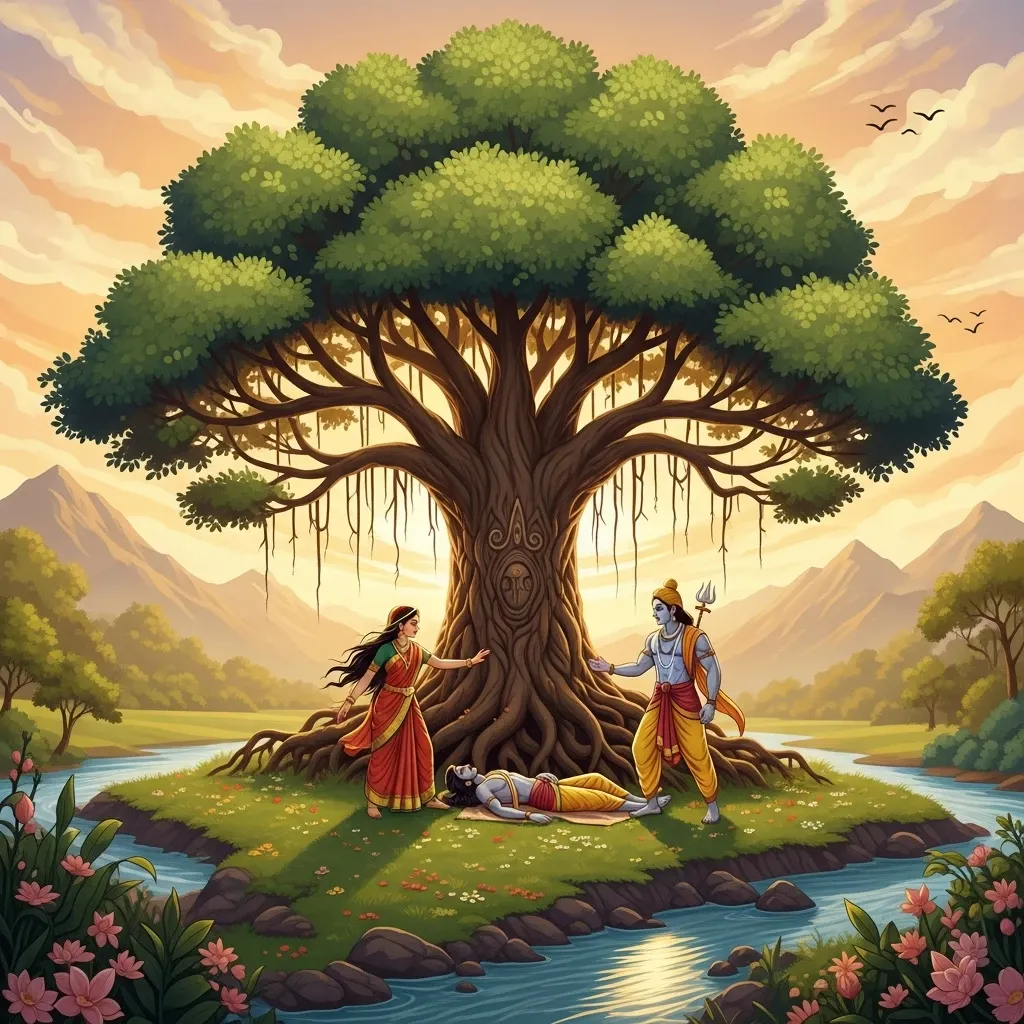
On the fated day, Satyavan went into the woods to chop wood for the sacrificial fire. Savitri, despite her physical weakness from fasting, insisted on accompanying him. While working, Satyavan suddenly felt a dizzying pain and collapsed with his head in Savitri's lap. It was then that Lord Yama, the King of Death, appeared in person. Unlike his usual terrifying form, he appeared majestic, dressed in red, carrying a noose.
The Intellectual Battle with Yama
Yama pulled the soul (the size of a thumb) from Satyavan's body and began his journey toward the southern realm of the dead. Savitri did not sit and weep; she followed him. Yama warned her that mortals cannot cross into the realm of death, but Savitri responded with profound philosophical verses on Dharma (righteousness), Satya (truth), and the company of the holy.
Yama was so impressed by her wisdom that he offered her three boons, provided she didn't ask for Satyavan's life. Here is how she strategically used her intelligence:
| Boon Number | Savitri's Request | The Result/Significance |
|---|---|---|
| 1st Boon | Restoration of her father-in-law's eyesight and kingdom. | Restored the dignity and power of her husband's family. |
| 2nd Boon | A hundred sons for her own father, King Ashvapati. | Ensured the continuation of her paternal lineage. |
| 3rd Boon | A hundred sons for herself. | The 'Masterstroke'—as a virtuous wife, she could only have children with her husband. Yama, having granted the boon, had to return Satyavan to life to fulfill his word. |
Why the Vat (Banyan) Tree?
The Banyan tree (Ficus benghalensis) is central to this festival because the legend says Satyavan died under its shade. However, the choice is also deeply scientific and symbolic.
- Longevity: The Banyan tree is known for its incredible lifespan and its 'aerial roots' that become new trunks. It represents immortality.
- Ecology: It is an 'Oxygen Bomb,' releasing large amounts of oxygen even at night. Circling the tree (Pradakshina) ensures the woman breathes in purified air.
- Shelter: Just as the Banyan provides shade to all, a woman is seen as the protective shade of the family.
Modern Significance and Rituals
Today, Vat Purnima is celebrated with great enthusiasm. Women dress in traditional sarees, wear jewelry, and apply henna. They tie a white thread around the Banyan tree seven times, symbolizing the seven vows of marriage and the seven lifetimes they wish to spend with their partners.
Interactive Trivia: Test Your Knowledge
Conclusion: The Moral Essence
The story of Savitri is not just about a wife's devotion; it is about the Empowered Woman. She chose her own husband, she challenged the King of Death with logic, and she secured the welfare of both her maternal and marital families. It teaches us that with determination, intelligence, and 'Dharma,' even the most inevitable fate can be changed.