Introduction: The Dawn of a New Maritime Era
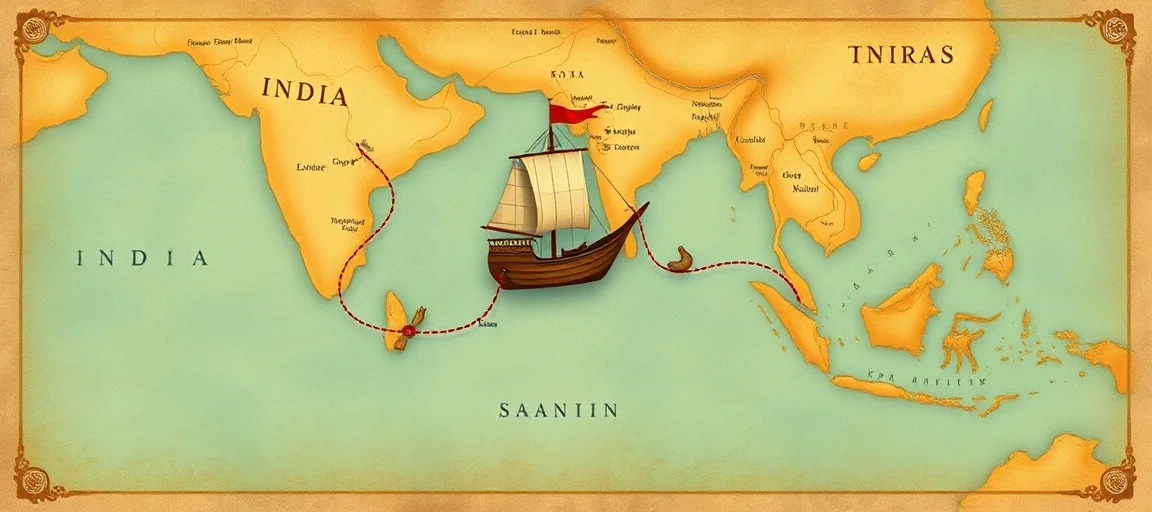
Some events in history are so profound that they transcend the boundaries of a single nation, fundamentally altering the global map and future trajectory. Vasco da Gama's sea voyage to India is one such pivotal event. Departing from Lisbon, Portugal, on July 8, 1497, da Gama navigated the treacherous seas for many months, overcoming immense challenges, to finally reach Calicut (modern-day Kozhikode, Kerala) on India's west coast on May 20, 1498. This was not merely the journey of an explorer; it marked the beginning of direct trade relations between Europe and Asia, leaving an indelible mark on global trade, politics, and culture for centuries to come.
This voyage directly connected European nations with the rich markets of Asia, propelling the spice trade to unprecedented heights. However, its consequences were not solely economic; they were also cultural, social, and political. This audacious expedition laid the groundwork for European colonialism, leading many Asian nations, including India, to fall under foreign rule. Today, we will delve into the historical context, the formidable challenges faced by Vasco da Gama, and the profound long-term impacts of his historic journey.
The Lure of the East: Europe's Quest for India
The Spice Trade and its Importance
In the 15th century, spices were more valuable than gold in Europe. Pepper, cloves, cinnamon, and cardamom were not only used to flavor food but also for medicinal purposes, cosmetics, and as preservatives. These precious commodities primarily originated from India and Southeast Asian countries. However, European nations did not have direct access to these sources.
Ottoman Control and the Need for a New Route
At the time, the primary trade routes between Europe and Asia were land-based, traversing Central Asia and the Middle East. These routes were largely controlled by the Ottoman Empire. The Ottomans imposed heavy restrictions and exorbitant taxes on European merchants, which inflated the prices of spices to astronomical levels. Consequently, European nations, particularly Portugal and Spain, felt an urgent need to discover a direct sea route to Asia, bypassing the Ottoman-controlled territories.
Portugal's Ambition and Prince Henry the Navigator's Legacy
Portugal, a small nation on the Atlantic coast, was at the forefront of maritime exploration. Prince Henry the Navigator, a Portuguese royal, made significant contributions to naval technology and cartography. Inspired by him, Portuguese navigators began exploring the west coast of Africa. Bartholomew Dias, another Portuguese explorer, had rounded the 'Cape of Good Hope' at the southern tip of Africa in 1488, raising hopes that a sea route to India was within reach. King John II, and subsequently King Manuel I, championed this goal of finding a sea route to India. Vasco da Gama was entrusted with this monumental mission.
Vasco da Gama's Audacious Expedition: Challenges and Triumphs
Setting Sail: The Fleet and its Crew
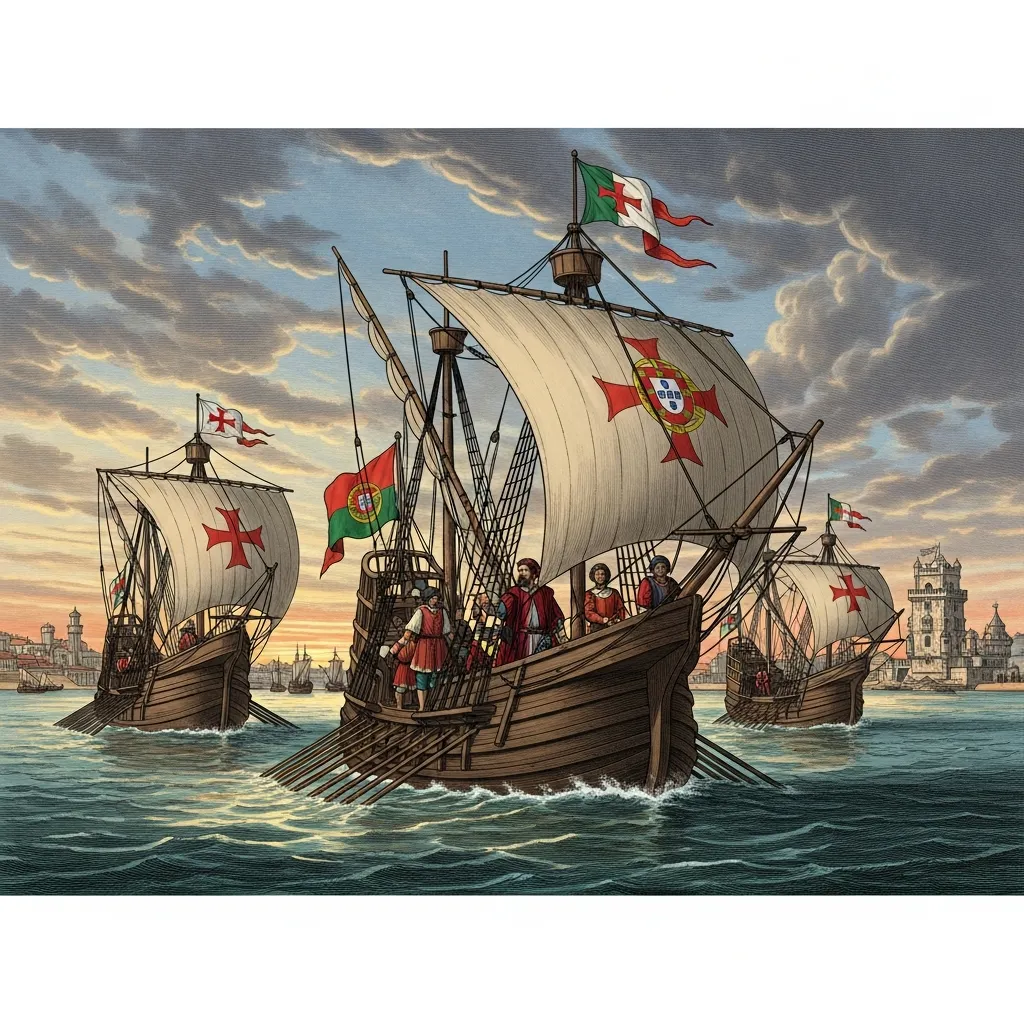
On July 8, 1497, Vasco da Gama set sail from Lisbon with a fleet of three ships and approximately 170 men. His fleet comprised the São Gabriel (flagship), the São Rafael, and the Berrio (a caravel), along with a supply ship. These vessels were specially constructed for long voyages, stocked with water, provisions, and other essential supplies.
Navigating the Unknown: Rounding the Cape of Good Hope
Da Gama began his journey by sailing down the west coast of Africa, following the route discovered by Bartholomew Dias to the Cape of Good Hope. However, the journey beyond this point was entirely uncharted. His fleet battled fierce storms in the Atlantic, unpredictable winds, and colossal waves before entering the Indian Ocean. The crew faced immense physical and psychological hardships during this leg of the journey, with the vast, featureless ocean stretching endlessly, fueling fear and uncertainty.
Battling Storms, Sickness, and Hostile Shores
Sea voyages in that era were exceedingly perilous. Violent storms could easily swallow ships. Many sailors suffered from 'scurvy,' a disease caused by Vitamin C deficiency, leading to numerous deaths within the crew. The scarcity of food and fresh water, contaminated supplies, and poor hygiene contributed to the spread of diseases. Vasco da Gama had to constantly work to maintain the morale of his weary crew.
To truly understand historical events, it's crucial to look beyond the immediate facts and consider the underlying causes, the prevailing conditions of the time, and the long-term ramifications. This approach offers a deeper insight into history and helps connect it to the present.
The African Coastline and the Search for a Pilot
After rounding the Cape of Good Hope, Vasco da Gama's fleet sailed northward along the east coast of Africa. They made stops at ports like Mozambique, Mombasa, and Malindi. Here, they encountered resistance from local Muslim traders who viewed the arrival of Europeans as a threat to their established trade networks. They faced opposition and attacks in several places. Eventually, in Malindi, they secured the services of an experienced Arab navigator, Ahmad ibn Mājid, who possessed extensive knowledge of the Indian Ocean's sea lanes and monsoon winds. With his guidance, da Gama's fleet was able to successfully cross the Indian Ocean and reach India.
Arrival in the Land of Spices: Calicut, India
Meeting the Zamorin of Calicut
On May 20, 1498, Vasco da Gama's fleet arrived at the port of Calicut on India's west coast. At that time, Calicut was a prosperous trading hub, attracting merchants from across the globe. The local ruler of Calicut, known as the 'Zamorin,' initially welcomed Vasco da Gama. Da Gama presented the Zamorin with gifts, but these were deemed unimpressive by the local wealthy merchants. Although the Zamorin granted da Gama permission to establish trade relations, he remained wary of the Portuguese intentions.
Early Encounters and Trade Negotiations
Vasco da Gama intended to trade for spices in Calicut, but he faced intense opposition from the entrenched Muslim merchants. These traders had monopolized the spice trade between India and the Middle East for centuries and saw the Portuguese as a direct threat to their livelihood. Da Gama found it difficult to procure sufficient quantities of spices in Calicut and encountered many challenges in the Zamorin's court. Ultimately, he departed with a limited amount of spices and after some skirmishes with local traders. Despite the small quantity, the spices fetched an enormous profit in Europe, encouraging Portugal to fund further expeditions.
A World Transformed: The Far-Reaching Impact of the Voyage
The Opening of the Sea Route to India
Vasco da Gama's voyage inaugurated the era of European colonialism. With the Portuguese having discovered a direct sea route to India, other European nations such as the Dutch, English, and French soon followed. These countries began establishing their colonies in Asian lands, significantly impacting local cultures, economies, and politics. India, in particular, would endure centuries of foreign rule, a process initiated by this very first sea voyage.
Global Trade Networks and the Exchange of Goods
This journey fundamentally reshaped the landscape of global trade. The importance of land-based trade diminished, and maritime trade across the Atlantic and Indian Oceans surged. Lisbon became a crucial center for the spice trade. Spice prices dropped, making them more accessible to ordinary Europeans. This shift dismantled the mercantile monopoly of Italian city-states (like Venice) in the Mediterranean, opening new economic opportunities for Atlantic coastal nations (Portugal, Spain, and later England, Netherlands).
Impact on India: Economic, Political, and Cultural Shifts
Vasco da Gama's arrival had multifaceted impacts on India. Initially, the Portuguese established their colony in Goa, and subsequently, other European powers gained control over various parts of India. This disrupted India's political systems and sowed divisions among local kingdoms. European culture, religions (especially Christianity), and languages made inroads into India. While there was cultural exchange in many areas, conflicts also arose. The Indian economy became increasingly dependent on European markets. This voyage brought India onto the global stage but also subjected it to the bitter experiences of colonialism.
The Significance of the Spice Trade
The immediate goal of this voyage was the spice trade. The immense profits reaped by Portugal from the spices da Gama brought back spurred them to send more ships to India and later use military force to establish trading posts (e.g., Goa, Daman, Diu). This increased the availability of spices in Europe and lowered their prices, leading to changes in European cuisine and lifestyle.
Conclusion: A Single Journey, a Changed World
Vasco da Gama's sea voyage to India was not merely a geographical discovery; it was a symbol of human courage, adventure, and the willingness to confront the unknown. His journey connected Europe and Asia, redefined global trade, and altered the course of history forever. Its immediate consequences were seen in the expansion of the Portuguese Empire, while its long-term effects manifested in global colonialism and the formation of the modern global economy.
While this voyage was significant for Indian history, its outcomes were not always positive. It paved the way for European powers to dominate India, leading to centuries of subjugation. Therefore, Vasco da Gama's journey is not just the tale of an explorer, but the beginning of a crucial chapter in global history that permanently changed the world.
Did You Know?
- On his first voyage, Vasco da Gama covered approximately 24,000 miles (about 38,600 kilometers), which is roughly 90% of the Earth's circumference at the equator.
- His ship 'São Rafael' had to be abandoned on the African coast during the return journey due to severe weather.
- Vasco da Gama was later appointed as the Viceroy of India and made three trips to India. He died in Cochin (Kerala) in 1524.
- The sale of the spices he brought back to Europe covered the expedition's cost 60 times over, providing immense motivation for Portugal's future explorations.
- There is a city named 'Vasco da Gama' in Goa, India, commemorating his connection with the country.