Hello, young learners!
Our Earth is a dynamic planet, constantly undergoing incredible transformations. From the majestic rise of mountains to the fiery eruptions of volcanoes, and sometimes, the ground beneath our feet trembles. This trembling is what we call an 'earthquake'. While earthquakes are natural events, they can be incredibly destructive. Therefore, understanding what earthquakes are, why they happen, their potential impacts, and most importantly, how to stay safe during such an event, is crucial for everyone.
India, owing to its unique geological position, especially the Himalayan belt and other active fault lines, is prone to seismic activity. This makes it even more important for every student in India to be well-informed and prepared for earthquakes.
What's Inside Our Earth? The Origin of Earthquakes
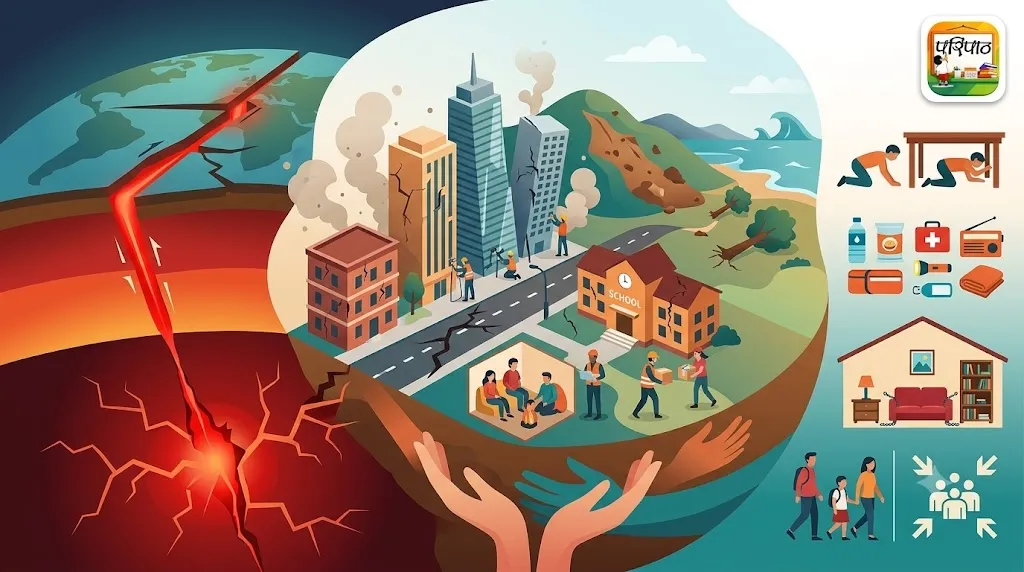
To understand earthquakes, we need to peek inside our planet. Although the Earth appears calm and stable on the surface, it's incredibly active within. The Earth is primarily composed of three main layers:
- Crust: This is the outermost and thinnest layer of the Earth, where we live. Its thickness can range from 5 to 70 kilometers.
- Mantle: Below the crust lies this layer, approximately 2900 kilometers thick, made of hot, semi-molten rock. The intense heat within this layer causes the rocks to move very slowly.
- Core: This is the Earth's innermost part, extremely hot and dense. Its outer part is liquid, and the inner part is solid.
The Earth's crust, where we reside, is not a single, continuous piece. Instead, it's broken into several large fragments called 'Tectonic Plates'. These plates float and move very slowly, just a few centimeters per year, over the semi-molten rocks of the mantle. As these plates move, they can grind against each other, collide, or pull apart. These movements are the primary cause of earthquakes.
Why Do Earthquakes Occur?
The movement of tectonic plates is the main reason for earthquakes. When these plates slide past each other, immense pressure builds up along their edges. This pressure accumulates until it becomes too great, causing the plates to suddenly slip. The energy released during this sudden movement travels through the Earth in the form of Seismic Waves, causing the ground to shake, which we experience as an earthquake.
Types of Earthquakes
- Tectonic Earthquakes: These are the most common type, caused by the movement of tectonic plates.
- Volcanic Earthquakes: These occur due to volcanic eruptions or the movement of magma beneath a volcano.
- Collapse Earthquakes: Smaller earthquakes caused by the collapse of underground mines or caverns.
- Explosion Earthquakes: These are man-made, resulting from nuclear tests or large explosions.
How Are Earthquakes Measured?
Two main methods are used to measure the strength and impact of an earthquake:
- Magnitude: This measures the amount of energy released at the earthquake's source. It's typically measured using the Richter Scale or the Moment Magnitude Scale. The Richter Scale ranges from 1 to 10, with each whole number increase representing a tenfold increase in the amplitude of seismic waves and about 32 times more energy released. For example, a magnitude 6.0 earthquake releases roughly 32 times more energy than a magnitude 5.0 earthquake.
- Intensity: This measures the effects of an earthquake at a specific location, indicating the level of damage and human perception. It's measured using the Mercalli Scale, which uses Roman numerals from I to XII.
Did you know? In India, several 'seismographs' are installed in various locations to monitor earthquake activity. These instruments can detect even the slightest ground movements.
Impact of Earthquakes and Their Effect on India
Earthquakes can have numerous severe consequences. Their effects depend on the earthquake's magnitude and the geological structure of the affected area.
Immediate Impacts:
- Building Collapse: Structures with weak construction can collapse under seismic shaking, leading to significant loss of life.
- Landslides and Fissures: Earthquakes can cause landslides, ground fissures, and rockfalls, especially in mountainous regions like the Himalayas.
- Fires: Ruptured gas pipelines or broken electrical wires can trigger fires, adding to the destruction.
- Tsunamis: Underwater earthquakes can generate massive ocean waves called tsunamis, which can devastate coastal areas. The 2004 Indian Ocean Tsunami, triggered by an earthquake off the coast of Sumatra, caused immense damage to India's coastal regions.
- Damage to Roads and Bridges: Transportation infrastructure can be severely disrupted, hindering rescue and relief efforts.
Long-term Impacts:
- Economic Loss: Extensive damage to buildings and infrastructure results in significant economic losses.
- Psychological Trauma: Survivors often experience long-lasting psychological effects.
- Social Displacement: Many people are forced to leave their homes and relocate to safer areas.
In India, the Himalayan mountain range and the northeastern states are considered highly seismically active. Regions like the Kutch district in Gujarat and the Koyna-Warna area in Maharashtra also fall into earthquake-prone zones. Therefore, preparedness in these areas is extremely vital.
What to Do During an Earthquake? Safety Measures
It's impossible to predict when an earthquake will strike, so being prepared is our best defense. Knowing what to do in those critical few seconds can save lives.
1. If You Are Indoors (Drop, Cover, and Hold On!):
- Drop: Immediately drop to the ground.
- Cover: Take cover under a sturdy table, desk, or bed. Protect your head and neck with your arms. If no sturdy furniture is nearby, crouch in an inside corner of the building and cover your head and neck with your arms.
- Hold On: Hold on to your shelter until the shaking stops.
- Stay away from windows, glass, mirrors, tall furniture, and heavy appliances.
- Do not use elevators. Use stairs, but only after the shaking has stopped.
- If safe to do so, turn off gas and electricity mains.
2. If You Are Outdoors or in an Open Area:
- Move to an open area away from buildings, trees, streetlights, and utility wires.
- Drop to the ground and stay there until the shaking stops.
3. If You Are Driving:
- Pull over to a clear spot away from buildings, overpasses, bridges, tunnels, and utility poles.
- Stay inside your vehicle until the shaking stops.
What to Do After an Earthquake?
The danger doesn't necessarily end when the shaking stops. It's crucial to take precautions even after an earthquake:
- Stay Calm: Do not panic. Help others around you to remain calm.
- Check for Injuries: Check yourself and others for injuries. Administer first aid if necessary.
- Evacuate Safely: If you are in a building and it is safe, evacuate using stairs, not elevators. Be cautious of broken glass, fallen wires, and other hazards.
- Communicate: Use mobile phones only for emergencies to keep lines clear. Listen to local news on a radio or TV for official information.
- Check Utilities: If you smell gas or see broken electrical wires, turn off the main switches immediately and report them to the authorities. Do not attempt to fix them yourself.
- Be Prepared for Aftershocks: Smaller tremors, called aftershocks, can occur after a major earthquake. Remain vigilant for some time.
- Do Not Trust Rumors: Rely only on official information from authorities.
Did You Know?
- About 90% of the world's earthquakes occur in the 'Pacific Ring of Fire', a region around the rim of the Pacific Ocean.
- The energy released from within the Earth during an earthquake is called 'Seismic Energy'.
- On January 26, 2001, a devastating earthquake of magnitude 7.7 struck the Kutch region of Gujarat, India, causing widespread destruction.
- There are three main types of seismic waves: P-waves (Primary Waves), S-waves (Secondary Waves), and L-waves (Love Waves). P-waves travel the fastest and arrive first.
- Millions of earthquakes occur worldwide every year, but most are so small that they go unnoticed. Only large earthquakes are destructive.
Conclusion
Earthquakes are natural phenomena beyond our control. However, having accurate information, being prepared, and knowing the right steps to take during and after an earthquake are well within our control. Always remember the 'Drop, Cover, and Hold On' mantra. Practice earthquake drills regularly at school and home. Keep an emergency kit ready. With knowledge and preparation, we can effectively face the risks posed by earthquakes and protect ourselves and our loved ones. Stay safe, stay informed!
(Article Date: September 19, 2026)