The Wonders of Our Solar System: A Journey Beyond Earth
Hello, young explorers!
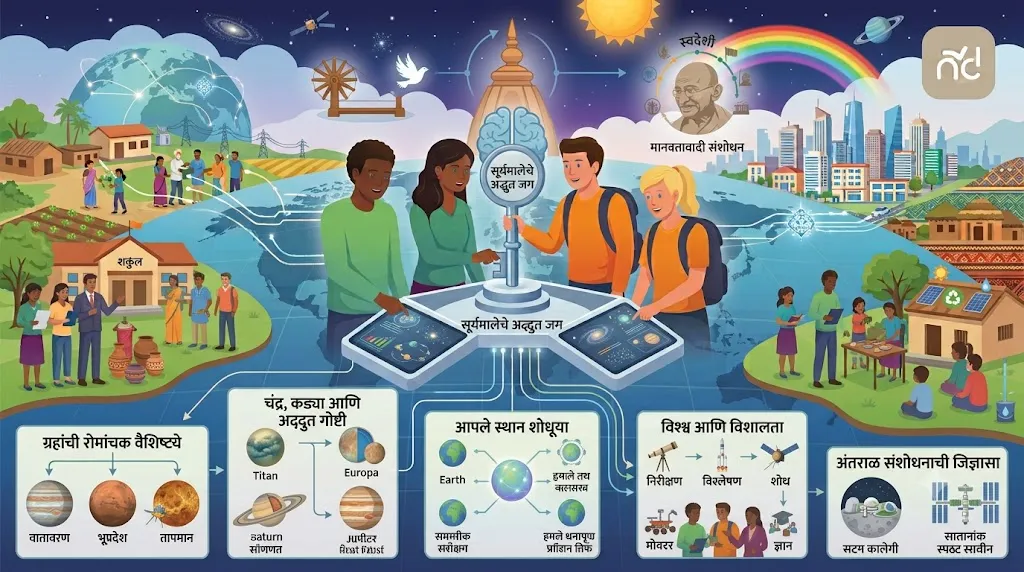
Imagine yourself soaring through the vast expanse of space, leaving Earth's atmosphere behind. Below you, our beautiful blue planet shrinks into a marble, and ahead, the magnificent celestial bodies of our solar system twinkle like cosmic jewels. Isn't that an exhilarating thought? Our solar system is truly a realm of wonders, where each planet holds its own unique story, mysteries, and breathtaking features. As we approach World Space Week (October 4-10), let's embark on an exciting journey to explore the fascinating characteristics of each planet, their remarkable moons, intricate rings, and other notable features. Prepare to be amazed and inspired to ponder your place in the grand tapestry of the universe!
Our Solar System: A Cosmic Family
Our Solar System is a vast cosmic family, comprising the Sun, eight planets, their numerous moons, dwarf planets, asteroids, comets, and countless other celestial objects. At its heart lies the Sun, a medium-sized star that accounts for an astounding 99.86% of the solar system's total mass. Its immense gravitational pull keeps all the planets orbiting in their respective paths. We can broadly categorize these planets into two main groups: the inner, rocky planets and the outer, gaseous giants.
The Inner Planets: Rocky and Resilient
The four planets closest to the Sun are known as the inner planets. They are primarily composed of rock and metal, are relatively small in size, and are often referred to as 'Terrestrial Planets' due to their Earth-like composition.
1. Mercury: The Sun's Swift Messenger
Mercury is the closest planet to the Sun and the smallest in our solar system, only slightly larger than Earth's Moon. Its proximity to the Sun results in extreme temperature swings: daytime temperatures can soar to 430°C, while nighttime temperatures plummet to -180°C. Mercury lacks a substantial atmosphere, leaving its surface heavily cratered, much like our Moon, from countless meteoroid impacts. It has no natural satellites (moons). A peculiar fact about Mercury is that one day on Mercury is longer than two of its years! It takes Mercury 88 Earth days to orbit the Sun, but approximately 59 Earth days to complete one rotation on its axis.
2. Venus: The Veiled Beauty
Venus, the second planet from the Sun, is often called Earth's 'twin sister' due to its similar size and mass. However, its conditions are drastically different. Venus boasts a thick atmosphere composed mainly of carbon dioxide, with dense clouds of sulfuric acid. This creates an extreme 'greenhouse effect,' making Venus the hottest planet in our solar system, with surface temperatures reaching a scorching 462°C – even hotter than Mercury! Unlike most planets, Venus rotates in the opposite direction, meaning the Sun rises in the west and sets in the east. Like Mercury, Venus has no moons.
3. Earth: Our Blue Haven
Our beautiful Earth is the third planet from the Sun and, for us, the most significant, as it is the only known celestial body to harbor life. Earth is unique in our solar system for having abundant liquid water on its surface, a critical ingredient for life. Its atmosphere, a delicate balance of nitrogen (78%), oxygen (21%), and other gases, provides the perfect conditions for a diverse biosphere. Earth has one natural satellite, our Moon, which influences tides and stabilizes our planet's axial tilt. From space, Earth appears as a vibrant blue marble due to its surface being 71% covered by water. Its protective atmosphere shields us from harmful solar radiation.
4. Mars: The Red Planet
Mars, the fourth planet, earns its nickname 'The Red Planet' from the iron oxide (rust) prevalent on its surface. Mars has a very thin atmosphere, primarily carbon dioxide. Scientists have found compelling evidence that liquid water once flowed on Mars, suggesting the possibility of past life. Mars has two small moons, Phobos and Deimos, which are thought to be captured asteroids. Mars is home to Olympus Mons, the largest volcano in the solar system, standing three times the height of Mount Everest! It also features Valles Marineris, an immense canyon system stretching thousands of kilometers, comparable in length to the United States.
Did You Know? A year on Mars is longer than an Earth year (687 Earth days), but a Martian day is only about 40 minutes longer than an Earth day.
The Asteroid Belt: A Cosmic Divide
Between Mars and Jupiter lies the vast Asteroid Belt, a region populated by millions of rocky and metallic objects orbiting the Sun. These range in size from tiny dust particles to dwarf planets like Ceres. This belt effectively separates the inner, rocky planets from the outer, gas giants.
The Outer Planets: Giants of Gas and Ice
Beyond the asteroid belt reside the four outer planets. These colossal worlds are much larger than their inner counterparts and are primarily composed of gases and ice. They are often referred to as 'Gas Giants' or 'Ice Giants.'
5. Jupiter: The King of Planets
Jupiter, the fifth planet, is the largest planet in our solar system. It is so massive that all the other planets combined could fit inside it! Jupiter is primarily composed of hydrogen and helium gas. Its surface is characterized by prominent bands of swirling clouds and enormous storms. The most famous of these is the 'Great Red Spot,' a colossal storm that has been raging for hundreds of years and is larger than Earth itself. Jupiter has at least 95 known moons, including the four large Galilean moons (Io, Europa, Ganymede, and Callisto) discovered by Galileo. Ganymede is even larger than the planet Mercury! Jupiter also possesses a faint ring system, though not as visually spectacular as Saturn's.
6. Saturn: The Ringed Jewel
Saturn, the sixth planet and the second-largest, is perhaps the most iconic for its breathtaking system of rings. These rings are made up of billions of ice particles, rocks, and dust, ranging in size from tiny grains to house-sized chunks. While thousands of kilometers wide, the rings are incredibly thin, often only tens of meters thick. Like Jupiter, Saturn is predominantly composed of hydrogen and helium. Saturn boasts over 130 known moons, with Titan being its largest and the second-largest moon in the solar system. Titan is unique as the only moon with a dense atmosphere and features liquid methane lakes and rivers on its surface. Saturn is also the least dense planet in our solar system; it's so light that it would float if placed in a giant bathtub of water!
7. Uranus: The Tilted Ice Giant
Uranus, the seventh planet, is the third-largest and is classified as an 'Ice Giant.' It is primarily composed of water, methane, and ammonia ices. Uranus's most distinctive feature is its extreme axial tilt; it effectively orbits the Sun on its side, like a rolling ball. This unusual orientation means its poles experience decades of continuous sunlight followed by decades of darkness. Uranus has 27 known moons and a faint ring system, similar to Saturn's but much less prominent. Its blue-green color comes from the methane in its atmosphere, which absorbs red light.
8. Neptune: The Blue Giant
Neptune, the eighth and farthest known planet from the Sun, is another 'Ice Giant,' similar to Uranus. Its striking deep blue color is also attributed to the methane in its atmosphere. Neptune is famous for having the fastest winds in the solar system, reaching speeds of up to 2,100 kilometers per hour! It once featured a 'Great Dark Spot,' a massive storm similar to Jupiter's Great Red Spot, though it has since disappeared. Neptune has 14 known moons, with Triton being the largest. Triton is unique among large moons for orbiting its planet in a retrograde (backward) direction. Being so far from the Sun, Neptune is incredibly cold, with temperatures around -220°C.
Did You Know?
- The Sun accounts for 99.86% of the entire mass of our solar system.
- Jupiter's Great Red Spot is a storm that has been raging for at least 350 years and is larger than Earth.
- Saturn is so less dense than water that it would float in a giant bathtub.
- Light from the Sun takes approximately 8 minutes and 20 seconds to reach Earth.
- Mars is home to the tallest mountain in the solar system, Olympus Mons, a volcano three times taller than Mount Everest.
Conclusion: Our Place in the Cosmos
Our journey through the solar system reveals a cosmos of incredible diversity and wonder. Each planet, with its unique characteristics and mysteries, compels us to reflect on our place within this vast universe. Though we are small inhabitants of Earth, our insatiable curiosity about the cosmos constantly drives us to learn and explore new frontiers.
As we celebrate World Space Week, take a moment to look up at the night sky, count the stars, and delve deeper into the wonders of our solar system. Perhaps one day, one of you will become a brilliant astronomer or an intrepid astronaut, unveiling new facets of this enigmatic universe. The incredible world around us is not just confined to books and the internet; it's right there, above our heads. Let's keep the spirit of this 'Journey Beyond Earth' alive in our hearts and remain forever curious about space exploration!