Chess: An Ancient Game with Modern Relevance
Hello, students! Welcome to Paripath, your leading educational platform. Today, we delve into a game that has captivated minds for centuries and continues to challenge millions globally: Chess. Chess is not just a board game; it's a profound exercise for the mind, stimulating thought, fostering critical decision-making, and enhancing strategic foresight. Did you know that the origins of chess can be traced back to India? In the 6th century, a game called 'Chaturanga' was played, which is considered the ancestor of modern chess. 'Chaturanga' meaning 'four divisions,' represented the four branches of the ancient Indian army: elephants, cavalry, chariots, and infantry. This game then traveled through Persia and the Arab world, eventually reaching Europe and evolving into the chess we know today.
As we mark July 21st, we remember various significant events. Droupadi Murmu was elected as the President of India, Pratibha Patil became India's first female President, and we recall the passing of eminent personalities like painter S. H. Raza, classical vocalist Gangubai Hangal, and actor Shivaji Ganesan. These events remind us of India's rich history and contributions across diverse fields. Chess, with its Indian roots, is another testament to this legacy, with grandmasters like Viswanathan Anand bringing global acclaim to India.
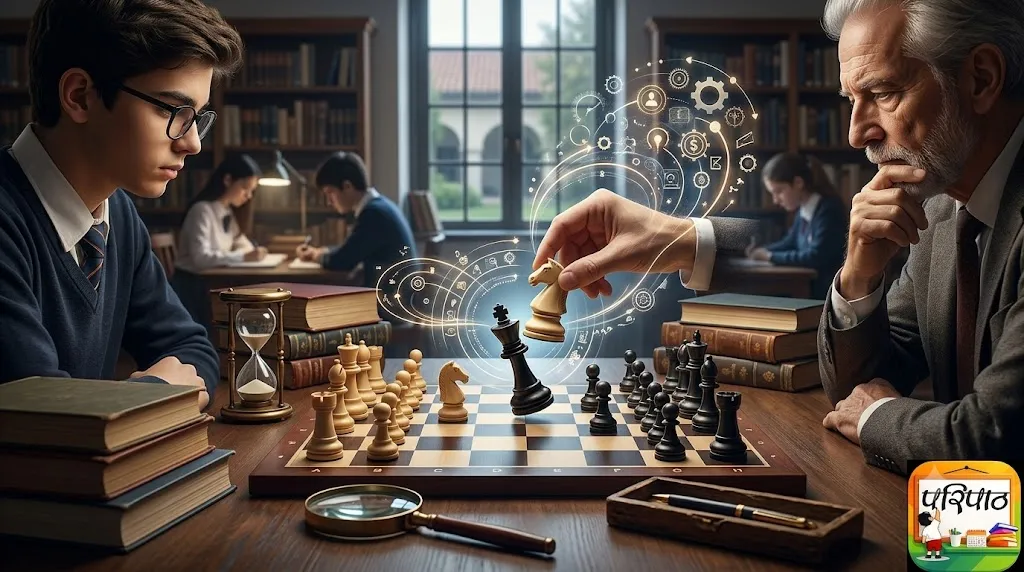
Chess is a two-player game played on a 64-square board with 16 pieces for each player: one king, one queen, two rooks, two knights, two bishops, and eight pawns. Each piece moves in a unique way, and every move has a specific purpose. Chess is not merely about moving pieces; it's about understanding your opponent's thoughts, anticipating their potential moves, and devising your own strategy accordingly. It tests your decision-making abilities, patience, and foresight.
Developing Strategic Thinking
The most crucial aspect of playing chess is 'strategy.' Strategy involves planning for the future. In chess, you don't just think about one move; you must consider multiple moves ahead. For instance, when you advance a pawn, you need to assess if it exposes your king to danger or if it creates an advantageous opportunity for your opponent. This is known as 'foresight.'
- Setting Objectives: Every chess player's ultimate goal is to deliver a 'Checkmate' to the opponent's king. However, to achieve this main objective, several smaller goals must be set – such as controlling the center of the board, eliminating important opposing pieces, and protecting one's own king.
- Systematic Planning: Chess teaches you to think systematically. Before making a move, you ask yourself questions like, 'What will happen with this move?', 'How will my opponent react to this?', 'What will I do next?'. This process helps you mentally simulate various scenarios and choose the optimal path.
- Attack and Defense: Both attacking and defending are vital in chess. Deciding when to attack and when to adopt a defensive posture requires a careful analysis of the board state. This develops your ability to maintain balance and adapt to changing circumstances.
The legendary chess player Garry Kasparov once stated, “Chess is a war game, where you are fighting your opponent's mind.” This powerfully illustrates the importance of strategic thinking. Every move you make must have a purpose, and that purpose must align with your ultimate objective.
The Art of Problem Solving and Decision Making
Each game of chess presents a complex web of problems. After every move, the board situation changes, and a new challenge arises. To solve these problems, you must examine various options and select the best one. This process sharpens your problem-solving and decision-making skills.
- Analyzing Options: When it's your turn to move, you don't make a hasty decision. Instead, you consider multiple potential moves. You mentally weigh the advantages and disadvantages of each move. This practice cultivates an analytical mindset.
- Anticipating Outcomes: You try to predict the consequences of your chosen move. This skill is beneficial not only in chess but also in your daily life and studies. For example, when solving a complex math problem, you consider various methods and choose the most appropriate one.
- Flexibility: Sometimes, your original plan might fail, or you might need to change it if your opponent makes an unexpected move. In such situations, chess teaches you the flexibility to adapt your strategy according to new circumstances. This adaptability is crucial for facing unforeseen changes in life.
Chess also teaches you 'tactics' – a sequence of moves used to gain an immediate advantage over your opponent. Tactics like forks, pins, and skewers compel your mind to think intensely and teach you how to achieve maximum gain in the fewest possible moves.
Critical Analysis and Foresight
Playing chess requires you to critically analyze every move. It's not enough to simply think, 'This move looks good'; you must deeply consider 'Why is this move good?' or 'What are the pros and cons of this move?'. This is what we call 'critical analysis.'
- Position Evaluation: After each move, you must evaluate the position of the pieces on the board and their relative strengths. You consider which pieces are in danger, which are well-placed, and whose king is safer. All these factors contribute to deciding your next move.
- Learning from Mistakes: Making mistakes is natural in chess. However, what's important is learning from those mistakes. Even if you lose a game, analyzing it helps you identify where you went wrong and how to improve. This fosters a willingness to admit mistakes and strive for improvement.
- Patience and Concentration: Chess is a game of patience and concentration. Without concentration, you might miss your opponent's moves or make blunders yourself. The habit of sustained concentration is also highly beneficial for your studies.
Chess instills 'foresight' – the ability to anticipate what might happen in the future. You don't just think about the present moment; you plan your strategy by considering 5-10 moves ahead. This develops your capacity to prepare for future challenges.
Benefits in Academic and Personal Life
The advantages of playing chess extend beyond the game itself, impacting your academic and personal life significantly. Numerous studies have shown that students who regularly play chess exhibit improved academic performance.
1. Academic Benefits:
- Improved Math Skills: Chess indirectly involves many mathematical concepts (such as geometry, logic, probability). This enhances students' understanding of mathematics and their problem-solving abilities in the subject.
- Reading Comprehension: Students' reading comprehension improves as they read and understand chess rules and strategies.
- Memory Enhancement: Playing chess requires remembering various moves, tactics, and opponent's responses. This boosts your memory and overall cognitive skills.
- Focus and Attention: Chess significantly improves concentration. The ability to focus and pay attention is paramount in academic pursuits.
2. Personal Benefits:
- Patience and Discipline: Chess is a game of patience. Hasty moves can lead to losses. This helps students develop patience and discipline.
- Self-Confidence: When you win a game or solve a complex problem, your self-confidence grows. This confidence extends to other areas of your life.
- Sportsmanship: Chess teaches you to accept both victory and defeat gracefully. This develops good sportsmanship.
- Creativity: Chess encourages you to discover new moves and strategies. This fosters creativity and imagination.
According to some research, children who regularly play chess show an increase in IQ scores and improve their school performance, especially in subjects like mathematics and science. Incorporating chess at the school level can significantly contribute to students' holistic development.
The Mathematical and Logical Dimensions of Chess
Chess is not merely a game but an excellent example of mathematics and logic in action. Every aspect of the game is underpinned by mathematical and logical principles.
- Combinatorics: The number of possible moves on a chessboard is astronomical. There are 20 possible first moves for white, and 20 for black, leading to billions of possible positions after just a few moves. This is a prime example of combinatorics, where you consider various combinations.
- Algorithms: Many 'algorithms' (specific rules or methods for making moves) are used in chess. For instance, in a 'rook endgame,' there are specific rules on how to checkmate the opponent's king with the help of your king and rook.
- Pattern Recognition: Experienced chess players recognize specific patterns on the board. They can quickly identify which tactics will be useful in a given situation. This pattern recognition is akin to identifying patterns in mathematics.
- Logic: Chess is entirely based on logic. The 'if-then' reasoning – 'If I make this move, then he will react this way, and then I can make that move' – is the foundation of logic. This enhances students' logical thinking abilities.
- Geometry: The moves of chess pieces are inherently geometric. Bishops move diagonally, rooks move straight, and knights move in an 'L' shape. Observing these movements helps you develop a better understanding of geometric shapes and directions.
Chess players are often proficient in mathematics because both fields require similar skills such as problem-solving, reasoning, and abstract thinking. Playing chess inadvertently trains your brain to think mathematically and logically, which is highly beneficial in school and life.
Did You Know?
- The number of possible chess games is estimated to be greater than the number of atoms in the observable universe!
- The longest recorded chess game had 280 moves, played between Ivanik and Pernice in 1989.
- The term 'Checkmate' comes from the Persian phrase 'Shah Mat,' meaning 'the king is helpless' or 'the king is dead.'
- Some studies suggest that playing chess can reduce the risk of brain diseases like Alzheimer's by keeping the brain active.
- According to chess rules, if a pawn reaches the opposite end of the board, it can be promoted to a queen, rook, knight, or bishop.
Conclusion
Chess is much more than just an entertaining game; it is a powerful educational tool. It develops strategic thinking, problem-solving abilities, critical analysis, and decision-making skills. These skills benefit students not only in their academic lives but also in their personal development. Chess helps improve mathematical comprehension, memory, concentration, and self-confidence. So, friends, if you want to sharpen your mind and make it more astute, start playing chess today. This game will not only entertain you but also equip you to face every challenge in life with greater capability. Remember, every move has a thought behind it, and every thought guides you towards success. Let's enjoy this ancient and wonderful game and sharpen our minds!