Imagine this: the rain has just stopped, the sun peeks through the clouds, and suddenly, a magnificent arc of colors appears in the sky. This breathtaking sight, the rainbow, has fascinated humanity for centuries. From ancient myths to modern science, its vibrant beauty has inspired artists, poets, and scientists alike. But have you ever wondered how this spectacular phenomenon is actually formed? What are the scientific principles at play behind this natural wonder? Today, we embark on a journey to unravel the colorful mystery of rainbows through the lens of science!
A rainbow is not just a pretty sight; it's a brilliant demonstration of light's incredible properties and the intricate interaction with tiny water droplets. By understanding a few fundamental concepts in physics, we can fully appreciate the genius behind nature's most dazzling light show. In this exploration, we will delve into the crucial roles of light's reflection, refraction, and dispersion.
What Exactly is a Rainbow?
Simply put, a rainbow is an optical and meteorological phenomenon that causes a spectrum of light to appear in the sky when sunlight shines onto water droplets. It forms a multi-colored arc, typically seen after a rain shower or when there are water droplets in the air, with the sun behind the observer and the water droplets in front.
The familiar spectrum of colors in a rainbow typically includes red, orange, yellow, green, blue, indigo, and violet (often remembered by the acronym VIBGYOR). These colors always appear in the same order, a testament to the consistent laws of physics.
For a rainbow to form and be visible, specific conditions must be met:
- There must be sunlight.
- There must be water droplets in the air (from rain, mist, or spray).
- The sun must be behind the observer, and the water droplets must be in front.
- The sun's elevation in the sky must be relatively low, typically less than 42 degrees above the horizon.
The ABCs of Light: Refraction, Reflection, and Dispersion
To truly understand how a rainbow paints itself across the sky, we need to grasp three fundamental properties of light: refraction, reflection, and dispersion. Let's explore each of these in detail.
Refraction: The Bending of Light
Refraction is the phenomenon where light changes direction as it passes from one medium to another (for example, from air into water). This change in direction occurs because light travels at different speeds in different mediums. When light enters a denser medium (like water from air), its speed decreases, causing it to bend. You might have noticed a pencil looking 'bent' when partially submerged in a glass of water – that's refraction in action!
Example: Place a pencil in a glass of water. Observe how the pencil appears to bend at the water's surface. This visual distortion is due to light refracting as it moves from air to water.
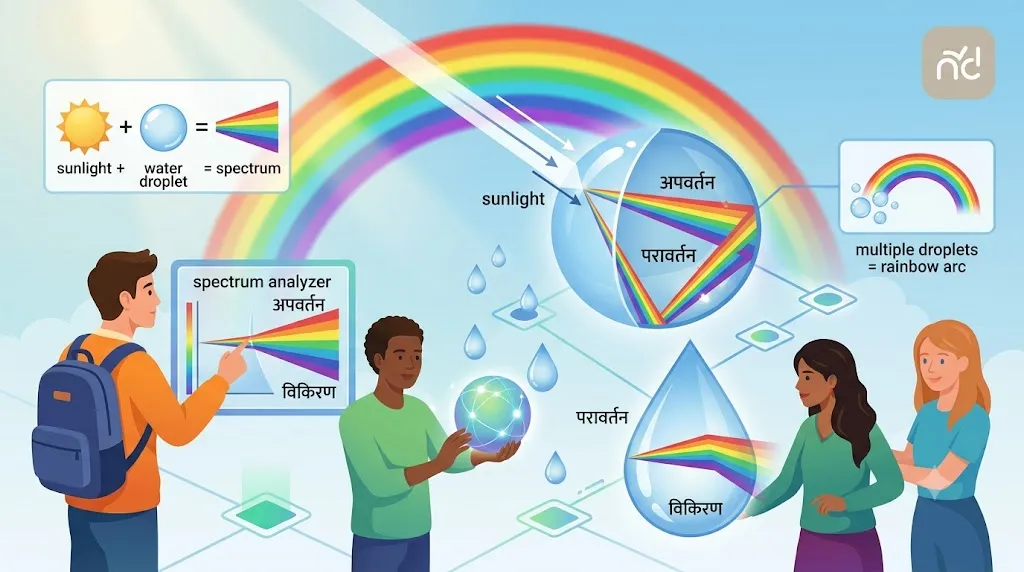
In the formation of a rainbow, sunlight first enters a water droplet, where it undergoes its initial refraction. This bending of light is the crucial first step in creating the colorful arc.
Reflection: Bouncing Back
Reflection is what happens when light strikes a surface and bounces back into the same medium. This is how mirrors work, allowing us to see our own image. There are two main types of reflection: specular reflection (like from a smooth mirror) and diffuse reflection (from a rough surface).
For rainbows, a specific type of reflection called 'total internal reflection' occurs inside the water droplet. After entering the droplet and refracting, the light hits the inner back surface of the droplet. Instead of passing through and exiting the droplet, it bounces off this inner surface and is redirected back inside.
Dispersion: The Unveiling of Colors
White sunlight, which appears colorless to us, is actually a mixture of all the colors of the visible spectrum. Dispersion is the process by which white light separates into its constituent colors. This phenomenon is best observed when white light passes through a prism. The prism separates the light into its individual colors: red, orange, yellow, green, blue, indigo, and violet (VIBGYOR).
Why does this happen? Each color of light has a different wavelength, and consequently, each color bends at a slightly different angle when it passes through a medium like water or glass. Red light, having the longest wavelength, bends the least, while violet light, with the shortest wavelength, bends the most. This differential bending causes the colors to spread out, revealing the beautiful spectrum.
Inside a water droplet, which acts like a tiny spherical prism, sunlight undergoes dispersion, breaking down into its seven component colors. These are the very colors we see in a rainbow.
The Magical Recipe: How Rainbows Form
Now, let's put these three concepts together to understand the step-by-step process of rainbow formation:
- First Refraction and Dispersion: Sunlight enters a water droplet. As it moves from air to water, the light is refracted (bends). Simultaneously, the white sunlight is dispersed, separating into its individual colors, each bending at a slightly different angle.
- Total Internal Reflection: These separated colors then travel to the back inner surface of the water droplet. Here, they undergo total internal reflection, bouncing off the inner surface and heading back towards the front of the droplet.
- Second Refraction: As the reflected and dispersed light rays exit the water droplet, they undergo a second refraction. This final bending further separates the colors and directs them at specific angles towards an observer's eyes.
This entire sequence of events happens within billions of individual water droplets, each acting as a tiny prism and mirror. However, for a single observer, only the light rays that exit the droplets at a specific angle (around 40-42 degrees from the anti-solar point) reach their eyes, creating the visible arc of the rainbow.
Beyond the Single Arch: Primary vs. Secondary Rainbows
Have you ever noticed two rainbows in the sky at once? This phenomenon highlights the existence of different types of rainbows, primarily the primary and secondary rainbows.
Primary Rainbow
- This is the most common and brightest type of rainbow we typically see.
- It results from sunlight undergoing one internal reflection inside the water droplet.
- In a primary rainbow, the colors are arranged from red on the outside (top) to violet on the inside (bottom).
- It appears at an angle of approximately 40-42 degrees from the anti-solar point.
- The colors are vivid and distinct.
Secondary Rainbow
- Sometimes, a fainter, broader rainbow can be seen above the primary rainbow. This is the secondary rainbow.
- It forms due to sunlight undergoing two internal reflections within the water droplet.
- Because of the extra reflection, more light energy is lost, making the secondary rainbow appear significantly fainter than the primary one.
- Crucially, the color order in a secondary rainbow is reversed compared to the primary: violet is on the outside (top), and red is on the inside (bottom).
- It appears at a wider angle, approximately 50-53 degrees from the anti-solar point, hence it's positioned above the primary rainbow.
The difference in the number of internal reflections is key to understanding their distinct appearance and color order. The double reflection in a secondary rainbow also means the light travels a slightly longer path, contributing to its reduced intensity.
Rainbow Lore: Myths, Facts, and Fascinating Phenomena
The beauty and mystery of rainbows have given rise to numerous myths and legends across cultures. Let's separate fact from fiction and explore some intriguing aspects of rainbows.
Myth: There's a pot of gold at the end of a rainbow.
Fact: This popular myth, often found in folklore, especially Irish legends, is scientifically impossible. A rainbow doesn't have an 'end' in a physical sense. It's a full circle of light, but we typically see only a semi-circle because the ground obstructs the lower half. If you were to view a rainbow from a plane or a very high vantage point, you might see its full circular form. Since it's an optical phenomenon, not a physical object, there's no fixed 'end' to reach, let alone a pot of gold!
Myth: You can touch a rainbow.
Fact: A rainbow is an optical illusion, not a tangible object. It's the light from specific water droplets reaching your eyes at a particular angle. As you move, the water droplets that create the rainbow for your eyes change. Therefore, no matter how close you try to get, a rainbow will always appear to move further away, maintaining its distance. You can walk through the rain, but you can't touch the rainbow itself.
Myth: Everyone sees the same rainbow.
Fact: This might come as a surprise, but every person sees their own unique rainbow! The specific light rays from water droplets that reach your eyes are unique to your position and perspective. Even two people standing side-by-side will see slightly different rainbows, as the angles and specific droplets involved will vary for each observer. It's truly a personal spectacle!
Myth: Rainbows only have seven distinct colors.
Fact: While we commonly identify seven colors (VIBGYOR) for convenience, the spectrum of light is actually continuous. This means there are countless shades and hues blending seamlessly from red to violet, far more than just seven distinct bands. The 'seven colors' are a simplification to help us categorize and remember the order.
Why Rainbows Matter: A Symbol of Hope and Science
Beyond their scientific explanation, rainbows hold significant cultural and symbolic meaning across the globe. In many cultures, they represent hope, peace, new beginnings, and even divine connections. In Indian culture, the rainbow is often referred to as 'Indradhanushya' (Indra's bow), symbolizing the powerful and benevolent aspect of the deity Indra.
From a scientific perspective, the rainbow serves as a powerful reminder of the fundamental properties of light and the incredible laws governing our natural world. It teaches us that behind every beautiful natural phenomenon lies a fascinating scientific explanation, waiting to be discovered and understood. The next time you gaze upon a rainbow, don't just admire its beauty; take a moment to appreciate the intricate dance of light and water that brings it to life. This appreciation can deepen your connection to both nature and the wonders of science.
Did You Know?
- Moonbows (Lunar Rainbows): Rainbows can also be created by moonlight! These are called 'moonbows' or 'lunar rainbows'. Since moonlight is much fainter than sunlight, moonbows are typically very dim and often appear white to the naked eye, although colors can be seen with long-exposure photography. They are quite rare to witness.
- Full Circle Rainbows: From the ground, we only see a semi-circular rainbow because the Earth obstructs the lower half. However, from an airplane or a very high building, it is sometimes possible to see a full circular rainbow!
- Twin Rainbows: Sometimes, two rainbows can emerge from the same anti-solar point, appearing parallel to each other. This can happen due to different rain shower regions or variations in droplet sizes.
- Fogbows: Rainbows formed in fog are known as 'fogbows'. Because the water droplets in fog are much smaller than raindrops, fogbows usually appear mostly white or very faintly colored, with less distinct color separation.
- Alexander's Dark Band: Between the primary and secondary rainbows, there is often a distinct dark band. This area is known as 'Alexander's Dark Band'. In this region, light is scattered away from the observer, resulting in a noticeable lack of light and thus a darker appearance.
Conclusion
The rainbow is far more than just a beautiful arc of colors in the sky; it's a magnificent display of fundamental scientific principles: refraction, reflection, and dispersion of light. As sunlight passes through countless tiny water droplets, it bends, bounces, and separates into its constituent colors, creating the stunning spectrum we behold. Whether it's the single internal reflection of a primary rainbow or the double reflection of a fainter secondary rainbow, each type offers a unique glimpse into the physics of light. By dispelling common myths and understanding the science, we can appreciate the true wonder of this natural spectacle. The next time a rainbow graces the sky, take a moment to marvel not only at its beauty but also at the ingenious science that makes it possible, fostering a deeper connection with the world around us.