Dear students and esteemed educators,
Many of you might have heard the term 'Autumnal Equinox'. It's a special day when, across our planet Earth, the length of day and night is almost precisely equal. Imagine, simultaneously across the entire world, daylight and darkness last for nearly the same duration! This is a fascinating astronomical event that occurs annually, usually around September 22nd or 23rd. This year, in 2026, it falls on September 22nd. But how does this happen? What science lies behind this phenomenon? Today, let's unravel the scientific mystery of the autumnal equinox and understand this incredible dance of our planet Earth more closely.
What Exactly is the Autumnal Equinox?
The word 'equinox' comes from Latin: 'aequus' meaning equal, and 'nox' meaning night. Twice a year, there are days when the duration of day and night on Earth is nearly identical. The first equinox occurs in March, known as the 'Vernal Equinox' or 'March Equinox', signaling the start of spring in the Northern Hemisphere. The second, occurring in September, is the 'Autumnal Equinox' or 'September Equinox'. In the Northern Hemisphere, the autumnal equinox marks the end of summer and the beginning of autumn, while in the Southern Hemisphere, it heralds the start of spring.
On this day, the Sun is directly overhead the Earth's Equator. This means that from any point on Earth, the Sun appears to rise precisely due east and set precisely due west. This unique alignment ensures that both the Northern and Southern Hemispheres receive an equal amount of sunlight, leading to the near-equal duration of day and night. This specific alignment happens only for a fleeting moment, but its effect is observed throughout the entire day. At the equator, the Sun's rays strike the surface at a 90-degree angle, making the Sun appear directly overhead.
Historically, many cultures have attached significant importance to this day. Since ancient times, humans have studied celestial movements to devise their calendars and agricultural schedules. The equinox is one such crucial astronomical event that signifies shifts in nature and often new beginnings in life and harvest cycles.
Earth's Axial Tilt and its Journey Around the Sun
To truly grasp the science behind the autumnal equinox, we need to understand two fundamental movements of our planet: its axial tilt and its orbit around the Sun. These two factors combine to create the seasons and phenomena like the equinoxes.
The Earth's Axial Tilt
We often imagine Earth standing upright, but that's not the case. Our planet is tilted on its imaginary axis by approximately 23.5 degrees. This tilt remains constant as Earth orbits the Sun, always pointing in the same direction (towards Polaris, the North Star). It is this tilted axis around which Earth rotates, giving us day and night. Without this axial tilt, Earth would not experience seasons; the equator would always be hot, and the poles would always be cold.
This axial tilt is incredibly important. It causes the Sun's rays to strike Earth's surface at varying angles throughout the year, meaning different parts of the planet receive more or less direct sunlight at different times. This tilt is the primary driver of our seasons.
Earth's Orbit Around the Sun
Earth travels in an elliptical orbit around the Sun. This revolution, combined with Earth's axial tilt, is what gives us the experience of distinct seasons. At different times of the year, Earth's axis is either tilted towards or away from the Sun.
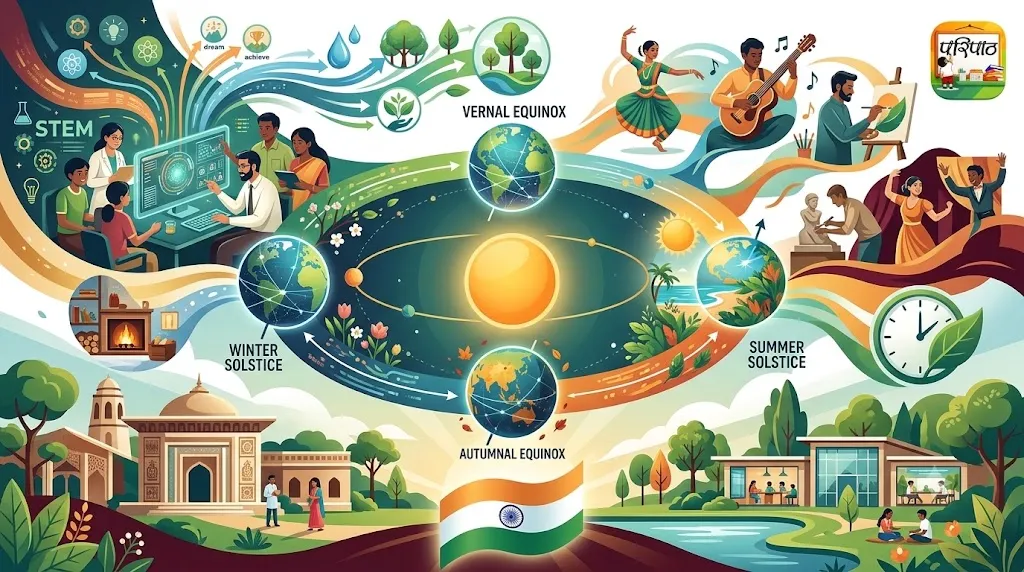
- Summer Solstice: Around June 21st, the Northern Hemisphere is tilted most directly towards the Sun. This day marks the longest day and shortest night in the Northern Hemisphere. The Sun's rays fall directly on the Tropic of Cancer.
- Winter Solstice: Around December 21st, the Northern Hemisphere is tilted furthest away from the Sun. This results in the shortest day and longest night in the Northern Hemisphere. The Sun's rays fall directly on the Tropic of Capricorn.
In between these two extremes, during the Vernal Equinox (March) and Autumnal Equinox (September), Earth's axis is neither tilted towards nor away from the Sun. Instead, it is oriented 'sideways' relative to the Sun. This allows sunlight to fall directly on the Equator, ensuring both hemispheres receive equal illumination. On this day, neither pole is tilted towards the Sun, so sunlight is distributed evenly from the equator all the way to the poles.
Equal Day and Night: A Moment of Celestial Balance
On the autumnal equinox, Earth's axis is positioned relative to the Sun such that sunlight falls perpendicularly on the Equator. This means that from the North Pole to the South Pole, sunlight is distributed equally across both hemispheres. Consequently, at every point on Earth, with the exception of the immediate polar regions, the duration of day and night is approximately 12 hours.
For instance, whether you are in Mumbai, New York, Tokyo, or Sydney, you will experience roughly 12 hours of daylight and 12 hours of darkness. Naturally, atmospheric refraction and other minor factors can cause this equality to vary by a few minutes, but broadly speaking, it remains equal. Atmospheric particles bend sunlight, making the Sun visible for a few minutes even when it is technically below the horizon. Thus, technically, the day is still a few minutes longer than the night on the equinox, but this difference is negligible compared to other days of the year.
Scientific Fact: While 'equinox' literally means 'equal night,' precise astronomical observations reveal that due to atmospheric refraction and the Sun's angular size, the day on an equinox is actually a few minutes longer than the night. Nevertheless, this equality is greater than on any other day of the year.
On this day, the Sun is located on the celestial equator, making it appear directly overhead at Earth's geographical equator. This results in the most intense sunlight at the equator, with intensity gradually decreasing as one moves towards the poles. This exact alignment is momentary, but its effects are observed throughout the day.
The Science of Seasonal Change and Equinox Significance
The autumnal equinox is not just a day of equal day and night; it officially marks the beginning of autumn in the Northern Hemisphere. After this point, the Northern Hemisphere begins to tilt further away from the Sun, causing the days to grow shorter and the nights longer. Temperatures start to drop, and leaves begin to change color and fall, signaling the arrival of the autumn season. This season is a period of rest for many plants, as they prepare for the colder months ahead. Agriculturally, it's also a crucial harvest time for many crops.
Conversely, in the Southern Hemisphere, the same day marks the beginning of spring. The Southern Hemisphere now begins to tilt towards the Sun, leading to longer days and rising temperatures. Nature awakens with new life, flowers bloom, and birds begin to sing. Thus, the equinox is not merely an astronomical moment but a significant turning point in Earth's biosphere and environmental cycles.
Furthermore, the equinox serves as an essential reference point for astronomers. On this day, the Sun crosses the celestial equator. During the vernal equinox, the Sun crosses the celestial equator from south to north, while during the autumnal equinox, it crosses from north to south. This crossing is crucial for determining the positions of stars and planets in the sky.
Ancient civilizations also recognized the importance of the equinox. Many cultures celebrate this day as a harvest festival, as it coincides with the ripening and gathering of various crops. For instance, the Mid-Autumn Festival in China is celebrated around this time. In Japan, Autumnal Equinox Day is a public holiday, where people pay respects to their ancestors. These traditions highlight humanity's deep connection with nature and celestial rhythms.
Global Implications of the Equinox
On the day of the equinox, while the Sun is directly overhead at the equator, at the polar regions, one pole emerges from six months of darkness into light, while the other transitions from six months of light into darkness. At the North Pole, after the autumnal equinox, the Sun will not be seen for approximately six months, whereas at the South Pole, the Sun will not set for the next six months. This is a remarkable phenomenon driven by Earth's axial tilt.
The equinox also indirectly affects ocean tides. When the Sun and Moon are aligned with the equator during an equinox, their combined gravitational pull on Earth's oceans is enhanced, resulting in stronger 'spring tides'. This demonstrates how celestial mechanics can influence even our planet's oceans.
Did You Know?
- On the autumnal equinox, the 24-hour sunrise at the North Pole ends, ushering in six months of darkness, while at the South Pole, six months of continuous daylight begin.
- Many ancient monuments and structures worldwide, such as the El Castillo pyramid at Chichen Itza in Mexico, are aligned with the sunrise or sunset of the equinoxes, showcasing the advanced astronomical knowledge of ancient peoples.
- The autumnal equinox signals the arrival of 'Autumn' in the Northern Hemisphere and 'Spring' in the Southern Hemisphere.
- The English word 'equinox' is derived from the Latin words 'aequus' (equal) and 'nox' (night).
- Each equinox occurs at a precise moment, which shifts slightly each year. This is why it sometimes falls on September 22nd and sometimes on September 23rd, influenced by leap years and subtle changes in Earth's orbit.
- The autumnal equinox is also commonly referred to as the 'September Equinox' because it always occurs in September.
Conclusion
The autumnal equinox is more than just an astronomical event; it is a beautiful illustration of Earth's dynamic movement and the magnificent cycle of nature. Earth's axial tilt and its revolution around the Sun are what provide us with the experience of equal day and night and the changing seasons. From this day forward, days in the Northern Hemisphere will progressively shorten, bringing with them the crisp feel of autumn, while the Southern Hemisphere prepares for the warmth of summer.
From a perspective of knowledge and science, the equinox reminds us of the complexity and order of our planet and the universe. Studying such phenomena not only enriches our understanding of astronomy but also highlights the importance of adapting to nature and our environment. It encourages us to look at the world around us with greater curiosity and to seek the science hidden behind every natural change.
So, the next time you hear about the autumnal equinox, we hope you'll remember the science behind it and its profound significance. Keep visiting our 'Paripath' platform for more such scientific and educational insights, and continue exploring this amazing world of knowledge!