The Science Behind Rainbows: Unraveling Nature's Colorful Secret
Hello students!
Today, July 13, 2026, on the auspicious occasion of Somvati Amavasya and Masik Shivratri, we embark on a journey to explore one of nature's most beautiful and mysterious phenomena – the rainbow. During the monsoon season, when the rain subsides and the sun peeks through the clouds, a magnificent arc of colors often appears in the sky. This sight is so enchanting that it leaves us spellbound. But have you ever wondered how this rainbow is actually formed? What science lies behind this world of colors? Let's delve into the fascinating science behind rainbow formation in simple terms.
Understanding Light: The Foundation of Rainbows
To understand the science of rainbows, we first need to grasp some fundamental concepts about light. The sunlight we typically see appears white. However, this 'white light' is actually composed of several different colors. These colors are Red, Orange, Yellow, Green, Blue, Indigo, and Violet – often remembered by the acronym VIBGYOR (or ROYGBIV in reverse order). This collection of colors is known as the 'spectrum of light'. Sir Isaac Newton famously demonstrated this by showing how white light could be split into its constituent colors using a glass prism.
Each color in the spectrum has its own unique wavelength. This difference in wavelength causes them to behave differently when interacting with various mediums. For instance, red light has the longest wavelength, while violet light has the shortest. This characteristic plays a crucial role in the formation of a rainbow.
Water Droplets: Nature's Tiny Prisms
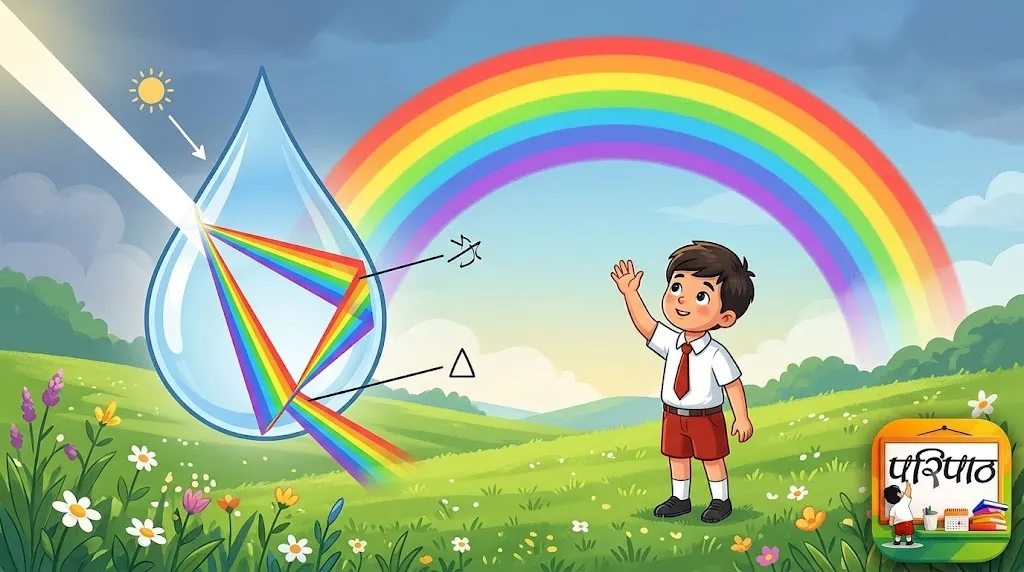
The formation of a rainbow absolutely requires water. After a rainfall, millions of tiny water droplets remain suspended in the atmosphere, acting as the primary agents for creating this colorful display. These water droplets function much like miniature prisms. A prism is typically a triangular piece of glass that disperses white light into its component colors. Raindrops perform a similar function, but their mechanism is slightly different.
Did You Know? Each raindrop is essentially spherical. When sunlight strikes these droplets, it enters them, undergoes refraction, and then reflects internally. These droplets are precisely what bend and redirect the light to reveal the rainbow to our eyes.
Understanding how light travels through these droplets is key. What happens when sunlight enters a water droplet? And what happens when it exits? These two actions are the foundation of rainbow formation: Refraction of Light and Reflection of Light.
Refraction of Light: The Bending of Light
When light travels from one medium (like air) to another (like water), it changes direction. This phenomenon is called 'refraction'. It occurs because light travels at different speeds in different mediums. As light moves from air into water, its speed decreases, causing it to bend or change its path.
In the case of a water droplet, when sunlight enters it, it is refracted once. This refraction causes the white light to split into its constituent colors (red, orange, yellow, green, blue, indigo, violet). Because each color has a different wavelength, they are refracted at slightly different angles. Violet light bends the most, while red light bends the least. This differential bending is what separates the colors and allows us to see the distinct bands of the rainbow.
Reflection of Light: The Bouncing Back of Light
After being refracted, these separated light rays travel to the back (inner surface) of the water droplet. Here, they bounce off the inner surface of the droplet. This phenomenon is called 'reflection'. It's similar to how your image appears in a mirror, but in this case, it happens within the droplet. This specific type of reflection is known as 'total internal reflection', as the light bounces back inside the droplet rather than passing through and exiting.
This reflection redirects the light rays back towards the front, in the direction of our eyes. It is this reflection that makes it possible for us to see a rainbow. Without this internal bounce, the light rays would simply pass through the droplet and continue on their path, and no rainbow would be visible.
How Rainbows Are Formed: The Complete Scientific Process
Now, let's combine both refraction and reflection to understand the full process. For a rainbow to be visible, three main conditions must be met:
- The sun must be behind you.
- There must be water droplets in the air in front of you (it should be raining or have just stopped raining).
- A specific angle (approximately 42 degrees) must be formed between the sunlight, the water droplets, and your eyes.
The process unfolds as follows:
- Sunlight strikes a water droplet.
- Upon entering the droplet, the light rays are refracted and split into their seven component colors.
- These separated colors travel to the back of the droplet and are then reflected internally, bouncing back.
- As these reflected colors exit the droplet, they are refracted once more.
- This sequence of two refractions and one reflection causes each color of light to emerge at a specific angle, reaching our eyes.
From any single water droplet, you typically see only one color. However, because there are billions of water droplets in the sky, each droplet sends a different color of light at a specific angle to your eyes. For example, some droplets send red light, while others send violet. When all these colors from countless droplets combine, they form the beautiful arc of the rainbow.
To see a rainbow, the sun should be behind you, and it should be raining or have just stopped raining in front of you. Rainbows are most vivid and appear larger when the sun is low in the sky, typically in the morning or late afternoon. You won't see a rainbow when the sun is high overhead, as the required 42-degree angle cannot be formed.
Primary and Secondary Rainbows
Have you ever noticed two rainbows in the sky at the same time? One that is bright and clear, and another fainter one above it? These are known as the primary and secondary rainbows.
- Primary Rainbow: This is the most common and brightest rainbow. It is formed when light undergoes one reflection and two refractions within a water droplet. In a primary rainbow, red is on the outside of the arc and violet is on the inside. The angle for this rainbow is approximately 42 degrees.
- Secondary Rainbow: This appears above the primary rainbow and is fainter. It is formed when light undergoes two reflections and two refractions inside a water droplet. Due to the extra reflection, the order of colors is reversed – violet is on the outside and red is on the inside. The angle for this rainbow is approximately 50-53 degrees. The light intensity is reduced because of the additional reflection, making it appear fainter.
Did You Know?
- You can sometimes see two rainbows at once – a primary and a secondary rainbow.
- Rainbows always appear opposite to the sun.
- Each person sees their own unique rainbow, as the angle of light and your eye's position are specific to you.
- A rainbow is actually a full circle. We only see a semi-circular arc from the ground because the Earth blocks the lower half. From an airplane or a very high vantage point, you might see a full circular rainbow.
- Occasionally, rainbows can be seen at night by moonlight, known as a 'moonbow'. These are rare and appear much fainter.
- Culturally, rainbows are often seen as symbols of hope, good fortune, or a bridge to the divine in many traditions.
Conclusion: Science Unveiling Beauty
A rainbow is not just a beautiful sight; it is a living testament to the amazing laws of science. It's truly astonishing how seemingly simple events like the refraction and reflection of light combine to create such a breathtaking spectacle. The next time you see a rainbow during the monsoon season, don't just get lost in its beauty; take a moment to appreciate the science behind it. Every natural phenomenon has a scientific explanation, and understanding these reasons is the essence of true curiosity.
This monsoon, whenever you spot a rainbow, remember that it is merely an exquisite dance between water droplets and sunlight. Observe the world around you more closely and try to uncover the science hidden behind every event. This will make you a better observer and a critical thinker. Enjoy these wonderful miracles of nature and keep exploring the world of science!
Thank you!