As the monsoon season gradually recedes, leaving behind a refreshed landscape, we are often treated to one of nature's most spectacular displays: the rainbow. This vibrant arc of colors adorning the sky captivates everyone, from young children to adults, sparking wonder and curiosity. More than just a beautiful sight, the rainbow is a profound lesson in physics, a testament to the intricate workings of light and water.
At Paripath, we believe in unraveling the mysteries of the world around us. Just as historical events shape our understanding of the past, like the significant verdict in the Ayodhya land dispute case, understanding scientific phenomena helps us comprehend the present and future. The science behind rainbows is a perfect example of how complex concepts can be broken down into simple, engaging ideas. Let's embark on this colorful journey to uncover the fascinating physics that creates these ephemeral masterpieces.
What Exactly is a Rainbow? Nature's Optical Illusion
Simply put, a rainbow is a meteorological and optical phenomenon that occurs when sunlight is reflected, refracted, and dispersed by water droplets in the atmosphere. It always appears in the section of the sky directly opposite the sun, meaning the sun must be behind you and rain (or mist) in front of you for you to see it. The classic rainbow appears as a multi-colored arc, featuring the seven distinct colors: Red, Orange, Yellow, Green, Blue, Indigo, and Violet (VIBGYOR).
In many cultures, including India, rainbows are considered symbols of hope, peace, and divine blessings. They are often associated with myths and legends, yet their formation is entirely governed by the precise laws of physics. Understanding the science behind such beautiful occurrences helps us appreciate the order and elegance of the natural world, much like appreciating the intellectual prowess of Viswanathan Anand in chess, or the contributions of scientists honored with Shanti Swarup Bhatnagar Awards.
The Magic of Light: Reflection, Refraction, and Dispersion
To truly understand how a rainbow forms, we need to grasp three fundamental properties of light. These three phenomena work in concert within each tiny water droplet to create the stunning spectrum we observe.
1. Reflection: The Bouncing Back of Light
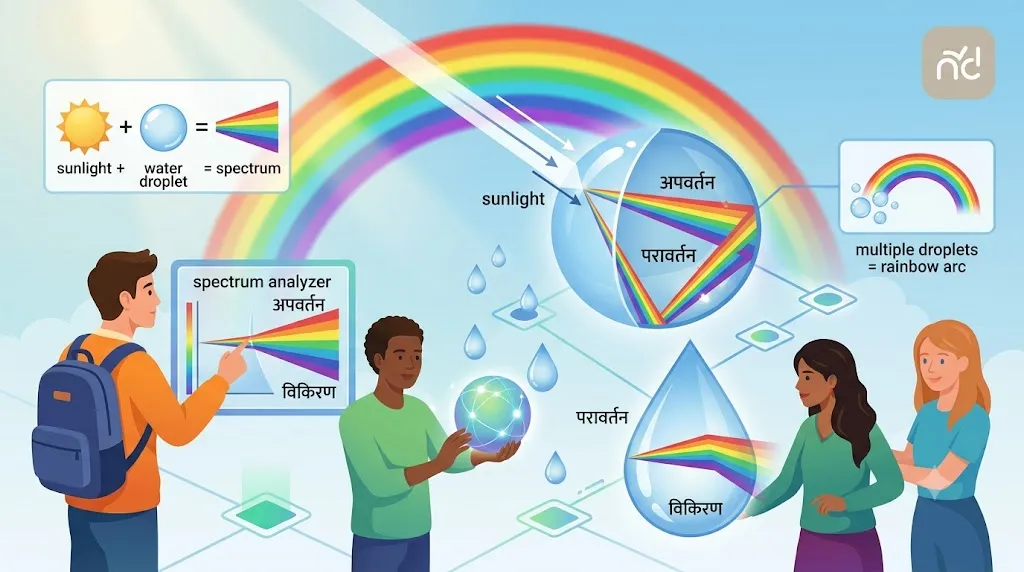
Reflection is what happens when light bounces off a surface. When you look in a mirror, you see your reflection because light rays from your body hit the mirror and bounce back to your eyes. In the context of a rainbow, sunlight enters a water droplet, hits the inner back surface of the droplet, and then bounces off it.
2. Refraction: The Bending of Light
Refraction is the bending of light as it passes from one medium to another. For example, when light travels from air into water, it slows down and changes direction slightly. This is why a pencil in a glass of water appears bent at the water's surface. In rainbow formation, sunlight is refracted twice: once when it enters the water droplet from the air, and again when it exits the droplet back into the air.
3. Dispersion: The Splitting of Light
Dispersion is the phenomenon where white light splits into its constituent colors. White sunlight is actually a mixture of all the colors of the rainbow. When white light passes through a prism, it separates into red, orange, yellow, green, blue, indigo, and violet. This happens because each color of light has a different wavelength and therefore bends (refracts) at a slightly different angle. Violet light, with the shortest wavelength, bends the most, while red light, with the longest wavelength, bends the least. Water droplets act like tiny natural prisms, causing the dispersion of sunlight.
- Reflection: Think of a ball bouncing off a wall.
- Refraction: Think of a straw appearing bent in a glass of water.
- Dispersion: Think of a prism splitting white light into colors.
These simple analogies can help you visualize the concepts more clearly!
Water Droplets: Nature's Tiny Prisms
Now, let's put these three concepts together and see how a single water droplet orchestrates the formation of a rainbow.
1. The Primary Rainbow: A Single Reflection
This is the most common and brightest type of rainbow we see. Its formation involves:
- Entry and First Refraction/Dispersion: Sunlight enters the spherical water droplet. As it enters, it slows down and bends (refracts). Because white light is composed of different colors, and each color refracts at a slightly different angle, the light also disperses into its individual colors (VIBGYOR).
- Internal Reflection: The separated colors travel to the back of the water droplet. When they hit the inner surface, they bounce off (reflect internally).
- Exit and Second Refraction: The reflected light then travels to the front of the droplet and exits, bending (refracting) once more as it passes from water back into the air.
This entire process—two refractions and one internal reflection—sends the light back towards the observer's eyes, creating the primary rainbow. In a primary rainbow, red is on the outside (top) and violet on the inside (bottom).
2. The Secondary Rainbow: A Double Delight
Sometimes, above the primary rainbow, a fainter and larger secondary rainbow can be seen. This occurs when sunlight undergoes two internal reflections within the water droplet, in addition to the two refractions. Because light loses some energy with each reflection, the secondary rainbow appears less bright than the primary one. A key characteristic of the secondary rainbow is that its colors are reversed, with violet on the outside (top) and red on the inside (bottom).
The Spectrum of Colors: Why VIBGYOR?
The sequence of colors in a rainbow—Violet, Indigo, Blue, Green, Yellow, Orange, Red (VIBGYOR)—is not arbitrary. It's a direct consequence of the dispersion of light. Each color corresponds to a different wavelength, and thus, each color bends at a specific angle when refracted:
- Violet: Has the shortest wavelength and bends the most.
- Red: Has the longest wavelength and bends the least.
The angles at which these colors emerge from the water droplets (approximately 40-42 degrees for the primary rainbow) are what allow our eyes to perceive them as a distinct band of colors. It's a precise natural phenomenon, much like the meticulously planned infrastructure projects that shape our nation.
Where and When Do Rainbows Appear?
For a rainbow to form, two crucial ingredients must be present simultaneously:
- Sunlight: Bright, direct sunlight is essential.
- Water Droplets: There must be numerous small water droplets in the air, typically from rain, mist, fog, or even spray from a waterfall.
This explains why rainbows are most commonly seen after a rain shower, especially when the sun reappears while there are still lingering water droplets in the atmosphere. The observer's position relative to the sun and the rain is also critical. You must have the sun behind you and the rain in front of you. Rainbows are never seen at midday when the sun is high in the sky, as they would form below the horizon. They are best observed in the morning or late afternoon when the sun is lower.
The beauty of a rainbow often makes us pause and reflect, much like remembering the life and contributions of leaders like Madhavrao Scindia, whose impact continues to resonate.
Beyond the Basics: Fascinating Rainbow Phenomena
- Every Rainbow is Unique: While you and a friend might be looking at the 'same' rainbow, the specific water droplets reflecting light to your eyes are different. Therefore, each person sees their own unique rainbow.
- Rainbows are Always Circular: From the ground, we only see an arc because the horizon blocks the lower part of the circle. From an airplane, or a very high vantage point, one can sometimes see a full circular rainbow.
- Moonbows: It's possible for moonlight to create a rainbow, known as a moonbow. These are much fainter than sun-produced rainbows and often appear white to the human eye because our color perception is diminished in low light.
- Supernumerary Bows: These are faint, narrow, colored bands sometimes seen just inside the primary rainbow or outside the secondary rainbow. They are caused by interference effects of light waves.
- You Can't Reach the End of a Rainbow: Rainbows are optical illusions; they don't exist at a specific location in space. They are formed by light interacting with water droplets at a certain angle relative to your eye, so as you move, the rainbow moves with you.
Conclusion
The rainbow is far more than just a pretty picture in the sky; it's a magnificent demonstration of fundamental physics principles. The interplay of reflection, refraction, and dispersion of sunlight through countless tiny water droplets orchestrates this stunning natural spectacle. Next time you witness a rainbow gracing the post-monsoon sky, remember the intricate science at play.
Understanding the science behind everyday phenomena not only enriches our appreciation for nature's beauty but also strengthens our grasp of scientific concepts. Just as Paripath strives to make learning engaging and accessible, the rainbow serves as a vibrant reminder that the world is full of wonders waiting to be explored and understood.
Did You Know?
- The total number of colors in a rainbow is infinite, as it's a continuous spectrum, but our eyes typically distinguish seven main colors.
- For a rainbow to be visible, the sun must be no more than 42 degrees above the horizon.
- A rainbow is always approximately 2 kilometers away from your eyes, and it appears to move as you move, maintaining that distance.
- Every raindrop disperses light, but only the droplets at the correct angle relative to your eye contribute to the rainbow you see.