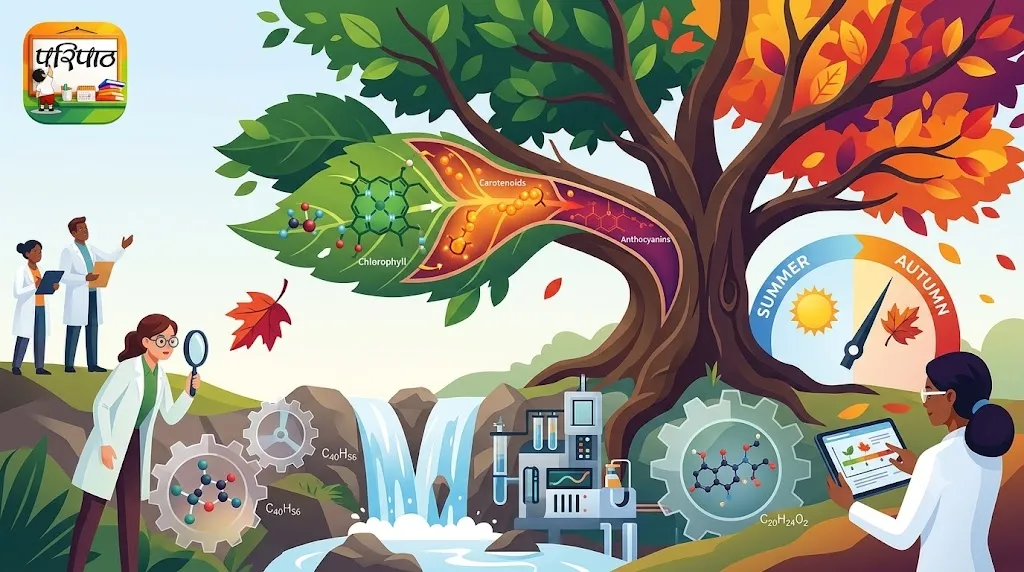
Hello, young explorers and science enthusiasts! Welcome to 'Paripath'. Today, we're going on a fascinating journey to uncover the science behind one of nature's most spectacular annual displays: the changing colors of autumn leaves. As September and October roll around, our surroundings transform into a vibrant tapestry of yellows, oranges, reds, and purples. It's a breathtaking sight that draws people from all over to witness its beauty. But have you ever wondered why leaves change their color? What scientific magic is at play? Join us at 'Paripath' as we delve into the amazing secrets of autumn's colorful transformation!
Why Do Leaves Change Color? A Glimpse into Nature's Chemistry
Throughout most of the year, we see tree leaves in various shades of green. This verdant hue is primarily due to a pigment called 'chlorophyll'. Chlorophyll is not just responsible for the green color; it's also the key player in photosynthesis, the process by which plants convert sunlight into food. Using sunlight, carbon dioxide from the air, and water from the soil, chlorophyll helps plants produce glucose (sugar), their main source of energy.
However, as autumn approaches, daylight hours shorten, and temperatures begin to drop. These environmental changes signal to the trees that winter is coming. To prepare for the harsh conditions of winter – with less sunlight and often frozen water – trees begin to shut down their food production process. They stop supplying nutrients and water to their leaves. Consequently, chlorophyll production ceases, and the existing chlorophyll molecules in the leaves start to break down and disappear. As the dominant green pigment fades, other pigments that have been present in the leaves all along, but were masked by the strong green, finally get their chance to shine, revealing the stunning array of autumn colors we admire.
Chlorophyll: The Green Powerhouse and the Essence of Life
Chlorophyll is arguably the most vital pigment in a plant's leaves. It imparts the characteristic green color and, more importantly, absorbs energy from sunlight. This absorbed energy is then used to combine carbon dioxide (taken from the atmosphere) and water (absorbed by the roots) to create glucose, which is the plant's food. This entire process is known as photosynthesis, and it forms the very base of nearly all life on Earth, as plants are the primary producers in most food chains.
During summer and spring, when sunlight is abundant, temperatures are favorable, and water is plentiful, trees are actively growing and producing vast amounts of chlorophyll. New chlorophyll molecules are constantly being synthesized, while older ones break down. But because production outpaces breakdown, the leaves maintain their vibrant green color. This powerful green pigment is so dominant that it completely overshadows any other pigments present in the leaves, making them invisible to our eyes.
Understanding Photosynthesis: Nature's Food Factory
Photosynthesis is a complex yet fundamental biochemical process:
- Energy Source: Sunlight.
- Raw Materials: Carbon Dioxide (CO₂) from the air and Water (H₂O) from the soil.
- Key Player: Chlorophyll pigment in leaves.
- Products: Glucose (C₆H₁₂O₆ - plant food) and Oxygen (O₂ - released into the atmosphere).
The simplified chemical equation for photosynthesis is:
6CO₂ (Carbon Dioxide) + 6H₂O (Water) + Light Energy → C₆H₁₂O₆ (Glucose) + 6O₂ (Oxygen)
As autumn arrives, the days become shorter, and the intensity of sunlight diminishes. These changes signal to the trees that winter is approaching. Recognizing that photosynthesis becomes less efficient in these conditions, trees gradually stop producing new chlorophyll. The existing chlorophyll then begins to degrade, and the green color starts to fade, paving the way for other colors to emerge.
Chlorophyll's Decline and the Rise of Other Pigments: The Magic of Colors Unveiled
Once chlorophyll production ceases and its molecules break down, the other pigments that have been lurking in the leaves, hidden by the intense green, finally get their moment in the spotlight. This is when the dazzling array of autumn colors truly begins to appear. These pigments primarily fall into two categories: Carotenoids and Anthocyanins.
1. Carotenoids: The Hues of Yellow and Orange
Carotenoids are pigments that are present in the leaves throughout the year. They play a crucial role in protecting chlorophyll from excessive sunlight and assist in the photosynthesis process. When chlorophyll degrades and its green color vanishes, the yellow and orange colors of carotenoids become visible. Think of the vibrant colors of carrots, corn, sweet potatoes, bananas, and many flowers – these are all due to carotenoids. 'Xanthophylls' are a type of carotenoid specifically responsible for many of the bright yellow hues we see in autumn leaves.
Scientific Fact: Carotenoids don't just provide color; they also act as antioxidants and help protect the plant's cells from damage caused by harmful UV radiation from the sun. They are essential for overall plant health.
Most of the brilliant yellows and oranges we observe in autumn foliage are due to these stable carotenoid pigments. Unlike chlorophyll, carotenoids are more resilient and do not break down as quickly, allowing them to remain visible for a longer period once the green fades.
2. Anthocyanins: The Fiery Reds, Purples, and Deep Blues
Anthocyanins are distinctly different from carotenoids because they are generally not present in the leaves throughout the growing season. These striking pigments are newly produced in the autumn, particularly when there are warm, sunny days followed by cool, crisp nights. As chlorophyll breaks down, the leaves are still producing sugars (glucose). However, with the formation of a special 'abscission layer' (which we'll discuss later) at the base of the leaf stem, these sugars become trapped in the leaves.
When these trapped sugars are exposed to sunlight, they undergo a chemical reaction, leading to the synthesis of anthocyanins. It's these anthocyanins that give leaves their spectacular reds, vibrant purples, deep crimson, and sometimes even bluish tints. The rich red colors in apples, cherries, strawberries, grapes, and purple cabbage are all attributed to anthocyanins. The production of anthocyanins is believed to be a protective mechanism for the plant, shielding the leaves from UV radiation and aiding in the process of nutrient recycling before the leaves fall.
Environmental Influences: The Role of Temperature, Sunlight, and Water
Environmental factors play an incredibly crucial and decisive role in the process of leaf color change. These factors determine the timing, intensity, and specific hues we see each autumn.
- Sunlight: The shortening of daylight hours is the primary signal for trees that autumn has arrived. Reduced sunlight triggers the cessation of chlorophyll production and its subsequent breakdown. Furthermore, sufficient sunlight is essential for the synthesis of anthocyanins. Bright, sunny autumn days enhance the production of these red pigments.
- Temperature: Cool, but not freezing, nights combined with warm, sunny days are ideal for the most vibrant fall foliage. Cool nights cause sugars to accumulate in the leaves (as their transport out of the leaf slows down), which boosts anthocyanin production. If an early, severe frost or freeze occurs, the color-changing process can be abruptly halted, causing leaves to turn brown and drop prematurely.
- Water Stress: If trees experience water stress (lack of water) during the summer or early autumn, it can lead to an earlier color change or less vibrant colors. Conversely, excessive rainfall or flooding can deprive roots of oxygen, potentially causing leaves to drop prematurely.
- Soil Nutrients: The availability of essential nutrients like nitrogen, phosphorus, and potassium in the soil also affects the overall health of the leaves and, consequently, their fall colors. Healthy trees tend to produce more vivid and diverse colors.
The unique combination of these factors each year results in the specific palette of autumn colors we witness, making every fall season slightly different and uniquely beautiful.
The Color Change Process: A Natural Cycle and Tree's Winter Preparation
The changing of leaf colors is far more than just a beautiful spectacle; it's a critical natural process in the life cycle of trees. Trees are actively preparing themselves for the harsh conditions of winter. During winter, daylight is scarce, temperatures often dip below freezing, and water in the soil can become frozen and unavailable. Under these challenging conditions, photosynthesis is not feasible for deciduous trees. Therefore, by shedding their leaves, trees conserve energy and prevent water loss through transpiration (the evaporation of water from leaves).
The Abscission Layer: Nature's Detachment Zone
Before shedding their leaves, trees efficiently reclaim and store valuable nutrients (such as nitrogen, phosphorus, and potassium) from the leaves back into their branches and roots. These stored nutrients will then be used to fuel new growth – new leaves and flowers – in the following spring. This clever recycling process is made possible by a specialized layer of cells called the 'abscission layer', which forms at the base of the leaf's stem (petiole).
This abscission layer gradually seals off the leaf from the rest of the tree, impeding the flow of water and nutrients to the leaf. As this layer develops, the leaf weakens at its attachment point. Eventually, with a gentle breeze or even just its own weight, the leaf detaches and falls. It's truly a marvel of natural engineering, ensuring that the tree doesn't waste any precious resources.
A Spectrum of Colors: Each Tree's Unique Identity
Different tree species possess varying amounts of pigments and respond uniquely to environmental cues, which is why a single forest can display such an incredible diversity of colors. This diversity adds to the unparalleled beauty of autumn:
- Maples: Famous worldwide for their brilliant reds, oranges, and golden hues, due to a high concentration of both anthocyanins and carotenoids.
- Oaks: Typically display shades of reddish-brown, russet, and yellow. Their leaves often contain tannins, which contribute to these specific colors.
- Birches: Known for their bright, luminous yellow leaves, primarily due to carotenoids.
- Aspens: Turn a shimmering golden-yellow, with their leaves trembling gently in the breeze, creating a magical visual effect.
- Sumacs: Exhibit deep reds and purples, a result of abundant anthocyanin production.
- Sweetgums (Liquidambar): Their star-shaped leaves can show a stunning mix of red, purple, orange, and yellow on a single tree.
This incredible variety ensures that the autumn landscape is always a dynamic and captivating work of art, reminding us of nature's boundless creativity.
Ganesh Chaturthi and Nature's Beauty: A Spiritual Connection
Today, September 17th, marks the fifth day of Ganesh Chaturthi. In this auspicious and festive atmosphere, witnessing the marvel of nature's changing colors is truly an inspiring experience. Just as we celebrate our festivals by blending tradition with underlying scientific principles, every natural phenomenon holds a profound scientific truth. The changing colors of autumn leaves remind us of nature's ever-transforming essence, the cycle of life, and the deep science hidden within every shift.
On Vishwakarma Jayanti, appreciating the immense creation of the universe and the science behind it is, in a way, an homage to the great architect. Everything in nature has an order and a purpose. The changing leaf colors are a vital step for a tree's survival, teaching us how to adapt to life's changes and find new beauty in transformation.
Did You Know?
- In Japan, special trips are organized to view the autumn leaves, a tradition known as 'Momijigari' (which literally means "maple leaf hunting").
- Chlorophyll is one of the most abundant organic molecules on Earth. Beyond its role in plants, it's also considered beneficial for human health and is used in some dietary supplements.
- The process of leaf color change is a form of 'recycling' for the tree, allowing it to recover valuable nutrients from the leaves before they fall and utilize them for future growth.
- Certain regions globally, such as New England in the USA, Quebec in Canada, and parts of Scotland, are world-renowned for their spectacular autumn foliage. The unique combination of climate and tree species in these areas creates ideal conditions for breathtaking color displays.
- Some plants, like poison ivy, turn incredibly vibrant red in the autumn, making them even more noticeable – and a good reminder to be cautious!
Conclusion: The Science and Splendor of Nature
The changing colors of autumn leaves are not just a beautiful and mesmerizing sight; they are a magnificent example of nature's incredible science. The degradation of chlorophyll, the emergence of carotenoids and anthocyanins, and the influence of environmental factors like temperature and sunlight all combine to create this yearly magic. This intricate process teaches us about the life cycle of trees, their ingenious preparation for winter, and the profound scientific principles embedded in every natural event.
The next time you gaze upon the colorful tapestry of autumn leaves, don't just admire their beauty; take a moment to ponder the science behind them. These leaves inspire us to embrace change and discover new beauty in transformation. Observe nature, ask questions, and keep learning new things. 'Paripath' will always be here to help you unravel many such scientific mysteries. Enjoy this wonderful natural phenomenon and remain curious about the world around you!