Dear Students and Readers,
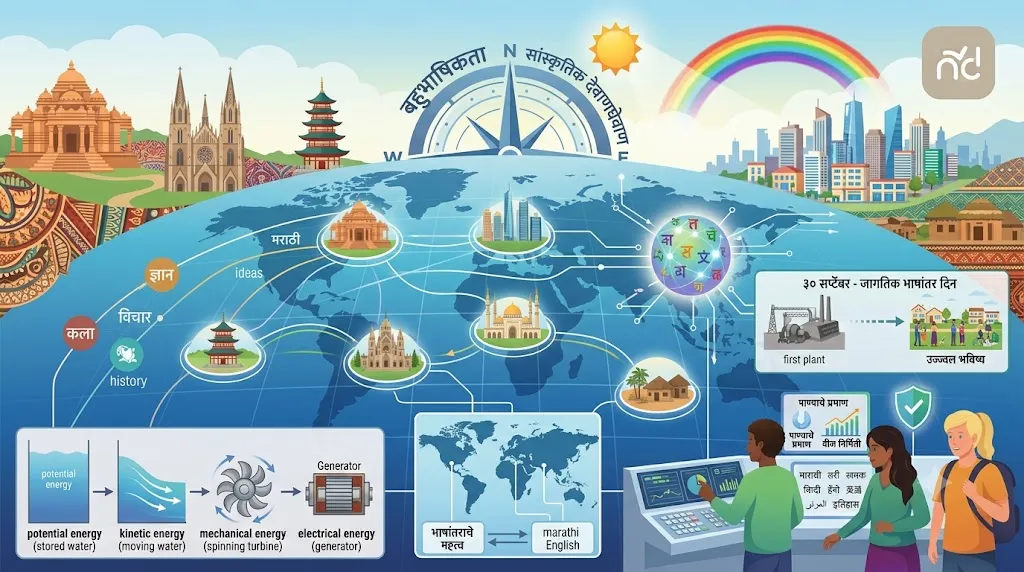
Today, September 30th, marks International Translation Day! This day is chosen to honor St. Jerome, the patron saint of translators, reminding us that despite a world full of diverse languages, we can communicate, understand each other's cultures, and exchange knowledge. In this era of globalization, where the world has become a global village, the importance of translation and multilingualism is immeasurable. This article will provide you with an in-depth understanding of the power of translation, India's rich linguistic diversity, and the profound benefits of learning multiple languages.
Translation: A Bridge Between Cultures
Imagine reading a story from a distant land, originally written in a language you don't speak. This is made possible only through translation! Translation acts as a vital bridge connecting two different cultures. It doesn't just convey the meaning of words; it also communicates the emotions, history, and cultural nuances embedded within them.
The Global Journey of Literature and Art
Great literary works, poems, and plays from around the world have reached us thanks to translation. For instance, Shakespeare's plays are performed in Japan, Russian novels are read in India, and Indian epics like the Ramayana or Mahabharata are studied globally. All of this is possible due to the tireless efforts of translators. Translation allows us to understand the thinking, lifestyles, and values of people from different cultures, fostering respect and empathy within us.
Did You Know? The United Nations (UN) has six official languages: Arabic, Chinese, English, French, Russian, and Spanish. Documents are translated into all these languages, and interpreters facilitate communication during meetings, making global dialogue possible.
Preserving History and Traditions
Translating ancient manuscripts, historical documents, and religious texts allows us to understand the knowledge and traditions of our ancestors. Translation keeps history alive and ensures it reaches future generations. In India, many ancient Sanskrit texts have been translated into various regional languages and then into English and other global languages, enabling their study worldwide.
Knowledge Exchange and Progress
In fields like science, technology, medicine, and education, the role of translation is paramount. New discoveries, theories, and information are translated from one language to another, allowing researchers and students worldwide to benefit from them.
Advancing Scientific and Technological Frontiers
A scientific discovery or new technology developed in one country would remain confined if not translated and shared with others. For example, advancements in robotics from Japan, engineering breakthroughs from Germany, or new medical treatments from the USA reach the world through translation. This enables global collaboration to solve problems and accelerates human progress.
The Role in Education
For students, translation opens a vast door to knowledge. The best international textbooks, research papers, and educational materials become accessible through translation, enriching their learning experience. Especially in higher education, many international research papers and reference books are available only in English or other specific languages. Their translation helps students grasp new concepts and expand their academic horizons.
India's Linguistic Diversity: A Source of Strength
India is one of the most linguistically diverse countries in the world. Our Constitution recognizes 22 official languages, but in reality, thousands of dialects and sub-dialects are spoken across the nation. This rich diversity is a great strength for our country.
Many Languages, Many Perspectives
Each state in India boasts its own rich language, literature, and cultural traditions. Through languages like Marathi, Hindi, Bengali, Tamil, Telugu, Kannada, Malayalam, Gujarati, and Punjabi, we gain access to diverse stories, poems, folk songs, and traditional knowledge. This linguistic variety introduces us to different ways of thinking and living, broadening our perspectives significantly.
A Medium of Communication and Unity
Despite having many languages, Indians communicate with each other and live in harmony. Many people are multilingual, making it easier for them to connect with different communities. This linguistic flexibility plays a crucial role in India's unity. Even though we speak many languages, our identity as 'Indians' remains singular.
The Benefits of Multilingualism: Opportunities for Students
Learning more than one or two languages offers numerous advantages to students. It not only enhances their intellectual capacity but also provides them with opportunities to succeed on a global scale.
Cognitive Development and Problem-Solving Skills
Research shows that students who learn multiple languages often have better memory, concentration, and problem-solving abilities. They find it easier to focus on multiple tasks simultaneously. Understanding concepts from one language in another requires the brain to work harder, which in turn sharpens it.
Broader Perspectives and Empathy
Learning different languages provides us with more information about various cultures and people. This broadens our perspective and allows us to better understand the feelings, thoughts, and problems of others. It cultivates empathy and tolerance within us, which are crucial virtues in today's world.
Career Opportunities
In today's globalized world, multilingual individuals are in high demand. International companies, embassies, the tourism industry, education, and translation services offer numerous career opportunities for those proficient in multiple languages. You can build a successful career not only in India but also abroad.
Learning Languages: A Life Skill
Learning a language is a lifelong skill that benefits you not just during your school years but throughout your entire life. It's an investment that consistently yields excellent returns.
Some Tips for Students:
- Start Early: There's no specific age to learn a language, but starting young can be particularly beneficial.
- Practice is Key: Dedicate a little time each day to read, listen to, and speak the new language. Try conversing with friends or teachers in that language.
- Use Engaging Methods: Watch movies, listen to songs, read books, or play games in the new language. This will make the learning process more enjoyable.
- Don't Be Afraid to Make Mistakes: Making mistakes is a natural part of language learning. We learn from our errors. Speak confidently and keep improving.
- Understand the Culture: Don't just learn the language; also delve into its culture. This will enable you to use the language more effectively and appropriately.
Did You Know?
- There are over 7,000 languages spoken worldwide, many of which are endangered.
- While Hindi is the most widely spoken language in India, English also serves as a prominent language extensively used in education and business.
- International Translation Day is celebrated annually on September 30th, commemorating the death of St. Jerome, who translated the Bible into Latin and is considered the patron saint of translators.
- The word 'translation' comes from the Latin word 'translatio,' meaning 'to carry across' or 'to bring over.'
- The Killari (Latur) earthquake, a devastating event that caused significant loss of life, occurred on September 30, 1993, marking a tragic day in Maharashtra's history.
Conclusion
Translation and multilingualism are not just important in today's global world; they are essential. Through translation, we exchange knowledge, connect cultures, and contribute to human progress. Multilingualism offers new opportunities, fosters intellectual development, and helps us become more empathetic global citizens.
Students, while honoring your mother tongue, do not miss the opportunity to learn other languages. Every new language offers you a fresh perspective on the world. So, let's immerse ourselves in the wonderful world of languages and strive to become multilingual, more understanding, and truly global citizens!