Hello, young learners!
Imagine a world where the very element essential for life – water – also powers our homes, schools, and cities. That’s the magic of hydroelectricity! Today, September 30th, holds a special significance in the history of this remarkable energy source, as it marks the day the world's first hydroelectric power plant began operation in 1882. This makes it the perfect time to delve into the incredible power of water.
From the lights in our rooms to the devices we use for learning and entertainment, electricity is an indispensable part of our modern lives. But have you ever wondered where this electricity comes from? One of its most powerful and sustainable sources is hydroelectric power, where the force of flowing water is transformed into the electricity that lights up our world.
Understanding Hydroelectricity: The Basics
Hydroelectricity, simply put, is the generation of electricity from the movement of water. It's a clean, renewable energy source that leverages the natural water cycle. When water flows from a higher elevation to a lower one, it possesses energy. Hydroelectric power plants capture this energy and convert it into electricity.
"Hydroelectricity is a testament to human ingenuity, transforming nature's simplest force into the power that drives progress."
The Science Behind the Flow: How Hydro Power Works
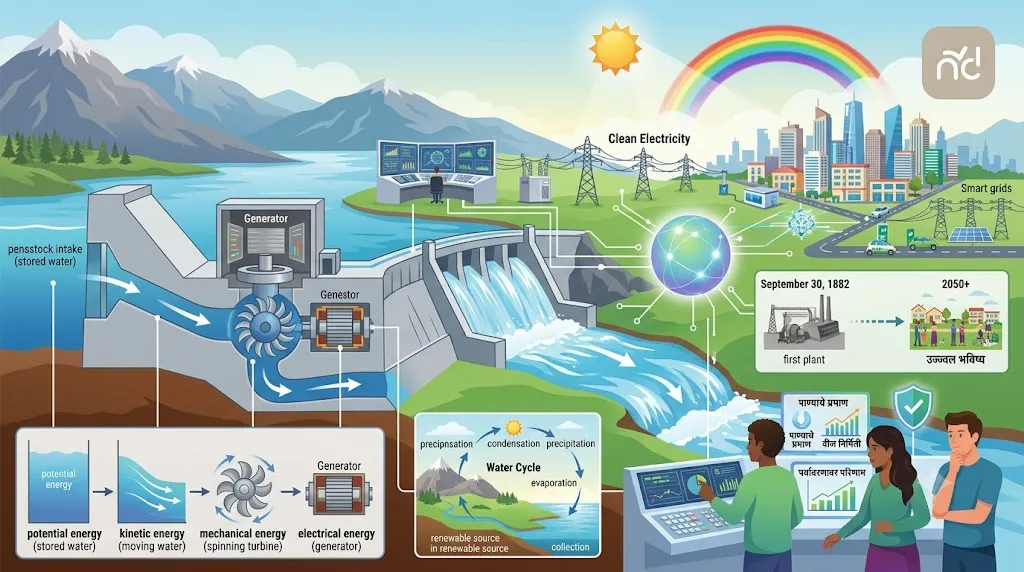
The process of generating electricity from water is a brilliant application of physics, primarily involving the conversion of potential energy into kinetic energy, and then into electrical energy. Let's break it down step-by-step:
- Dam Construction: The first step in a hydroelectric project is building a dam across a river. This dam creates a large reservoir of water at a higher elevation. The water stored in this reservoir holds a significant amount of potential energy due to its height.
- Controlled Water Flow: Gates in the dam are opened, allowing water to flow through large pipes called penstocks. Gravity pulls the water downwards, causing it to rush through these penstocks at high speed. As the water moves, its potential energy is converted into kinetic energy.
- Turbine Rotation: The fast-flowing water strikes the blades of a turbine, which is essentially a large wheel with specially designed blades. The force of the water causes the turbine to spin rapidly.
- Generator Operation: The spinning turbine is connected to an electrical generator. As the turbine rotates, it drives the generator, which uses electromagnetic induction (Faraday's Law) to convert the mechanical energy of the spinning turbine into electrical energy.
- Electricity Transmission: The electricity generated by the generator is then stepped up in voltage by transformers and sent through power lines to homes, businesses, and industries.
After passing through the turbines, the water is released back into the river downstream, continuing its natural course. This ensures that the water resource is not consumed but rather utilized and recycled.
A Glimpse into History: The First Spark
The idea of harnessing water power is ancient, with watermills being used for grinding grain for centuries. However, the application of water power to generate electricity is a relatively modern innovation, emerging in the late 19th century.
September 30, 1882, marks a pivotal moment in energy history. On this day, the world's first commercial hydroelectric power plant, the Vulcan Street Plant, began operation on the Fox River in Appleton, Wisconsin, USA. Powered by an Edison DC dynamo, this small plant initially supplied electricity to two paper mills and a single home. Though modest in scale, it demonstrated the immense potential of water to generate clean electricity, paving the way for larger and more sophisticated hydroelectric projects around the globe that would eventually power entire cities and industrial complexes.
India's Hydroelectric Journey: Powering a Nation
India, with its vast network of rivers, particularly in the Himalayan region and the Western Ghats, possesses significant hydroelectric potential. Post-independence, India recognized the strategic importance of hydropower for energy security and economic development. Major projects like Bhakra-Nangal, Damodar Valley Corporation, Sardar Sarovar, Tehri, and Koyna have become symbols of national progress and self-reliance.
- Bhakra-Nangal Dam: Built on the Sutlej River, this multi-purpose project is not only a major power generator but also crucial for irrigation in northern India.
- Koyna Hydroelectric Project: Located in Maharashtra, it is one of the largest hydroelectric projects in India, often referred to as the 'Lifeline of Maharashtra' due to its significant contribution to the state's power supply.
- Tehri Dam: Situated on the Bhagirathi River in Uttarakhand, it is India's tallest dam and a massive source of hydroelectric power.
Today, hydroelectric power continues to be a crucial component of India's energy mix, contributing significantly to the country's total electricity generation capacity. It's not just a source of clean, renewable energy; it also plays a vital role in maintaining grid stability. Hydroelectric plants can quickly increase or decrease power output, making them ideal for balancing the intermittent nature of other renewables like solar and wind power.
The Green Promise and the Grey Areas: Environmental Impact
Like any large-scale infrastructure project, hydroelectric power comes with its own set of environmental benefits and challenges.
Environmental Benefits:
- Clean Energy: Hydroelectric power generation does not produce greenhouse gases or air pollutants, unlike fossil fuel power plants. This helps combat climate change and improves air quality.
- Renewable Resource: The water cycle ensures a continuous supply of water, making hydropower a truly renewable and sustainable energy source.
- Low Operating Costs: Once a hydroelectric plant is built, the cost of generating electricity is relatively low as there is no fuel cost.
- Water Management: Dams not only generate electricity but also provide benefits like flood control, irrigation for agriculture, and a stable supply of drinking water.
Environmental Challenges:
- Habitat Destruction: Damming rivers alters natural river flows and habitats, affecting aquatic ecosystems and fish migration. Large reservoirs can inundate forests, farmlands, and wetlands, leading to loss of biodiversity.
- Displacement of Local Communities: The construction of large dams often requires the displacement of local communities, particularly indigenous populations, impacting their livelihoods, culture, and social fabric.
- Siltation: Rivers carry sediment (silt) which can accumulate in reservoirs, reducing their storage capacity and the operational life of the dam.
- Seismic Activity: Some scientists suggest that the immense weight of water in large reservoirs can, in certain geologically sensitive areas, induce seismic activity, increasing the risk of earthquakes.
Hydro Power in a Sustainable Tomorrow
In an era grappling with climate change and the urgent need for decarbonization, hydroelectric power is increasingly recognized as a cornerstone of a sustainable energy future. It not only provides clean energy but also contributes to energy security and economic stability.
Modern hydropower technologies include 'pumped-storage hydropower,' which acts like a giant battery. During periods of low electricity demand (e.g., at night), excess power from other sources (like solar or wind) is used to pump water from a lower reservoir to an upper one. When electricity demand is high, the water is released back down through turbines to generate power. This provides crucial grid flexibility and energy storage, complementing the variable output of other renewable sources.
The Indian government is actively promoting hydropower projects, especially in the North-Eastern states, where a significant portion of the hydroelectric potential remains untapped. In the future, hydropower will work in conjunction with other renewable energy sources (solar, wind) to provide a robust, clean, and sustainable energy supply for the world.
Conclusion
Hydroelectric power stands as one of humanity's greatest achievements in harnessing the forces of nature for progress. From its humble beginnings on September 30, 1882, it has grown to illuminate countless lives and power industries across the globe. For a developing nation like India, it remains a pillar of energy security and economic growth.
While the environmental benefits are substantial, it's crucial to address the challenges associated with its development. Through careful planning, advanced technology, and a commitment to ecological balance, we can maximize the benefits of hydroelectricity. It teaches us the immense value of every drop of water and its potential to brighten our future. Let us respect this clean energy source and strive to build a sustainable tomorrow for our planet.
Did You Know?
- The Three Gorges Dam in China, built on the Yangtze River, is the world's largest hydroelectric power plant.
- India's first major hydroelectric power station was commissioned in 1897 at Sidrapong, near Darjeeling.
- Hydroelectric power is one of the largest and oldest sources of renewable energy in the world.
- The water used to generate power in a hydroelectric plant is not consumed; it is simply passed through the turbines and continues its journey downstream.
- Globally, hydropower accounts for approximately 16% of the world's electricity generation.