Dear students, imagine your home. It has clear boundaries – walls, a fence, a door. These boundaries ensure your safety, privacy, and the identity of your family. Similarly, every country has its own borders, which are crucial for its existence, security, and identity. These borders are not just geographical lines; they also represent a nation's sovereignty. Today, we will explore 'The Importance of National Borders and Sovereignty' in detail.
India is one of the world's largest democracies, rich in diverse cultures, languages, and traditions. To maintain our nation's prosperity and security, it is essential to understand and respect our borders and sovereignty. Let's delve into the meaning and significance of these two vital concepts.
What Are National Borders and Why Do They Matter?
Borders are geographical, political, or natural lines that separate two or more countries. These lines can be on land, at sea, or even in the air. Our nation's borders tell us, 'This is Indian territory,' and 'That is another country's territory.' Borders define the extent of each nation, and within these boundaries, the laws of that nation apply.
Types of Borders:
- Natural Borders: Some borders are formed by natural features such as rivers, mountains (e.g., the Himalayas), deserts, or seas. These borders are often stable and clearly defined.
- Artificial or Political Borders: Other borders are man-made, determined by maps or treaties. These lines can be straight and often do not follow human settlements or cultural divisions.
Importance of Borders:
- Geographical Identity: Borders give each country a defined geographical identity. India's borders help us understand its size and its neighbors.
- Security: Borders act as the first line of defense against external aggression. Our armed forces are deployed day and night to protect our borders.
- Rule of Law: Within its borders, each country applies its own laws and regulations. This helps maintain order within the nation.
- Preservation of Culture and Traditions: Borders help a unique culture, language, and traditions to develop and be preserved within a specific territory.
- Control over Resources: The natural resources (e.g., water, minerals, forests) within a country's borders are under its control.
India's borders are vast and diverse. From the towering Himalayan ranges in the north to the vast Indian Ocean in the south, and from the dense forests in the east to the deserts in the west, our nation's borders traverse various terrains. Protecting these borders is paramount for our national security.
Sovereignty: The Supreme Authority of a Nation
Sovereignty refers to the supreme authority of any nation to make its own decisions and to control its internal and external policies. Simply put, sovereignty means that a country can govern itself according to its own will, without being subjected to pressure from any other nation.
Two Main Aspects of Sovereignty:
- Internal Sovereignty: This means that within a country's borders, the government has the supreme authority to make and enforce laws and to govern its citizens. No group or individual is superior to the government. For example, the Indian Parliament makes laws that apply throughout India.
- External Sovereignty: This means that a country is independent at the international level and has the right to determine its foreign policy without interference from any foreign power. India decides for itself which countries to befriend or trade with.
Importance of Sovereignty:
- Independent Existence: Sovereignty gives any country a position as an independent and equal partner on the international stage. This allows the country to make decisions in its own best interest.
- National Security: With sovereignty, a country can take necessary steps to protect its borders and ensure the security of its citizens.
- Protection of Democracy: In democratic countries, sovereignty represents the will and vote of the people. The public elects its representatives, who then use sovereign powers to govern the country.
- Economic Development: Sovereignty grants a nation the right to use its natural resources for its own development, enabling economic progress without foreign intervention.
Sovereignty is not just power; it is a symbol of a nation's self-respect and freedom. A country without sovereignty is not truly independent.
How does sovereignty work on a global scale?
International organizations like the United Nations bring together all sovereign nations of the world. In these organizations, each country has an equal voting right, which is a crucial part of their sovereignty. This allows even small countries to voice their opinions alongside larger nations and influence global policies, promoting a sense of equality and mutual respect.
Safeguarding National Identity and Cultural Heritage
Our nation's borders and sovereignty are not merely political or geographical concepts; they are also the guardians of our national identity and rich cultural heritage. India is a country adorned with numerous languages, religions, festivals, and art forms. Our borders unite this cultural diversity under one umbrella, creating a distinct 'Indian' identity.
How is National Identity Preserved?
- Language and Literature: Many languages are spoken in our country, but Hindi and other regional languages are given importance at the national level. Sovereignty allows us to preserve and develop our languages.
- Arts and Traditions: From Bharatanatyam to Garba, our country boasts diverse dance forms, music, and arts. These traditions can be safely nurtured and grown within our borders.
- Historical Sites and Heritage: Numerous historical sites like the Taj Mahal, Ajanta-Ellora Caves, and Red Fort are symbols of our nation's history and culture. Sovereignty gives us the responsibility to protect this heritage and preserve it for future generations.
- National Symbols: Symbols like the national flag, national anthem, and national emblem are integral to our national identity. Sovereignty ensures respect for these symbols and fosters patriotism through them.
When a country is sovereign, it can prevent external influences on its culture and develop its education, art, and social life according to its own traditions. This instills pride in every Indian and inspires them to preserve their culture.
Borders: Guardians of Security and Peace
For any country, the security of its borders is the highest priority. Borders not only define a nation's territory but also protect it from external threats and aggressions. For a large and diverse country like India, border security is a continuous and massive responsibility.
Key Components of Security:
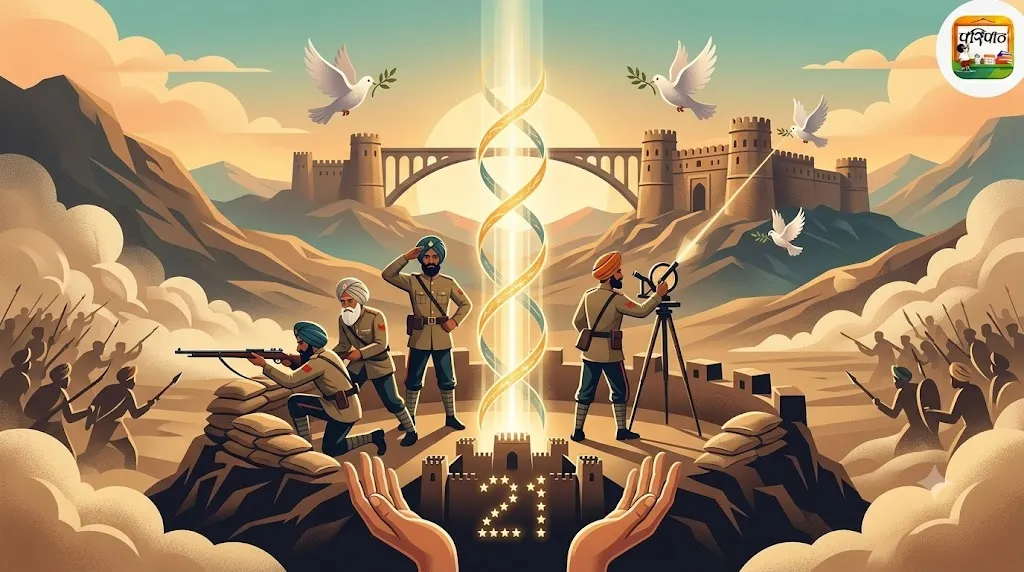
- Armed Forces: The Indian Armed Forces (Army, Navy, Air Force) are the primary shield protecting our borders and sovereignty. Our soldiers work tirelessly for the nation's defense even in challenging conditions (e.g., extreme cold in the Himalayas or heat in the desert). It is because of them that we can live safely.
- Border Security Force (BSF): This force patrols land borders and prevents illegal activities such as infiltration and smuggling.
- Coast Guard: The responsibility of protecting our vast maritime borders falls on the Coast Guard, which safeguards the nation from threats originating from the sea.
- Intelligence Agencies: Intelligence agencies like RAW and IB gather information about threats from within and outside the country and alert the government.
Only when borders are secure can peace and stability prevail in the country. Peace enables economic and social development. If borders are insecure, unrest arises, which slows down the pace of development and negatively impacts the lives of citizens. Therefore, the sacrifices and work of our soldiers are highly revered.
Our Role as Citizens: Protecting Our Nation's Foundations
It's not just the military or the government; as citizens, we all have a responsibility to protect our nation's borders and sovereignty. We are the future of our country, and our actions have a significant impact on its development and security.
Our Responsibilities:
- Patriotism and National Integration: It is important to love our country, respect national symbols, and foster the feeling of 'we are all one.' Unity in diversity is India's specialty.
- Educated and Aware Citizens: It is essential to be knowledgeable about the country's history, geography, constitution, and international relations. Only aware citizens can make appropriate decisions and contribute to the nation's progress.
- Adherence to Law: Obeying the country's laws and helping maintain peace and order is the duty of every citizen.
- Contribution to National Development: Excelling in education, science, art, or any other field to bring glory to the nation. Actively participating in national initiatives like Swachh Bharat Abhiyan or water conservation.
- Social Harmony: Promoting harmony and brotherhood in society, without encouraging caste or religious discrimination.
While we may not be able to fight on the borders, we can work for the development and integration of our country. If we, as citizens, fulfill our responsibilities honestly, our nation will become stronger, more secure, and more prosperous.
Did You Know?
- India has a total land border of 15,106.7 kilometers, shared with 7 countries: Bangladesh, China, Pakistan, Nepal, Myanmar, Bhutan, and Afghanistan (through Pakistan-occupied Kashmir).
- The length of India's coastline is 7,516.6 kilometers, including its islands.
- The smallest sovereign state in the world is Vatican City, located within Rome, Italy. Its area is only 0.44 square kilometers.
- The United Nations (UN) has 193 member states, each of which is sovereign and has an equal vote.
- SAARC (South Asian Association for Regional Cooperation) is a regional intergovernmental organization of South Asian nations, with India as a key member. It respects the sovereignty of its member states and promotes regional cooperation.
Conclusion
Our nation's borders and sovereignty are not merely geographical lines or political concepts; they are symbols of our nation's soul and existence. They give us our identity, keep us secure, and preserve our rich culture. Understanding the importance of both and protecting them is the duty of every Indian.
As students, by becoming aware and responsible citizens, we can contribute to our nation's development and integration. Respecting our soldiers, obeying laws, and striving tirelessly for the country's progress are the true ways to protect our nation's borders and sovereignty. Let us resolve to cherish and honor this invaluable asset of our great nation!