Introduction: A New Moon Rises
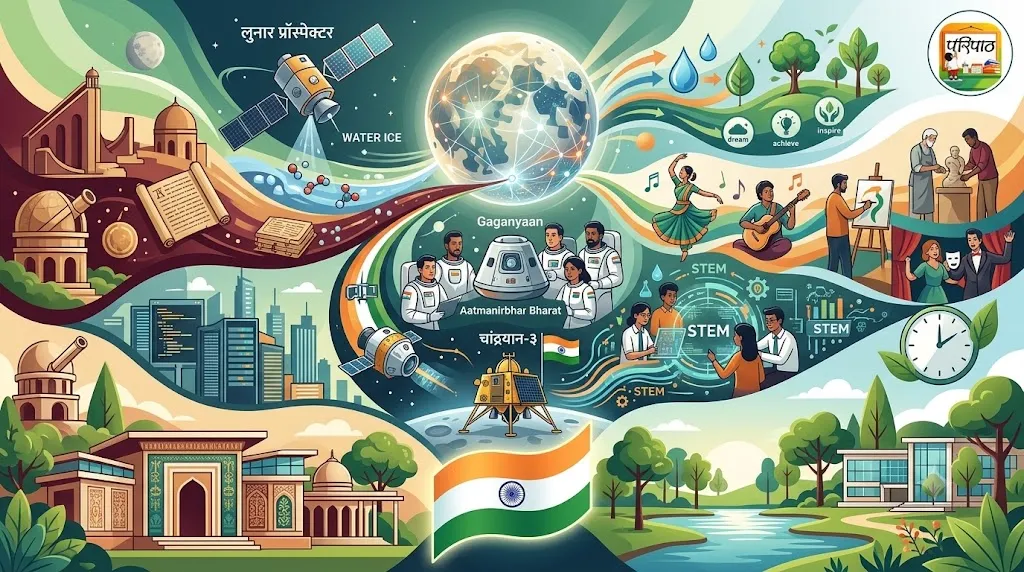
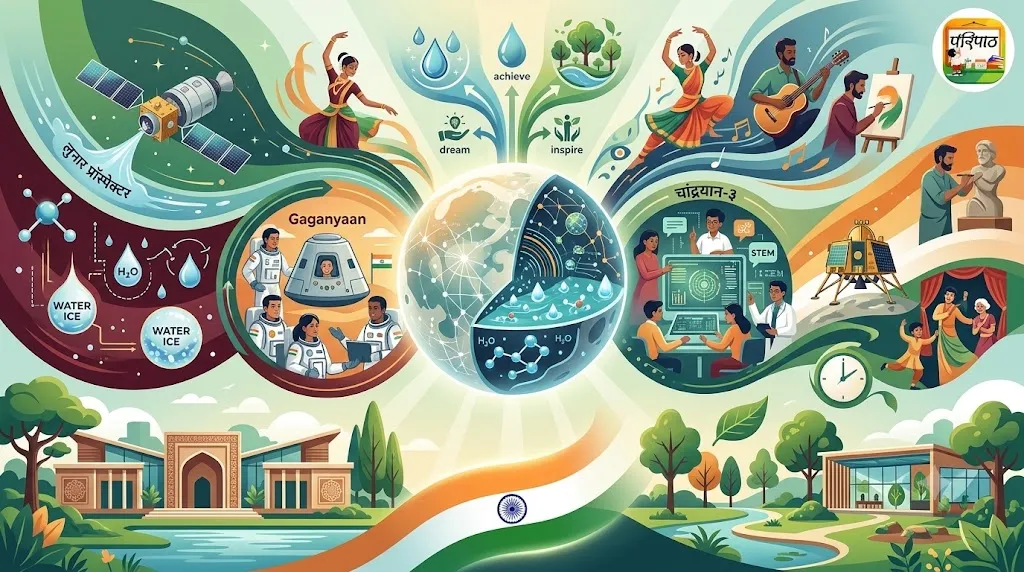
For millennia, the Moon has been a constant companion in our night sky, inspiring poets, scientists, and dreamers alike. We've long viewed it as a desolate, arid, and lifeless rock. However, the relentless pursuit of scientific knowledge and advancements in space exploration have dramatically reshaped our understanding of our celestial neighbor. A pivotal moment occurred in 1999 when NASA's 'Lunar Prospector' spacecraft detected compelling evidence of water ice at the Moon's polar regions. This discovery was nothing short of revolutionary, altering our perception of the Moon and unlocking unprecedented possibilities for future human settlements and deep-space exploration.
In this blog post, we will embark on a journey through the history of lunar water discovery, explore how this finding transformed our understanding of the Moon, delve into its implications for future missions and human colonization, and highlight the significant contributions of India's 'Chandrayaan' missions in this ongoing quest. Prepare to have your mind opened to a Moon far more dynamic and resource-rich than previously imagined.
The Quest for Lunar Water: A Historical Turning Point
The idea of water on the Moon has been a subject of scientific speculation for decades. Early Apollo missions in the 1960s and 70s brought back lunar soil samples that showed no signs of water, reinforcing the belief that the Moon was bone-dry. Yet, a persistent minority of scientists theorized that water, delivered by comets and asteroids over billions of years, could be trapped as ice in the permanently shadowed regions (PSRs) of the Moon's poles, where sunlight never reaches and temperatures plummet to extreme lows.
Early Whispers: The Clementine Mission
The first tantalizing hint came in 1994 from the 'Clementine' mission, a joint project between NASA and the U.S. Department of Defense. While orbiting the Moon, Clementine collected radar data that, when analyzed, suggested the presence of water ice at the lunar south pole. Although not definitive, these initial findings sparked renewed interest and provided the impetus for more focused missions to confirm the existence of lunar water.
Lunar Prospector: The Game-Changer of 1999
Building on Clementine's intriguing data, NASA launched the 'Lunar Prospector' spacecraft in 1998. The primary objective of this mission was to map the Moon's surface composition and gravitational field. Crucially, it carried a 'Neutron Spectrometer,' an instrument designed to detect hydrogen atoms beneath the lunar surface. Since hydrogen is a key component of water, its presence would be a strong indicator of water ice.
In 1999, after meticulous analysis of the data transmitted by Lunar Prospector, scientists announced their groundbreaking discovery: significant quantities of water ice were indeed present at both lunar poles, particularly within the permanently shadowed craters. The Neutron Spectrometer detected an unmistakable increase in hydrogen concentrations in these regions, consistent with the presence of ice mixed into the lunar regolith (soil). This confirmation revolutionized our understanding of the Moon, proving it wasn't as barren as once thought, and opening a new chapter in space exploration.
Beyond Ice: The Many Forms of Lunar Water
While Lunar Prospector confirmed the presence of water ice, the story of lunar water is far more nuanced. Subsequent missions have provided deeper insights into the various forms and distribution of water on the Moon.
Diverse Forms and Distribution:
- Water Ice: This is the most significant form, found predominantly in the permanently shadowed regions (PSRs) of the lunar poles. This ice can be buried a few centimeters to several meters beneath the surface and is considered the most valuable resource for future human endeavors.
- Hydroxyl (OH): A component of water, hydroxyl is chemically bound within lunar minerals. While not directly usable as water, its presence suggests ongoing water-forming processes on the Moon's surface.
- Water Molecules (H2O): Research from later missions indicated that trace amounts of molecular water (H2O) are also scattered across the Moon's sunlit surface. These molecules might be formed by solar wind interactions with lunar soil or delivered by micrometeoroids.
Understanding these different forms and their distribution is crucial for developing strategies to extract and utilize lunar water efficiently.
India's Chandrayaan Missions: Deepening the Mystery
India's space agency, ISRO (Indian Space Research Organisation), has played a pivotal role in the global effort to understand lunar water through its 'Chandrayaan' missions.
Chandrayaan-1 and the M3 Instrument (2008)
In 2008, India launched its first lunar probe, 'Chandrayaan-1.' This mission carried several international payloads, including NASA's 'Moon Mineralogy Mapper' (M3) instrument. M3 was designed to analyze reflected sunlight from the lunar surface. In 2009, based on M3's data, scientists formally announced the definitive detection of hydroxyl and water molecules on the Moon's surface, particularly at the poles. While Lunar Prospector had inferred hydrogen, Chandrayaan-1 provided direct spectral evidence of water (H2O) and hydroxyl (OH) molecules, providing concrete scientific confirmation to the earlier hints and discoveries. This was a monumental contribution to global space science.
Chandrayaan-2 and Advanced Exploration (2019)
India's 'Chandrayaan-2' mission, launched in 2019, aimed for a more ambitious goal: to land a rover and lander near the Moon's south pole to conduct in-depth studies of lunar water. Although the 'Vikram' lander unfortunately failed to achieve a soft landing, the mission's 'Orbiter' continues to circle the Moon, gathering invaluable data. Instruments on the Chandrayaan-2 orbiter, such as the 'Imaging Infrared Spectrometer' (IIRS) and 'Synthetic Aperture Radar' (SAR), have provided even clearer evidence of sub-surface water ice in the permanently shadowed regions of the south pole. This data has further refined our understanding of water distribution and depth, which is vital for future extraction efforts.
Chandrayaan-3 and Future Prospects (2023)
In 2023, India achieved a historic success with the 'Chandrayaan-3' mission, successfully landing the 'Vikram' lander and deploying the 'Pragyan' rover near the Moon's south pole. While Chandrayaan-3's primary objective was to demonstrate safe landing capabilities, its scientific instruments collected crucial data about the lunar surface and exosphere. The success of Chandrayaan-3 has significantly boosted India's confidence in lunar exploration, particularly in the context of studying and potentially utilizing lunar resources (In-Situ Resource Utilization - ISRU). The dream of extracting and using lunar water is no longer a distant fantasy but a tangible goal on the horizon.
The Future is Water: Lunar Settlements and Beyond
The discovery of water on the Moon is not merely a scientific triumph; it's a game-changer for the future of space exploration. This water can be utilized in numerous ways, making human settlements on the Moon feasible and opening pathways to distant planets like Mars.
Multifaceted Uses of Lunar Water:
- Drinking Water and Life Support: Water is the most fundamental requirement for any human settlement. It can be used for drinking, preparing food, and maintaining hygiene for astronauts.
- Oxygen Generation: Water can be split into its constituent elements, hydrogen and oxygen. Oxygen (O2) is vital for astronauts to breathe and also serves as an oxidizer for rocket fuel.
- Rocket Fuel: By splitting water, we can produce liquid hydrogen (H2) and liquid oxygen (O2), which are powerful components of rocket propellants. Producing fuel on the Moon would drastically reduce the cost and complexity of launching missions from Earth. The Moon could become a 'gas station' in space, allowing missions to Mars or beyond to refuel there.
- Agriculture and Food Production: Lunar settlements would require small-scale agriculture to grow food, and water would be essential for supporting plant life.
Artemis Missions and the Lunar Future
NASA's 'Artemis' program aims to return humans to the Moon by the mid-2020s and establish a long-term human presence there. These missions are specifically targeting the Moon's south pole, precisely because of the potential abundance of water ice. Artemis missions will test technologies for extracting, processing, and utilizing lunar water, laying the groundwork for future Mars missions. The vision is to build a sustainable lunar base where humans can live and work, leveraging local resources to extend humanity's reach further into the cosmos.
“The discovery of water on the Moon is not just a scientific victory; it's a revolution in the history of human space exploration. It has forced us to look at not just the Moon, but the entire solar system, with fresh eyes.”
— Dr. Anya Sharma, Planetary Scientist
Conclusion
The discovery of water on the Moon, initially by Lunar Prospector in 1999 and subsequently confirmed and elaborated upon by India's Chandrayaan-1 and Chandrayaan-2 missions, represents a monumental scientific achievement. This finding has irrevocably changed our traditional understanding of the Moon, transforming it from a barren rock into a potential 'gas station' and 'life support' hub for future human settlements and deep-space exploration.
Lunar water can be harnessed for drinking, oxygen generation, and even rocket fuel, making missions to distant planets like Mars significantly more feasible and sustainable. India's contributions to this field have been globally recognized, and the success of Chandrayaan-3 has further solidified its position as a leading spacefaring nation, opening new avenues for future lunar endeavors.
This discovery serves as a powerful reminder of how much we still have to learn about our universe and the countless mysteries awaiting unraveling through scientific inquiry. The quest for lunar water is a testament to human curiosity and perseverance, inspiring us to dream bigger and journey further into the vast expanse of space.
Did You Know?
- The water on the Moon is primarily found as ice in permanently shadowed regions (PSRs) at the poles, where temperatures are so low that ice can persist for billions of years without sublimating.
- Lunar water exists not only as ice but also as chemically bound 'hydroxyl' (OH) within minerals and as trace amounts of molecular water (H2O) scattered across the surface.
- India's Chandrayaan-1 mission, using NASA's Moon Mineralogy Mapper (M3) instrument, provided the first definitive spectral evidence of water molecules (H2O) and hydroxyl (OH) on the lunar surface in 2009.
- One ton of lunar water ice could potentially yield around 700 liters of potable water, 800 kilograms of oxygen, and 100 kilograms of hydrogen fuel.
- The ability to extract and utilize water ice on the Moon is considered critical for future human missions to Mars, as it would drastically reduce the amount of fuel and water that needs to be launched from Earth.