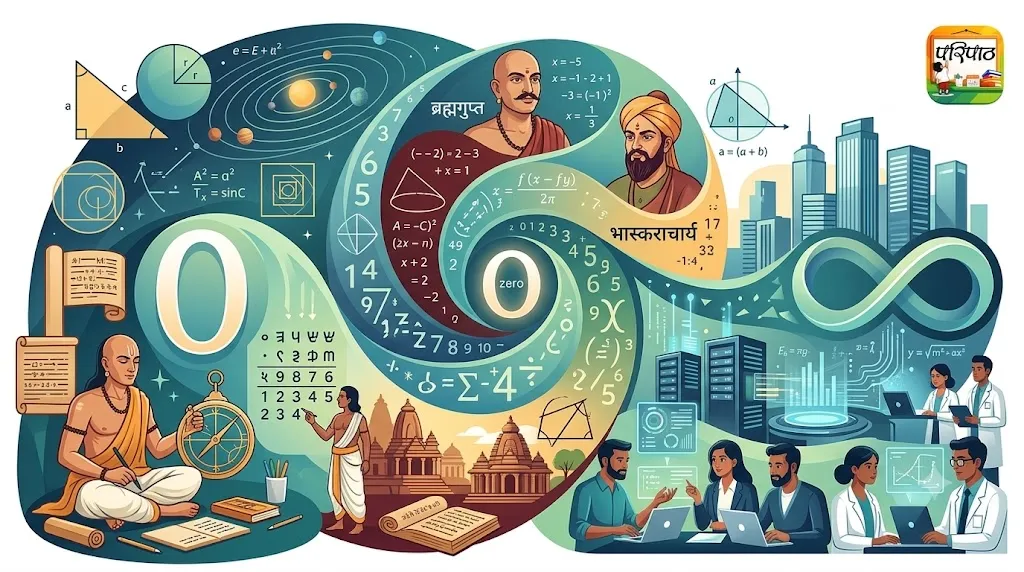
Hello students and welcome to this special blog from 'Paripath'! Today, we're diving into the story of a concept that is an integral part of our daily lives, yet its profound significance often goes unnoticed. We're talking about 'Zero'. Zero, often understood as nothing, emptiness, or absence, has paradoxically become one of the most powerful and revolutionary ideas in the history of mathematics. And it's a revolution that originated in India, a fact we can all take immense pride in.
As we observe October 14, 2026, a day marked by Vinayak Chaturthi and the fourth day of Navratri (Kushmanda Puja), we reflect on India's monumental contributions. In a broader context that includes the death anniversaries of Mohan Dharia and Dattopant Thengadi, the commencement of the NDA government, Amartya Sen's Nobel Prize announcement, and the Sangeet Natak Akademi Fellowship declarations, the story of India's mathematical revolution through zero stands out as particularly inspiring.
The Ancient Indian Roots of Zero: The Rise of an Invisible Hero
The concept of zero wasn't born overnight; it evolved through centuries of intellectual inquiry and refinement. While various ancient civilizations had ways to denote 'nothingness' or 'absence,' it was ancient India that first gave zero a numerical value and integrated it into a positional value system, fundamentally altering how we perceive and manipulate numbers.
Early Evidence and Key Figures
- The Bakhshali Manuscript: Dating back to the 3rd or 4th century CE, this ancient Indian mathematical text features a dot used as a placeholder for zero. It is one of the earliest known instances of a symbol representing zero in a numerical context.
- Pingala's Chhandashastra: Pingala, an ancient Indian prosodist who lived between the 5th and 2nd centuries BCE, is believed to have implicitly used a binary numeral system in his work on Sanskrit prosody, which laid foundational ideas for the concept of zero.
- Aryabhata (c. 476–550 CE): The celebrated Indian mathematician and astronomer, Aryabhata, extensively described the decimal system in his treatise, 'Aryabhatiya.' Although he didn't explicitly use the term 'zero' as a numeral, his sophisticated positional notation system inherently relied on the concept of zero to represent empty places and facilitate calculations with large numbers.
- Brahmagupta (c. 598–668 CE): Brahmagupta is widely credited with being the first to define zero as a number in its own right and to establish the rules for operations involving zero, such as addition, subtraction, multiplication, and division. In his work, 'Brahmasphutasiddhanta,' he referred to zero as 'kha' (space) or 'shunya' (empty), giving it a status equal to positive and negative numbers.
“The product of a positive and a positive is a positive; of a negative and a negative, a positive; of a positive and a negative, a negative; of a positive and zero, zero; of a negative and zero, zero; of zero and zero, zero.” - Brahmagupta, Brahmasphutasiddhanta
Brahmagupta's clear articulation of zero as an operational number, rather than just a placeholder, marked a monumental leap in mathematical thought.
The Significance of Zero: The Foundation of a Positional Value System
Before the advent of zero, many civilizations struggled with cumbersome numeral systems. Roman numerals (e.g., I, V, X, L, C, D, M) are a prime example. In these systems, each symbol had a fixed value, regardless of its position. While they could represent numbers, performing complex arithmetic operations was incredibly difficult and inefficient. There was no inherent need for a 'zero' in such additive systems.
Zero completely transformed this landscape by perfecting the positional value system. In this system, the value of a digit changes depending on its position within a number. For instance:
- 2: Unit's place - value 2
- 20: Ten's place - value 20 (Here, zero indicates that the 'two' is in the tens place, not the units place)
- 200: Hundred's place - value 200 (Here, zero indicates that the 'two' is in the hundreds place)
Zero doesn't just represent an 'empty' space; it critically defines the place and thus the value of other digits. It allows us to write and read any large number with ease and precision. This system vastly simplified fundamental arithmetic operations (addition, subtraction, multiplication, division), paving the way for rapid advancements in mathematics.
Zero's Global Journey and Impact
The concept of zero, born in India, did not remain confined to its land of origin. It embarked on a global journey, influencing mathematics and science across diverse cultures.
From the Arab World to Europe
In the 9th century, the Indian numeral system, including zero, reached the Arab world. Al-Khwarizmi, a brilliant mathematician in Baghdad, studied and popularized the Indian numeral system through his seminal work, 'Kitab al-Jabr wal Muqabala,' from which the term 'Algebra' is derived. Al-Khwarizmi's influential advocacy for the Indian numeral system, complete with zero, led to these numbers being known today as 'Hindu-Arabic numerals.'
From the Arab world, the concept of zero made its way to Europe. Initially, Europeans were hesitant to adopt this new system, finding it challenging to transition from their familiar Roman numerals. However, in the 12th century, the Italian mathematician Leonardo Fibonacci, in his book 'Liber Abaci,' eloquently explained the Hindu-Arabic numeral system and the crucial role of zero. Fibonacci's work gradually led to the widespread adoption of the decimal system, including zero, across Europe, ultimately becoming the universal standard.
A Global Mathematical Revolution
The arrival of zero did not just change how numbers were written; it catalyzed the development of numerous mathematical branches:
- Arithmetic: Complex calculations with large numbers became manageable and efficient.
- Algebra: Zero made it possible to formulate and solve equations. Rules like x + 0 = x and x * 0 = 0 were first laid down by Brahmagupta.
- Calculus: The development of calculus, which deals with infinitesimally small quantities and rates of change, would have been impossible without the concept of zero.
Revolution in Science and Technology: The Infinite Uses of Zero
Zero's influence extended far beyond mathematics, revolutionizing every field of science and technology.
Astronomy and Physics
- Astronomy: Ancient Indian astronomers utilized zero in their calculations of planetary motions and celestial phenomena. Aryabhata and Brahmagupta effectively employed zero in astronomical computations, simplifying the measurement of vast distances and time periods.
- Physics: From Albert Einstein's theories of relativity to quantum mechanics, the concept of zero underpins numerous physical theories. Concepts like 'zero gravity' and 'absolute zero' temperature are testaments to zero's fundamental importance in physics.
Modern Technology and Computing
The digital age we inhabit today is built on the foundation of zero. Computers and all digital devices operate on a 'Binary Code,' which consists of just two digits: 0 and 1. 'Zero' represents 'off' or 'false,' and 'one' represents 'on' or 'true.' It is through the combination of these two digits that all modern software, the internet, and artificial intelligence function.
Without the concept of zero—had it not been developed—the binary code would not exist. Without binary code, there would be no computers, no internet, no smartphones, and indeed, no digital world as we know it. Zero has undeniably fueled one of the greatest technological revolutions in human history.
Zero in Modern Life: An Indispensable Tool
From your bank balance to the data storage on your phone, zero is ubiquitous. Weather forecasting, engineering, pharmaceuticals, economics—the role of zero is indispensable in every sector.
- Financial Transactions: Bank balances, loans, and investment figures would be incomplete without zero.
- Scientific Measurement: Zero is crucial for measuring many physical quantities like temperature, pressure, and velocity.
- Data Analysis: In large datasets, zero is used to represent missing values or to categorize specific groups.
Zero is not just a mathematical symbol; it is a symbol of human intellect and imagination. It possesses the power to create 'everything' from 'nothingness.'
Did You Know?
- In Sanskrit, zero was called 'shunya' (meaning 'empty' or 'void') or 'kha' (sky/space).
- Some historians suggest that the concept of zero in India might have been influenced by the philosophical concept of 'Shunyata' (emptiness) in Buddhism.
- Zero is considered an even number because it is perfectly divisible by 2 (0 ÷ 2 = 0).
- While 1 is the smallest natural number, zero makes it possible to have 'whole numbers,' where it is the smallest.
- The discovery of zero led to the development of the decimal system and consequently decimal fractions, enabling incredibly precise measurements.
Conclusion
The story of zero is not just the story of a digit; it is the story of human progress and India's intellectual prowess. This gift from ancient India fundamentally reshaped mathematics. Thanks to zero, we can perform complex calculations, study the vast universe, and drive new discoveries through modern technology.
The next time you write any number or use your smartphone, remember the revolution ignited by zero – an invaluable boon given to the world by India's great mathematicians. Zero truly created 'everything' from 'nothing.' That is the true marvel of zero!
Thank you!