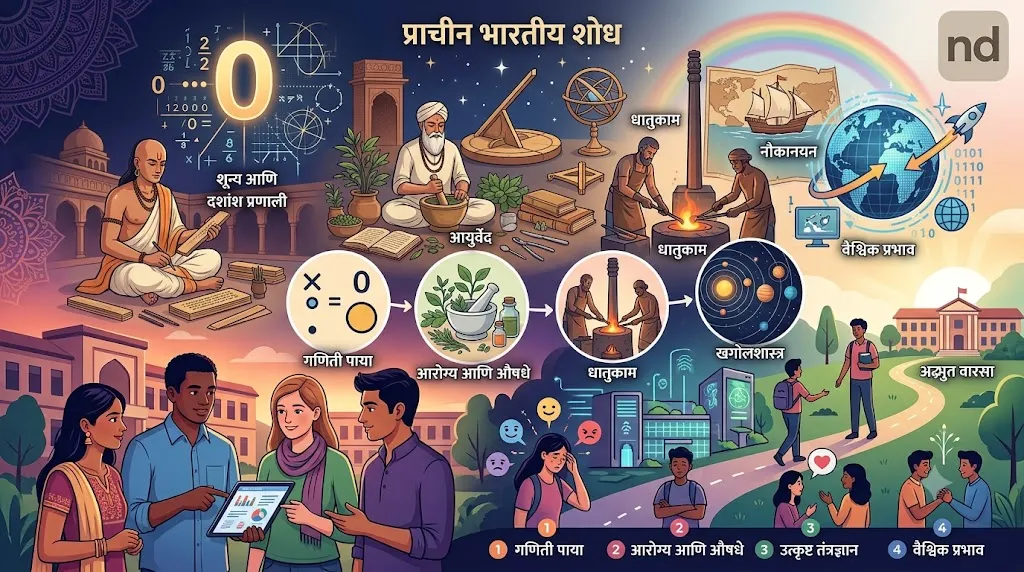
Imagine a world where the concept of 'zero' simply doesn't exist. Many aspects of your life, from your bank balance to the games you play on your computer, would be impossible. The advanced technological age we live in today owes its very foundation to the seemingly simple 'zero.' And to whom do we attribute the discovery of this 'zero'? To our very own India!
Today, October 15, 2026, as we observe World Students' Day, the importance of knowledge and discovery is highlighted. It is fitting, then, to remember one of the most significant and revolutionary discoveries from India's mathematical tradition – the invention of 'zero.' This was not merely a symbol; it was a concept that gave human thought a new direction, forever changing the face of mathematics, science, and technology.
The Genesis of Zero: India's Mathematical Brilliance
The concept of zero did not appear overnight. Its journey spans thousands of years, with various cultures contributing in their own ways. In Babylonian and Mayan cultures, 'zero' was used primarily as a 'placeholder' – to indicate an empty position. However, it did not possess its own numerical value; it wasn't an independent digit. For instance, in the Babylonian system, to write 105, a space would be left between '1' and '5' to signify 'zero,' but that space itself wasn't a number.
However, ancient India went beyond using zero merely as a placeholder. Indian mathematicians developed it into an independent numeral and a fundamental mathematical concept. Several factors contributed to this. The decimal system had been prevalent in India for a very long time. In such a system, the position of each digit is crucial (e.g., 10, 100, 1000). In this context, there was a profound need for a specific symbol and concept to represent 'nothingness.' Zero fulfilled this need perfectly.
Key Milestones in the Origin of Zero:
- Indus Valley Civilization (c. 2500-1900 BCE): Some historians suggest that elements of the decimal system are found in the weights and measures of the Indus Valley Civilization, implying an indirect understanding of zero.
- Pingala (3rd-2nd Century BCE): The Sanskrit grammarian Pingala, in his treatise 'Chandah-shastra,' proposed a system akin to binary code, using 'zero' and 'one.' This is considered an early form of the concept of zero.
- Bakhshali Manuscript (3rd-4th Century CE): This manuscript is the oldest known evidence of zero's use, where a small dot is used for zero. Discovered in modern-day Pakistan, it is a significant historical document for the use of zero.
In India's spiritual and philosophical traditions, the concept of 'Shunya' (void, emptiness) held great significance. Concepts like 'Sunyata' (emptiness) in Buddhism or 'Neti Neti' (not this, not that) in the Upanishads were based on the idea of 'nothingness' or 'non-existence.' These philosophical ideas likely provided a profound context for zero, elevating it beyond just a mathematical symbol to a deeper concept.
Zero's Evolution: From Placeholder to Philosophical Concept
The credit for establishing zero not just as a placeholder but as an independent numeral and a mathematical concept goes to ancient Indian mathematicians. Many great scholars contributed significantly to this journey.
Aryabhata (c. 476-550 CE): A Pillar of Mathematics
Aryabhata was a pioneer of Indian mathematics and astronomy. In his treatise 'Aryabhatiya,' he used a decimal place-value system that inherently required the concept of 'zero.' Although he did not explicitly use the word 'zero,' calculations in his arithmetic system would have been impossible without it. He developed a novel notational system for handling large numbers, where each position had a specific value, and the idea of zero was essential for empty positions.
Brahmagupta (c. 598-668 CE): The True Architect of Zero
Brahmagupta was the first mathematician to define 'zero' not just as a placeholder but as an independent number and a mathematical concept. In his treatise 'Brahmasphutasiddhanta' (628 CE), he laid down rules for zero that we still use today:
- Zero plus any number = that same number (e.g., 0 + 5 = 5)
- Any number minus zero = that same number (e.g., 5 - 0 = 5)
- Zero minus any number = negative of that number (e.g., 0 - 5 = -5)
- Zero multiplied by any number = zero (e.g., 0 × 5 = 0)
Brahmagupta assigned zero a crucial position in the sequence of positive and negative numbers. His work was revolutionary, as it gave mathematics a new dimension. Although Brahmagupta made some incorrect rules regarding 'zero divided by zero' and 'any number divided by zero,' his work in establishing zero as an independent numeral was unparalleled.
Mahavira (9th Century CE) and Bhaskara II (c. 1114-1185 CE): Further Research on Zero
After Brahmagupta, mathematicians like Mahavira and Bhaskara II (also known as Bhaskaracharya) further elaborated on the concept of zero. Mahavira clarified rules related to zero in his work 'Ganita Sara Sangraha.' Bhaskara II, in his treatise 'Siddhanta Shiromani,' introduced the concept that 'any number divided by zero' results in 'infinity' (ananta), which was remarkably close to modern mathematical understanding. He linked zero with the concept of 'infinity,' which allowed for the solution of many mathematical problems.
The Power of Zero: Revolutionizing Mathematics
The discovery of zero fundamentally transformed every branch of mathematics. Its impact was so widespread that we continue to reap its benefits today.
1. The Foundation of the Decimal Place-Value System:
Zero made the decimal system incredibly efficient. The difference between numbers like 1, 10, 100, and 1000 is clearly defined solely by the placement of digits and the use of zero. Without zero, writing large numbers and performing operations on them would have been extremely difficult. For example, in Roman numerals, 'M' means 1000, but 'MM' means 2000. There's no place-value here, making calculations cumbersome.
2. The Development of Algebra:
Zero is the heart of Algebra. The concept of zero is indispensable for solving equations (e.g., x + 0 = x), finding the value of unknown quantities, and dealing with negative numbers. The rules laid down by Brahmagupta for zero were a milestone in the development of algebra.
3. A Crucial Position on the Number Line:
Zero gained a central position on the number line, acting as a bridge between positive and negative numbers. This clarified the relationships between numbers and provided a solid foundation for abstract mathematical concepts.
4. The Basis for Calculus and Higher Mathematics:
Modern Calculus and higher mathematical concepts like 'Limits' and 'Infinity' would have been impossible without a deep understanding of zero. The concept of 'approaching zero' is crucial for studying motion, change, and continuity.
Global Resonance: Zero's Impact on Science and Technology
The discovery of zero was not confined to mathematics alone; its influence spread across the globe, impacting science, technology, economics, and even philosophy.
1. Journey from the Arab World to Europe:
In the 7th century, the works of Indian mathematicians reached Arab scholars. Persian mathematician Al-Khwarizmi extensively used the Indian decimal system and zero in his treatises. In Arabic, zero was called 'sifr,' meaning 'empty' or 'nothing.' It was from this 'sifr' that the Italian word 'zephirum' and later 'zero' evolved, which we use in English today.
By the 12th century, Indian numerals and the concept of zero reached Europe. Italian mathematician Fibonacci explained the use of these numerals and zero in his work 'Liber Abaci.' Initially, there was resistance in Europe to this new system, as the Roman numeral system was prevalent. However, recognizing zero's efficiency and simplicity, it was rapidly adopted.
2. Revolution in Astronomy and Physics:
Zero enabled astronomers to measure vast distances in space, planets, stars, and the universe more accurately. Scientists like Copernicus, Galileo, and Newton effectively used zero in their theories and calculations, laying the foundation for modern astronomy and physics. The role of zero was crucial for understanding complex concepts like gravity.
3. Engineering and Technology:
Whether it's building bridges, designing skyscrapers, or launching spacecraft – every major engineering project requires precise calculations that would be impossible without zero. Everything in modern technology, from your smartphone to large data centers, relies on the concept of zero.
4. Computer Science and the Digital Age:
Zero's most significant and far-reaching impact was on computer science. Computers operate on binary code, using '0' (zero) and '1' (one). Without zero, the digital world and the internet would be unimaginable. The information technology era we experience today is a major fruit of the discovery of zero.
Did You Know?
- The Evolving Symbol of Zero: In ancient India, various symbols like a dot (bindu), a circle (chakra), and a small circle (shunya-bindu) were used for zero, which later evolved into the modern '0'.
- The Journey of the Word 'Zero': The word 'Zero' originates from the Arabic word 'sifr,' meaning 'empty' or 'nothing.' This word later transformed into 'zephirum' in Italian and then 'zero' in English.
- Zero and Infinity: Indian mathematicians, especially Bhaskara II, linked zero with 'infinity.' They proposed the concept that 'any number divided by zero results in infinity.'
- Zero in Ancient Indian Astronomy: Ancient Indian astronomers extensively used zero for calculations involving vast cycles of time.
- Absolute Zero: The concept of 'Absolute Zero' is crucial in physics, representing the theoretical temperature at which all atomic motion ceases.
Conclusion
The invention of zero was not just a mathematical discovery; it was a pivotal moment in human history. This invaluable gift from ancient India was not limited to mathematics but also propelled the development of science, technology, philosophy, and culture. It is thanks to zero that we can perform complex calculations, operate computers, and unravel the mysteries of the universe in our modern world. The foresight and tireless efforts of great Indian mathematicians like Aryabhata and Brahmagupta gave zero its rightful place. We will forever be indebted to our ancient Indian mathematicians for this invaluable contribution.
On this World Students' Day, let us draw inspiration from the incredible journey of zero and strive to seek new knowledge and understand the world better.