Have you ever looked up at the sky and wondered why it's blue? Or why the ocean appears blue? What about the vibrant colors of a rainbow? All these wonders are connected to the mysterious world of light. And at the heart of unraveling these mysteries stands a towering figure in Indian science: Sir C.V. Raman (Chandrasekhara Venkata Raman).
Today, we embark on a journey to explore the life and groundbreaking work of this visionary Indian scientist. His discovery, known as the 'Raman Effect,' earned him the Nobel Prize in Physics in 1930, forever changing our understanding of light and matter. Join us as we delve into the magic of light and the extraordinary brilliance of Sir C.V. Raman!
What Exactly is Light? A Cosmic Messenger!
Everything we see around us is possible because of light. But what exactly is light? In simple terms, light is a form of energy that travels in waves. These are called electromagnetic waves. Imagine ocean waves crashing on a shore; light waves behave similarly, but they travel at an incredible speed – approximately 300,000 kilometers per second! That's fast enough to circle the Earth about seven times in just one second!
Light isn't just waves; it also behaves like tiny packets of energy called photons. This dual nature of light – acting as both a wave and a particle – has fascinated scientists for centuries. How can something be both at the same time? That's the beauty and mystery of physics!
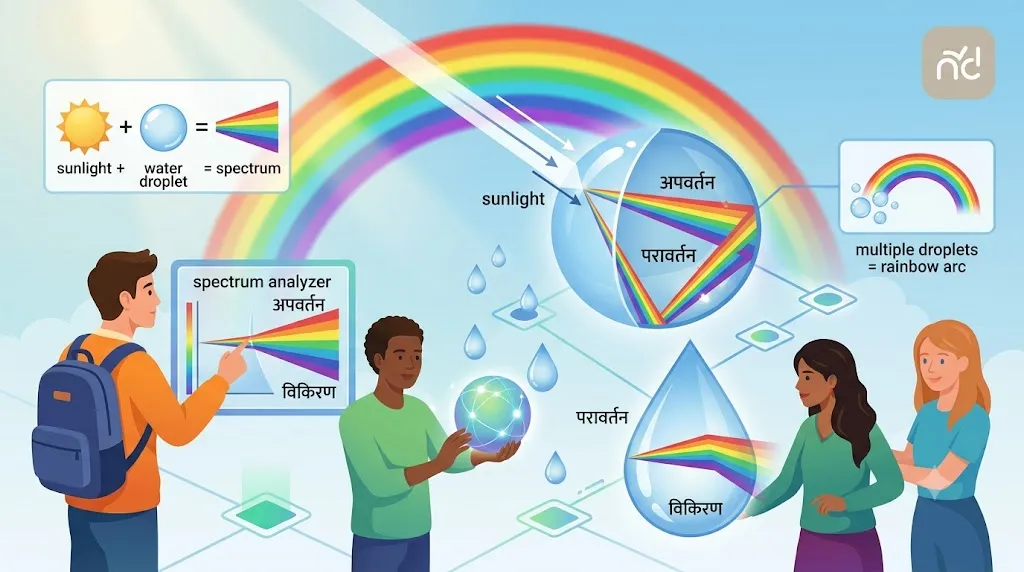
The sunlight we see as white is actually a mix of many colors. Think of a rainbow, where you see red, orange, yellow, green, blue, indigo, and violet. Each of these colors has a different wavelength and carries a different amount of energy. When all these colors combine, we perceive white light. When light hits an object, some colors are absorbed, and others are reflected, which is why we see objects in specific colors.
Understanding these basic properties of light is crucial to appreciating the significance of the Raman Effect. Each photon carries a specific amount of energy, and what happens when it interacts with matter holds the key to incredible discoveries.
When Light Meets Matter: A Dance of Interaction
When light encounters matter (like air, water, glass, or any object), several interesting things can happen. The photons interact with the atoms and molecules within that substance. Here are a few ways light interacts with matter:
- Reflection: Light bounces off a surface, like when you see your reflection in a mirror.
- Refraction: Light bends as it passes from one medium to another (e.g., from air to water), which is why a straw in a glass of water looks bent.
- Absorption: Some materials soak up light energy, which can make them warm. Darker objects absorb more light.
- Scattering: This is a crucial interaction for understanding the Raman Effect. Scattering occurs when light hits a particle or molecule and is redirected in various directions.
Scattering and the Blue Sky:
Why is the sky blue? It's all thanks to scattering! Earth's atmosphere contains tiny nitrogen and oxygen molecules, along with dust particles. When sunlight enters the atmosphere, it hits these molecules and gets scattered. Blue light has a shorter wavelength than other colors, so it scatters more effectively and in all directions. This is why we see a blue sky during the day. This phenomenon is called Rayleigh Scattering. At sunrise and sunset, sunlight has to travel through more atmosphere, so most of the blue light is scattered away, leaving the red and orange light to reach our eyes, making the sun appear reddish.
Before Raman's discovery, scientists knew about light scattering. However, they believed that when light scattered, its energy remained unchanged. In other words, light would simply change direction but maintain its original color (wavelength). But Raman proved that this isn't always the case!
Sir C.V. Raman: A Beacon of Indian Science
Sir Chandrasekhara Venkata Raman was born on November 7, 1888, in Tiruchirappalli, Tamil Nadu, India. His father was a professor of mathematics and physics, which sparked Raman's interest in science from a young age. He completed his M.A. degree in Physics from Presidency College, Madras, at the tender age of 18, earning a gold medal from the British government for his exceptional academic performance.
Initially, Raman joined the Indian Finance Department, but his heart was always in science. He dedicated his free time to research at the Indian Association for the Cultivation of Science (IACS) in Kolkata. This was a modest laboratory with limited resources, but Raman's scientific curiosity was boundless.
The Mediterranean Sea Mystery:
In 1921, while returning to India by ship after a trip to Europe, Raman observed the striking blue color of the Mediterranean Sea. He questioned why the sea was blue. Conventional wisdom suggested it was merely a reflection of the blue sky. However, Raman found this explanation unsatisfactory. He wondered how water, if not inherently blue, could reflect the sky's blue so intensely. Using a small spectroscope he carried, he made observations on board, realizing that the sea's blue was distinct from the sky's reflection. This moment was a pivotal point in his life, inspiring him to delve deeper into the phenomenon of light scattering.
Upon his return to India, Raman began an intensive study of light scattering in his Kolkata laboratory. Working alongside his students and colleagues, often with simple, homemade equipment, he was determined to unlock the secrets of light.
The Raman Effect: Light's Hidden Conversation
In his experiments, Raman passed monochromatic light (light of a single color) through various transparent liquid substances, such as water or benzene. He then analyzed the scattered light that emerged. He expected the scattered light to retain its original color (wavelength), as predicted by Rayleigh scattering.
However, he made a startling discovery! While most of the light scattered without changing its wavelength, a very small fraction of the scattered light had its wavelength altered. This meant that as light photons interacted with the molecules in the liquid, they either gained or lost a tiny amount of energy from or to the molecules. This energy exchange caused a slight shift in the light's color.
Imagine throwing a ball against a wall; it bounces back with the same energy. This is like normal (Rayleigh) scattering. Now, imagine throwing the ball at a bell. Most of the time, it just bounces off. But sometimes, the ball might hit the bell in such a way that it makes the bell ring, or the bell's vibration might slightly alter the ball's speed when it bounces. In this analogy, the ringing bell represents the energy exchange that happens in the Raman Effect.
This phenomenon was named the 'Raman Effect' or 'Raman Scattering.' Raman announced his discovery on February 28, 1928. This day is now celebrated as National Science Day in India, honoring his monumental contribution.
The Raman Effect provides crucial information about the internal structure of matter. Since every substance has a unique molecular arrangement, it interacts with light in a distinct way. By analyzing the shifted wavelengths of light in the Raman Effect, scientists can determine the types of molecules present in a substance and how they are bonded together. Just as every person has unique fingerprints, every molecule has a unique 'light fingerprint' revealed by the Raman Effect.
The Raman Effect in Action: Shaping Our World
The Raman Effect was not just a scientific curiosity; it revolutionized many fields of science and technology. Today, Raman Spectroscopy is a powerful analytical technique used across various disciplines:
- Chemistry: It's widely used to identify unknown chemical compounds and study their molecular structures. Pharmaceutical companies use it to check the purity of drugs and ensure quality control.
- Medicine: Raman spectroscopy helps in early diagnosis of diseases like cancer, studying cellular changes in the body, and developing new medicines. It's also used in blood analysis.
- Forensics: In criminal investigations, Raman spectroscopy is used to identify samples found at crime scenes, such as fibers, inks, paints, or illicit drugs, aiding in solving cases.
- Material Science: When creating new materials, Raman spectroscopy is invaluable for characterizing their properties and structure, playing a significant role in research on nanomaterials and semiconductors.
- Environmental Studies: It helps in identifying and quantifying pollutants in water and air, contributing to environmental monitoring and protection.
- Art and Archaeology: This technology is used to identify pigments and materials used in ancient artworks without damaging them, and to analyze historical artifacts non-invasively.
The Power of Observation and Inquiry
Sir C.V. Raman's journey teaches us that scientific discovery isn't just about intelligence; it requires intense curiosity, keen observation, and unwavering perseverance. His simple question about the blue color of the Mediterranean Sea led him to a monumental discovery. He conducted groundbreaking research using limited, often homemade, equipment. This demonstrates that progress in science relies more on 'freedom of thought' and a 'willingness to experiment' than on elaborate laboratories.
You too can cultivate this scientific mindset by observing the world around you with curiosity. Ask yourself, 'Why does this happen?' or 'What is the reason behind this?' Try to find the answers to your questions. Who knows, perhaps one of you will be the next C.V. Raman, leading the world to a new understanding.
Did You Know?
- C.V. Raman discovered the Raman Effect in 1928 and received the Nobel Prize just two years later, a remarkably short period in the history of science.
- Raman was also a music lover and conducted research on the acoustics of Indian musical instruments.
- February 28th is celebrated as 'National Science Day' in India, commemorating the day Raman announced his discovery.
- The Raman Effect is being used by NASA's Perseverance Rover on Mars to search for signs of past life and analyze the planet's surface and atmosphere.
- Raman often told his students, 'You are not looking with the best instruments in the world, but with the best eyes and mind in the world.'
Conclusion
Sir C.V. Raman's Raman Effect is not just a crucial discovery in physics; it is a prime example of human curiosity, observation, and scientific temperament. Through a subtle change in light, he unveiled the mysterious structure of matter, opening new avenues for numerous scientific and technological advancements.
His work not only helped us understand the amazing world of light but also showcased the brilliance and perseverance of an Indian scientist on a global stage. Raman's story teaches us that profound secrets can be hidden in the simplest of things around us, requiring only a scientific outlook and the courage to ask questions. Let us embrace this scientific spirit in our lives and continue this wonderful journey of knowledge!