Hello, dear students!
Today is a special day. It's Vinayak Chaturthi and the fourth day of Navratri, dedicated to the worship of Devi Kushmanda. On this auspicious occasion, we're going to delve into a very important aspect of knowledge and thought: Critical Thinking and Problem Solving. Education isn't just about gathering information; it's about using that information wisely to understand the world and find solutions to its challenges. In this journey, critical thinking can be a powerful tool for you.
We all encounter numerous questions in life – in our studies, with friends, at home, or about our future. To find answers to these questions and make sound decisions, we need the power of thought. But simply thinking is not critical thinking. Critical thinking involves analyzing information, discerning its true nature, considering different perspectives, and then arriving at a logical conclusion.
In today's world, where there's an overwhelming flood of information, it's crucial to identify what's true and what's false, what's important and what's not. Instead of blindly accepting what others say or what you read, asking questions, harboring healthy skepticism, and striving to discover the truth are at the core of critical thinking. So, let's explore this amazing skill in depth.
What is Critical Thinking?
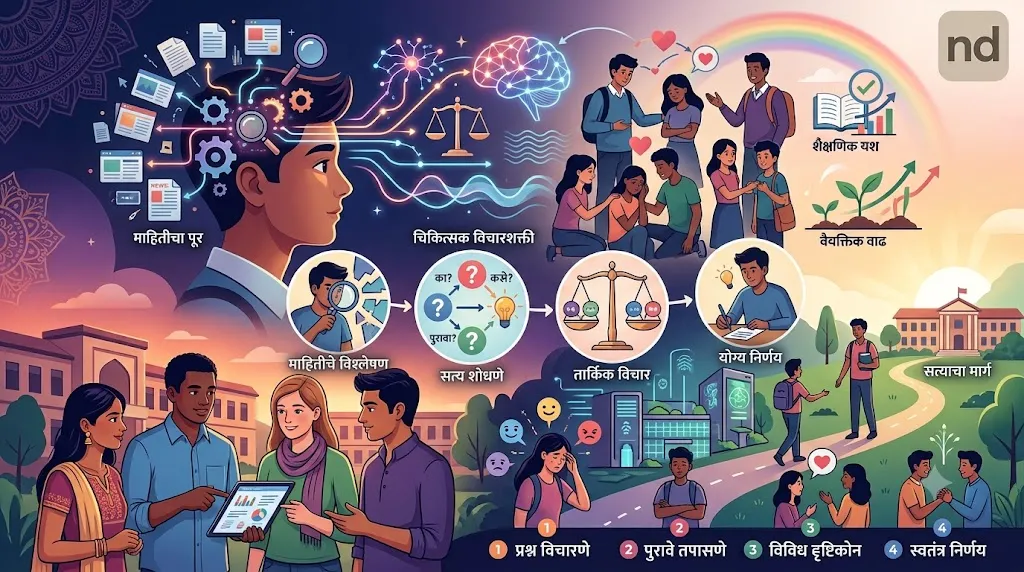
Critical thinking isn't just about accepting information; it's about deeply analyzing that information, evaluating it, and using it to make logical decisions. It's a skill that helps you think effectively and efficiently in any situation. It includes the following components:
- Analysis: Breaking down any information, problem, or situation into smaller parts for thorough examination. For example, scrutinizing a news report to identify facts, opinions, and their underlying basis.
- Evaluation: Assessing the truthfulness, credibility, and usefulness of information. For instance, checking if claims made in an advertisement are true and what evidence supports them.
- Inference: Drawing logical conclusions based on available information. For example, connecting various clues in an event to deduce what might have happened.
- Explanation: Clearly articulating your thoughts, conclusions, and the reasoning behind them to others.
- Self-Regulation: Examining your own thoughts, identifying errors, and correcting them.
In simple terms, critical thinking means 'not immediately believing anything, but questioning it, verifying the information, and reaching your own conclusions.'
A Small Example:
Suppose your friend tells you, 'Studying in the morning is the best.' A critical thinker wouldn't immediately accept this. They would ask:
- 'Why is morning study considered the best?'
- 'Is there any evidence to support this?'
- 'Is this true for everyone? Some might find it easier to study at night.'
- 'How can I determine what time works best for me?'
By asking such questions, they would find the right time for themselves, not just follow what others say.
Why is Critical Thinking Essential for Students?
In today's world, critical thinking is not just important; it's absolutely vital. As we celebrate Vinayak Chaturthi and Navratri on October 14, 2026, we should remember that the true worship of knowledge lies in its proper application.
1. Academic Success:
- Better Grades: Critical thinking helps you excel when writing essays, solving math problems, or working on science projects. You don't just regurgitate memorized knowledge but express a deep understanding of the subject in your own words.
- Problem Solving: This skill is crucial for overcoming academic challenges, difficult questions, or experimental hurdles.
- Developing New Ideas: Critical thinking is essential for presenting novel and original ideas in projects or presentations.
2. Daily Life Decisions:
- Making Informed Choices: From choosing friends to managing pocket money, deciding which sport to play, or selecting a career, critical thinking guides you toward the right path in many small and big decisions.
- Evaluating Information: Critical thinking helps you discern whether numerous news reports, advertisements, or forwarded messages on social media are true. This prevents you from falling prey to misinformation.
- Resolving Conflicts: If disagreements arise with friends or family members, this skill helps you calmly analyze the situation, listen to both sides, and find an appropriate resolution.
3. Future Preparedness:
No matter what field you work in when you grow up, critical thinking will bring you success. In 2026, with new education policies introduced by the NDA government, there's an increased emphasis on skill-based learning. Companies prioritize individuals who can not only perform tasks but also creatively solve new problems. The announcement of Amartya Sen's Nobel Prize highlights the immense importance of critical thought and analysis.
- Job Readiness: In future jobs, merely memorizing information won't suffice. Companies need employees who can solve problems, generate new ideas, and adapt to changing circumstances.
- Boosting Creativity: Critical thinking encourages you to come up with innovative ideas and think beyond traditional approaches.
- Role as a Citizen: In a democracy, citizens need critical thinking to make informed decisions and express their opinions for the betterment of society.
How to Develop Critical Thinking?
Critical thinking is not a skill that develops overnight; it grows with practice and effort. Here are some simple steps and questions to help you:
Step 1: Ask Questions!
Instead of immediately believing any information, ask yourself questions. This is the most crucial step.
- 'Is this true?'
- 'How do I know this?'
- 'What evidence supports this?'
- 'What is the source of this information? Is it reliable?'
- 'What might be the motive behind this?' (e.g., if it's an advertisement, the motive is to sell; if it's news, to inform.)
Step 2: Think from Different Perspectives.
Try to look at the same thing from multiple angles. Every coin has two sides.
- 'What might other people be thinking about this situation?'
- 'What other possible interpretations could there be?'
- 'Are there other solutions to this problem?'
- 'Could my own thinking be wrong?' (Be ready to acknowledge your mistakes.)
Step 3: Analyze Information.
Examine the information you receive and break it down.
- 'What are the main points in this information?'
- 'Which parts of this information are facts, and which are opinions?' (e.g., 'The sun rises in the east' is a fact, but 'Morning study is best' might be an opinion.)
- 'Is there any contradiction in this information?'
Step 4: Use Logic.
After analyzing the information, use logical reasoning to reach a conclusion.
- 'What is the overall meaning of all this information combined?'
- 'What conclusion can I draw based on this information?'
- 'Why do I think my conclusion is correct?'
Step 5: Discuss with Others.
Discussing your thoughts with others can provide new perspectives and sharpen your thinking. Remembering the contributions of great personalities like Mohan Dharia and Dattopant Thengadi to society reminds us of the importance of exchanging ideas.
- Talk openly with friends, teachers, or parents.
- Listen to their thoughts and compare them with yours.
- Try to learn from each other, rather than just arguing.
Using Critical Thinking for Problem Solving
The ultimate goal of critical thinking is to solve problems. When you use critical thinking to solve problems, the solutions are often more effective and sustainable.
Stages of Problem Solving:
- Identify the Problem: Clearly understand what the exact problem is. E.g., 'I'm getting low grades in math.'
- Gather Information: Collect all relevant information related to the problem. E.g., 'Which chapters am I struggling with?', 'How much time do I spend studying?', 'Where are my mistakes occurring?'
- Brainstorm Solutions: Find as many possible solutions to the problem as you can. Don't dismiss any ideas immediately. E.g., 'Get a tutor,' 'Ask the teacher for help,' 'Study with friends,' 'Use different textbooks,' 'Practice more.'
- Evaluate Solutions: Consider the pros and cons of each option. E.g., 'Tutoring will cost money but provide more focused attention,' 'Self-study saves time but doubts might not be cleared immediately.'
- Choose the Best Solution: Select the most effective and practical solution. E.g., 'First, I'll meet the teacher to clear doubts, then I'll do group study with friends.'
- Act and Evaluate: Implement the chosen solution and assess its results. Be ready to change or refine the solution if needed.
Example: A School Project
Imagine you have to do a group project on 'Environmental Protection' at school. Your group members come up with different ideas:
- One says, 'Let's just plant trees.'
- Another says, 'Let's tell people not to use plastic.'
- A third suggests, 'Let's focus on saving water.'
As a critical thinking student, what would you do?
- You would ask questions: 'Which of these solutions would be most effective?', 'Which solution is most applicable given our school's and locality's situation?', 'How much time and resources do we have for each?'
- You would gather information: 'How much plastic is used in school?', 'Is there enough space to plant many trees?', 'What measures are already in place for water conservation?'
- You would analyze: 'Just planting trees is good, but its immediate impact might not be visible,' 'The message of plastic ban is important, but implementation might be difficult,' 'Small water-saving measures can be started immediately.'
- You would conclude: 'Let's create a multi-faceted project that includes reducing plastic, saving water, and planting small saplings. This will involve more people and achieve a greater impact.'
Examples in Daily Life
Critical thinking is not only useful in academics but also very helpful in your everyday life.
1. Social Media and News:
You see many news items or forwarded messages on social media. E.g., 'A certain fruit cures all diseases.' A critical thinking student wouldn't immediately believe it. They would ask themselves:
- 'Where did this information come from?' (A credible doctor/researcher or an unknown person?)
- 'Is there any scientific evidence for this?'
- 'Doesn't this sound exaggerated?'
- 'Are there any commercial interests behind this information?'
By asking such questions, you protect yourself from misinformation.
2. While Shopping:
You go to the market to buy something, say a new smartphone. The salesperson tells you about many attractive features. As a critical thinking student, what would you do?
- 'Do I really need all these features?'
- 'What other good options are available within my budget?'
- 'What are the reviews for this phone?'
- 'What are the pros and cons of this phone?'
This way, you won't just fall for advertisements but choose the right product according to your needs.
3. Relationships with Friends:
Your friend tells you, 'The teacher treated me unfairly.' As a critical thinking student, you wouldn't immediately take your friend's side. You would calmly think:
- 'Why might the teacher have done that?'
- 'What is my friend's side, and what might be the teacher's side?'
- 'What can be learned from this situation?'
Doing so will help you handle situations more balanced and understandingly.
Conclusion
Dear students, critical thinking and problem-solving skills are not just academic competencies; they are life skills that will assist you at every stage of your life. In today's world, where there's an explosion of information, it's essential to discern what's true, what's false, and what's important.
By cultivating habits of asking questions, analyzing information, viewing things from different perspectives, and making logical decisions, you can sharpen your thinking abilities. From school studies to small daily decisions, this skill will lead you to the pinnacle of success.
On this auspicious occasion of Vinayak Chaturthi and Navratri, let us all worship knowledge and the power of thought. Remembering great thinkers like Mohan Dharia and Dattopant Thengadi, let us also use critical thinking to bring about positive change in our society. Remember, right thinking leads to right action, and right action builds a better future. So, starting today, begin asking 'Why?', 'How?', and 'For what purpose?' and experience the magic of your critical thinking!
Did You Know?
- Critical thinking is considered one of the most important skills of the 21st century. According to many global reports, this skill will be crucial for future jobs.
- Amartya Sen, who received the Nobel Prize in 1998, is an excellent example of using critical thinking in his work on economic and social justice.
- The ancient Greek philosopher Socrates is considered the father of critical thinking. He used to prompt people to think for themselves by asking questions, a method known as the 'Socratic Method'.
- Approximately 85% of students immediately believe information they encounter on social media, according to one survey. Critical thinking can help protect them from this.
- Many large companies worldwide now test candidates' critical thinking skills in interviews because they seek problem-solving employees. The announcement of the Sangeet Natak Akademi Fellowship also encourages new thinking, including new approaches to problem-solving.