India's Cosmic Leap: A Dream, A Determination
Since ancient times, humanity has been fascinated by the sky and its twinkling stars. Our ancestors gazed upwards, attempting to unravel the universe's mysteries. Today, September 21, 2026, on International Peace Day and World Alzheimer's Day, we delve into the story of an Indian institution that not only envisioned India reaching for the stars but made it a reality. This institution is the Indian Space Research Organisation (ISRO).
ISRO's journey is not just about scientific advancement; it symbolizes India's self-confidence, foresight, and indomitable will. From carrying rocket components on bicycles to successfully landing a spacecraft on the Moon, India has traversed an incredible path in space exploration. Along this journey, there have been numerous challenges and setbacks, but each time, Indian scientists persevered with renewed vigor and determination. Let's embark on this glorious journey of ISRO and listen to the amazing tale of India's tryst with the stars.
The Genesis of ISRO: A Vision for the Stars
ISRO was established in 1969, but its roots trace back to the early 1960s. The driving force behind India's space program was the visionary Dr. Vikram Sarabhai, widely regarded as the father of the Indian space program. He firmly believed that space technology would be crucial for India's development. He recognized its potential applications in communication, weather forecasting, natural resource management, and national security.
“There are some who question the relevance of space activities in a developing nation. To us, there is no ambiguity of purpose. We are convinced that if we are to play a meaningful role nationally, and in the comity of nations, we must be second to none in the application of advanced technologies to the real problems of man and society.” – Dr. Vikram Sarabhai
With this philosophy, the 'Indian National Committee for Space Research' (INCOSPAR) was formed in 1962, which later evolved into ISRO in 1969. In its nascent stages, ISRO operated with very limited resources. The St. Mary Magdalene Church in Thumba, Kerala, served as its first office, and a coconut grove by the sea became its launch site. Rocket parts were transported on bicycles and bullock carts. Yet, with these humble means, Indian scientists dreamed big and worked tirelessly to turn those dreams into reality.
Pioneering Steps: Early Satellites and Launch Vehicles
ISRO's first significant achievement was India's inaugural satellite, 'Aryabhata'. Launched on April 19, 1975, with the assistance of the Soviet Union, this mission marked India's capability in satellite development and a crucial step towards mastering space technology.
Developing its own launch vehicle was another major challenge for India. In the 1970s, work began on the Satellite Launch Vehicle-3 (SLV-3). A young scientist named Dr. A.P.J. Abdul Kalam led this project. After several setbacks, on July 18, 1980, SLV-3 successfully placed the 'Rohini' satellite into orbit. This moment was etched in golden letters in India's history, as it made India the sixth nation in the world capable of launching its own satellites.
ISRO's Workhorses: PSLV and GSLV
Over the subsequent decades, ISRO developed more powerful launch vehicles:
- Polar Satellite Launch Vehicle (PSLV): Developed in the 1990s, the PSLV has become ISRO's most reliable and versatile launch vehicle. It has successfully launched numerous Indian and foreign satellites, including the Chandrayaan-1 and Mangalyaan missions. PSLV is globally recognized for its cost-effectiveness and high success rate.
- Geosynchronous Satellite Launch Vehicle (GSLV): In contrast to PSLV, GSLV was developed to launch heavier satellites into geosynchronous transfer orbit. Its key feature is cryogenic engine technology, which uses propellants at extremely low temperatures. This technology provided India with the capability to send large communication satellites into space.
Lunar and Martian Triumphs: Chandrayaan and Mangalyaan
Among ISRO's most significant and inspiring missions are Chandrayaan and Mangalyaan. These missions established India as a leading space power on the global stage.
Chandrayaan-1: The Discovery of Water on the Moon
On October 22, 2008, India launched its first lunar probe, Chandrayaan-1, using the PSLV-XL rocket. This mission made India the fourth country in the world to send a spacecraft to the Moon. The 'Moon Impact Probe' (MIP) on Chandrayaan-1 deliberately crashed onto the lunar surface, making the pivotal discovery of water (in the form of water molecules) on the Moon. This finding was a landmark in the history of space science.
Mangalyaan (Mars Orbiter Mission - MOM): Mars in the First Attempt
On November 5, 2013, India launched its Mangalyaan (MOM). The mission's objective was to study Mars' atmosphere and surface. On September 24, 2014, Mangalyaan successfully entered Mars' orbit. This achievement set a record: India became the first nation in the world to reach Mars orbit in its maiden attempt. Furthermore, it was the most cost-effective inter-planetary mission globally (approximately ₹450 crore, less than many Hollywood movies).
Chandrayaan-2 and Chandrayaan-3: India's Mark on the Lunar South Pole
On July 22, 2019, India launched the Chandrayaan-2 mission. This mission included an orbiter, a Vikram lander, and a Pragyan rover. The orbiter successfully entered lunar orbit and continues to send valuable data. Unfortunately, the Vikram lander faced technical glitches during its descent and could not achieve a soft-landing on the lunar surface.
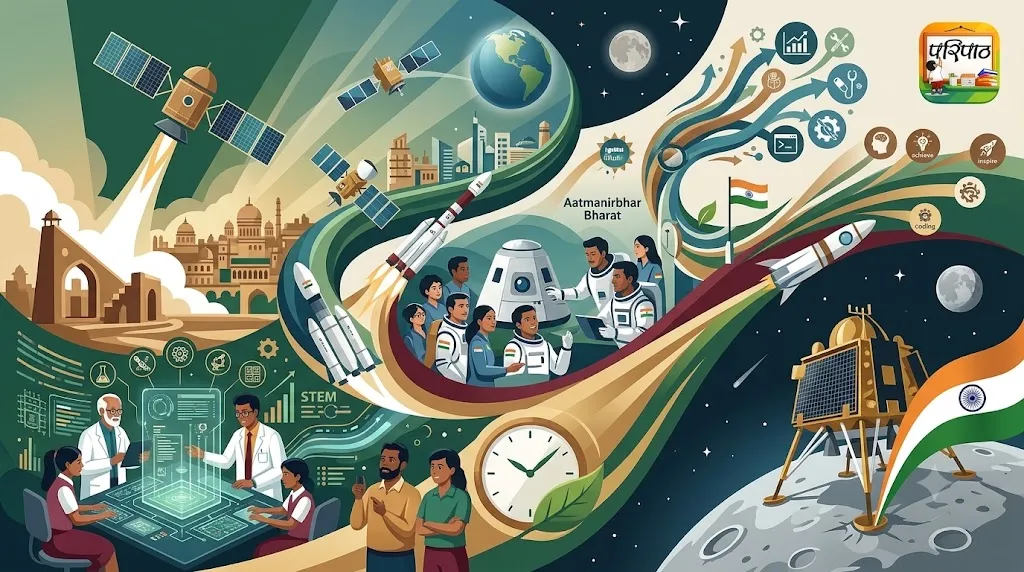
However, Indian scientists did not give up. Learning from the setback, ISRO planned the Chandrayaan-3 mission. On July 14, 2023, Chandrayaan-3 was successfully launched from Sriharikota. After a 40-day journey, on August 23, 2023, at 6:04 PM IST, the Vikram lander successfully performed a soft-landing near the Moon's South Pole. This historic moment made India the fourth country in the world to successfully land a spacecraft on the Moon and the first to reach its South Pole. The Pragyan rover traversed the lunar surface, conducting various scientific experiments that provided new insights into lunar geology and the potential for water ice.
Gaganayaan and Future Plans: Towards Human Spaceflight
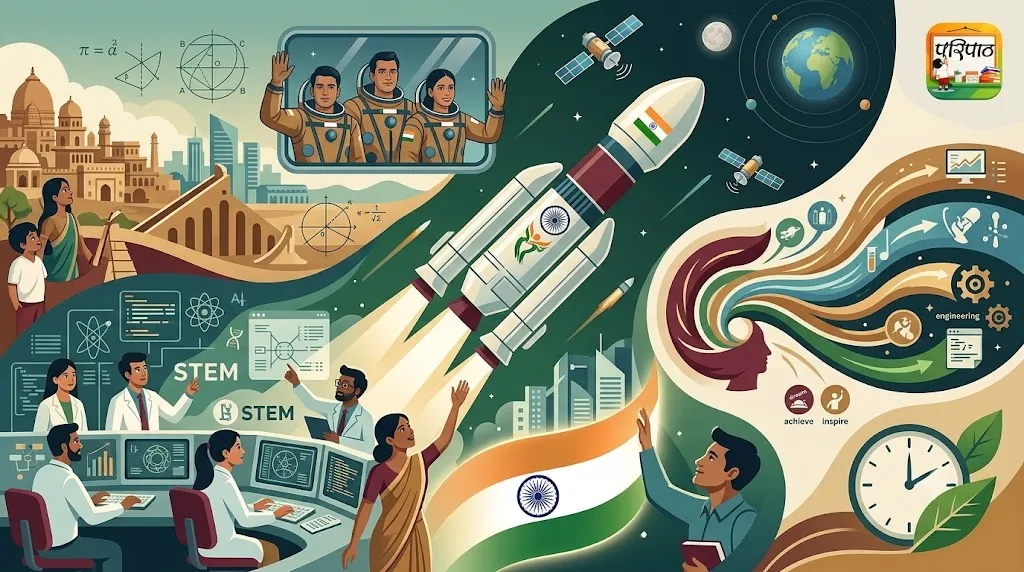
ISRO is now progressing towards human spaceflight missions. Gaganayaan is ISRO's ambitious project to send Indian astronauts (Vyomnauts) into space. This mission will make India the fourth nation in the world to undertake human spaceflight. For this project, selected Indian Air Force pilots have undergone training in Russia, and further stages of training are now underway in India.
Some of ISRO's Ambitious Future Missions:
- Shukrayaan-1: A mission to study Venus's atmosphere and surface.
- Aditya-L1: India's first space-based observatory to study the Sun. This spacecraft is positioned at 'Lagrange Point 1' (L1) of the Sun-Earth system, from where it can observe the Sun without any occultation.
- NISAR: A joint mission between NASA and ISRO, which will study Earth's environment.
- Developing next-generation launch vehicles to further reduce the cost of space launches.
- Increasing private sector participation in space research, fostering new ideas and technologies.
ISRO's Impact on Humanity and Exciting Career Opportunities
ISRO has not only achieved technological advancements but is also directly transforming the lives of millions of Indians. Communication satellites have extended television, radio, and internet services to rural areas. Weather satellites provide timely forecasts for natural disasters like cyclones, floods, and droughts, saving thousands of lives and preventing agricultural losses.
Remote sensing satellites aid in crop cultivation, water management, deforestation monitoring, and urban planning. 'NavIC' is India's indigenous regional navigation system, providing positioning services similar to GPS. In education, the EDUSAT satellite has promoted distance learning.
Exciting Career Opportunities
ISRO's success inspires many young people to pursue careers in science and engineering. Diverse career opportunities are available at ISRO:
- Scientists/Engineers: In fields such as aerospace, mechanical, electronics, computer science, physics, chemistry, and mathematics.
- Researchers: To conduct research on new technologies and missions.
- Technicians: For the manufacturing, testing, and maintenance of satellites and rockets.
- Administrative Officers: For management and administrative functions.
To pursue these paths, you need dedication, scientific curiosity, and a passion for problem-solving. Working at ISRO is not just a job; it's an opportunity to contribute to the nation's progress and expand the frontiers of human knowledge.
Conclusion: India's Space Power and Inspiration
ISRO's journey is not merely a tale of scientific triumph but a testament to human determination and vision. Starting with meager resources, ISRO has today become one of the world's leading space organizations. Missions like Chandrayaan-3 and Mangalyaan have showcased India's capabilities to the world. This success belongs not only to the scientists but to every Indian who supported these dreams.
ISRO has taught us that no challenge, however formidable, is insurmountable with hard work, perseverance, and unity. ISRO's journey will continue to inspire us, to shape our future, and to look beyond the stars. Dream big, and strive to achieve your goals just like the scientists at ISRO!
Did You Know?
- ISRO's headquarters are located in Bengaluru, India.
- ISRO has successfully launched over 400 foreign satellites, generating significant revenue for India.
- The cost of the Mangalyaan (MOM) mission was less than that of the famous Hollywood movie 'Gravity'.
- Dr. Vikram Sarabhai is considered the father of the Indian space program.
- NavIC (Navigation with Indian Constellation) is India's own independent regional satellite navigation system, developed by ISRO.