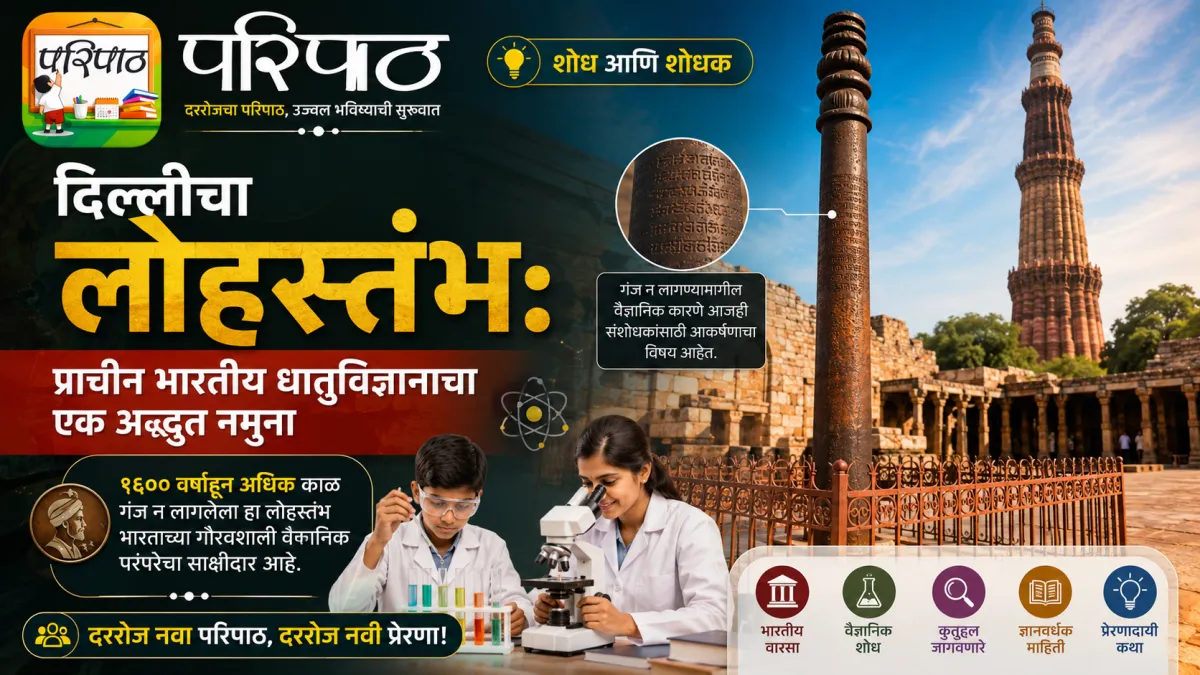
The Enigma of Delhi's Iron Pillar
In the heart of India's capital, Delhi, within the sprawling Qutub Minar complex, stands an extraordinary monument: the Iron Pillar. This pillar is renowned not only for its historical significance but also for its remarkable scientific marvel. Erected over 1600 years ago, around 400 CE, this iron pillar remains largely uncorroded to this day, enduring centuries of exposure to sun, wind, and rain without succumbing to rust. This phenomenon is its greatest mystery, a profound testament to the immense knowledge possessed by ancient Indian engineers and metallurgists.
Most of us know that iron rusts easily. When exposed to air and moisture, iron forms a reddish-brown flaky coating known as rust, which weakens the metal and eventually destroys it. So, how has the Iron Pillar of Delhi managed to preserve itself for so many centuries without rusting? The answer lies deep within the advanced science and technology of ancient India, a legacy that continues to baffle and inspire modern scientists.
A Glimpse into History: The Pillar's Origins and Context
The Iron Pillar of Delhi is a magnificent example from the golden age of the Gupta Empire. An inscription on the pillar, written in Sanskrit using the Brahmi script, refers to a king named 'Chandra'. Historians widely believe this 'Chandra' to be the great Gupta emperor Chandragupta II (Vikramaditya), who reigned from 375 to 415 CE. It is believed that the pillar was originally erected on Vishnupada Hill (modern-day Udayagiri, Madhya Pradesh) in front of a Vishnu temple, serving as a standard or 'dhvaja' dedicated to Lord Vishnu. It was later moved to Delhi, though the exact circumstances of its relocation remain debated.
According to the inscription: The pillar was erected as a standard of Lord Vishnu and in memory of the valour of King Chandra, who had conquered his enemies and ruled over India.
The pillar stands approximately 7.21 meters (23 feet 8 inches) tall, with a base diameter of about 41 centimeters (16 inches) tapering to 30 centimeters (12 inches) at the top. Its estimated weight is around 6 tons (6000 kilograms). The creation of such a massive and heavy iron pillar, and its potential transportation over long distances, presented a significant engineering challenge in ancient times. This fact alone highlights the advanced metalworking and engineering skills of ancient Indians.
Unravelling the Rust-Proof Secret: Ancient Indian Metallurgical Genius
To uncover why the Iron Pillar resists rust, numerous scientists and metallurgists have conducted extensive studies. Their research reveals that the iron used in the pillar differs significantly from modern industrial iron, primarily due to its high phosphorus content.
The Role of Phosphorus and the 'Misawite' Layer
- High Phosphorus Content: The iron in the pillar contains approximately 0.25% phosphorus, which is considerably higher than the phosphorus content in modern industrially produced iron (typically less than 0.05%). Ancient Indian blacksmiths did not use lime flux in their smelting furnaces, which meant that phosphorus was not removed during the iron-making process. Consequently, the resulting iron had a higher phosphorus concentration.
- Protective 'Misawite' Layer: Due to this high phosphorus content, a unique crystalline iron-oxyhydroxide layer, known as 'misawite', has formed on the surface of the Iron Pillar in Delhi's humid climate. This layer is often referred to as a 'passivation layer'.
- Corrosion Inhibition: This misawite layer is extremely thin and tightly adherent. It acts as a protective barrier, preventing the iron from coming into direct contact with air and moisture. This halts the oxidation process, thereby preventing rust. Modern stainless steel achieves similar rust resistance by incorporating chromium to form a protective oxide layer, but ancient Indians achieved this naturally using phosphorus.
The formation of this layer was a gradual process. Initially, the pillar might have experienced some superficial rusting, but the specific climatic conditions of Delhi (dry summers and humid monsoons), combined with the high phosphorus content of the iron, allowed this protective layer to strengthen over time, eventually halting the corrosion process entirely.
Beyond the Pillar: India's Rich Metallurgical Legacy
The Delhi Iron Pillar is not an isolated example of ancient Indian metallurgical brilliance. For thousands of years, the art of metalworking and metal purification was highly advanced in India. One of the world's oldest and highest-quality steels, 'Wootz Steel', originated in India. Swords and weapons crafted from Wootz steel were famous worldwide and were known as 'Damascus Steel'. Wootz steel was incredibly sharp and flexible, giving warriors a significant advantage.
- Harappan Metallurgy: Even during the Harappan civilization, metals like copper, bronze, and lead were used extensively. Excavations at Mohenjo-Daro and Harappa have unearthed numerous metal artifacts, tools, and artworks.
- Gold and Silver Work: Ancient India also excelled in crafting high-quality gold and silver jewellery. Intricately designed ornaments, showcasing the skill of contemporary artisans, can still be admired in Indian museums today.
- Copper and Brass Utensils: To this day, copper and brass utensils are common in Indian homes. From ancient times, various types of vessels, idols, and religious objects were fashioned from these metals.
This clearly indicates that ancient Indians were not only proficient in ironworking but also adept in the purification, alloying, and fabrication of many other metals. Their knowledge was not merely empirical but was underpinned by a deep scientific understanding of metal properties and their environmental interactions.
Modern Science Meets Ancient Wisdom: Analysing the Pillar
In the modern era, the Delhi Iron Pillar has been the subject of extensive research and study. Scientists are employing various advanced technologies to thoroughly investigate its chemical composition, manufacturing process, and the mechanism of its rust resistance. Sophisticated techniques such as Electron Microscopy, X-ray Diffraction, and Spectroscopy are being used to examine the structure and properties of the protective layer on the pillar's surface.
These studies have revealed that ancient Indian blacksmiths worked not merely by experience but with specific intent and knowledge. They possessed a profound understanding of the properties of different metals, the effects of heat on them, and how to create alloys. They developed specific methods for purifying iron, shaping it, and making it durable, techniques that continue to challenge modern technology.
Some researchers have also suggested that the iron used in the pillar's construction might have been purified through a specific type of 'solid-state reduction' process, where iron ore was heated to very high temperatures with charcoal. This process would reduce carbon and other impurities but retain a significant amount of phosphorus, which later contributed to the formation of the protective layer.
The Iron Pillar: A Beacon of Inspiration
The Delhi Iron Pillar is more than just a historical monument; it is a profound source of inspiration for us all. It reminds us of the advanced state of science and technology that existed in ancient India. Our ancestors not only built magnificent temples and artworks but also achieved unparalleled feats in the fields of science and engineering.
- Pride in Heritage: This pillar teaches us to be proud of our rich scientific and engineering heritage, providing students with insight into the great contributions of our nation's history.
- Scientific Curiosity: The mystery of this pillar helps students develop scientific curiosity. They are inspired to seek answers to 'how?' and 'why?' questions.
- Connection to Modern Science: Through the study of ancient technology and modern science, students can learn new concepts and be motivated to find solutions to future challenges.
It is our duty to preserve this Iron Pillar so that future generations can also learn about the extraordinary intelligence and skill of our ancestors. This pillar teaches us that with knowledge and hard work, nothing is impossible.
Did You Know?
- The Delhi Iron Pillar stands 7.21 meters tall, with approximately one meter of its base buried underground.
- Despite its weight of over 6 tons, the pillar is not made from a single piece of iron but was created by forge-welding multiple smaller pieces of iron together at high temperatures.
- It is believed that the pillar was originally erected in front of a Vishnu temple in Udayagiri, Madhya Pradesh, before being moved to Delhi.
- The inscription on the pillar mentions a king named 'Chandra', widely identified as Chandragupta II, in whose honour it was erected.
- The pillar's high phosphorus content, compared to modern iron, is key to the formation of the protective 'misawite' layer that prevents rust.
Conclusion
The Iron Pillar of Delhi is not merely a historical relic; it is a living testament to ancient Indian metallurgy. Standing uncorroded for over 1600 years, this pillar bears witness to the unparalleled scientific and engineering prowess of our ancestors. The formation of a protective 'misawite' layer, owing to its high phosphorus content, is the primary reason for its rust-resistant capability. This monument reminds us of our rich scientific heritage and inspires students to appreciate the importance of science. It is a shining chapter in India's glorious history and its scientific progress, continuing to astonish the world even today.