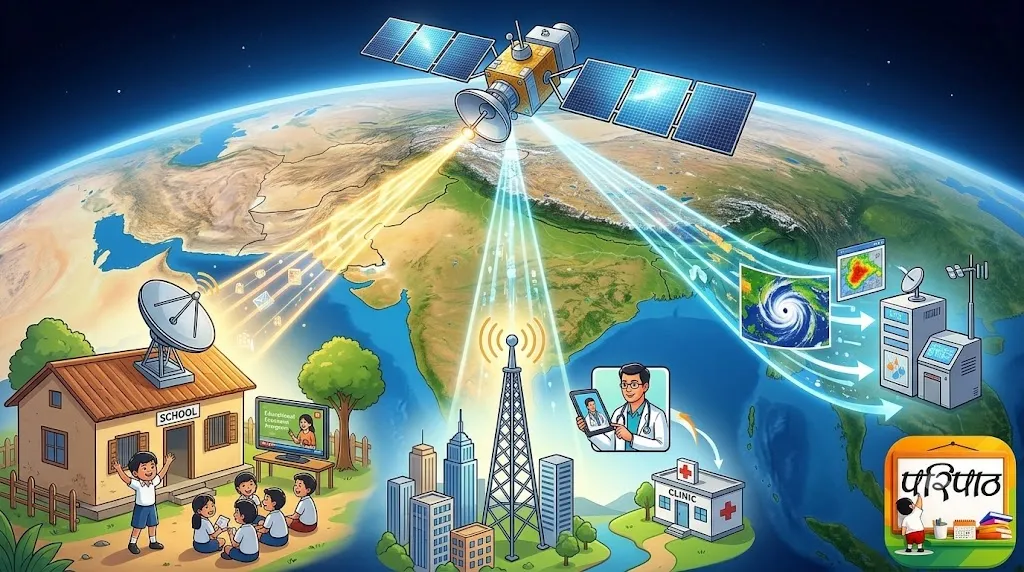
Hello students and respected educators! Today, July 10th, marks a significant milestone in India's space journey. On this very day in 1992, India successfully launched INSAT-2A, its first fully indigenous multi-purpose satellite. This event was a turning point, ushering in a new era for India's communication revolution. Let's delve into the fascinating story of the Indian National Satellite (INSAT) System, a groundbreaking initiative that transformed the face of our nation.
INSAT: A Vision for a Self-Reliant India
In the early 1980s, India heavily relied on foreign satellites for its telecommunications, television broadcasting, and meteorological needs. To overcome this dependency and foster national growth, India envisioned developing its own satellite system. The Indian Space Research Organisation (ISRO) took on this monumental task, leading to the birth of the INSAT system.
The foresight to leverage space technology for India's development led to the conceptualization of the INSAT system. It not only revolutionized communication but also played a vital role in education, healthcare, and disaster management.
The INSAT system is more than just a series of satellites; it's a testament to India's self-reliance and scientific prowess. While the initial INSAT-1 series satellites were built by the United States, their control and operation were firmly in Indian hands. Learning from this experience, ISRO scientists and engineers embarked on building the INSAT-2 series satellites entirely within India. INSAT-2A was the first successful step in this journey of indigenous development, marking a significant leap forward in India's technological capabilities.
The Multifaceted Objectives of INSAT
- Telecommunications: Expanding telephone, fax, and later, internet services across the nation.
- Television and Radio Broadcasting: Reaching every corner of the country with TV and radio programs.
- Meteorology: Providing accurate weather forecasts, early warnings for cyclones and heavy rainfall.
- Disaster Communication: Ensuring prompt and reliable communication during natural calamities.
- Education: Facilitating distance learning and broadcasting educational programs.
A Network of Multi-purpose Satellites: INSAT's Unique Approach
One of the most remarkable features of the INSAT system is its multi-purpose nature. Few countries globally possess the capability to provide telecommunications, television broadcasting, and meteorological services from a single satellite platform. INSAT made this possible, ensuring efficient resource utilization and enabling India to progress simultaneously in multiple sectors.
Revolutionizing Communication
The INSAT satellites brought about unprecedented changes in India's communication landscape. In remote areas where cable or fiber optics couldn't reach, satellites made telephone and internet services accessible. This connected rural populations with urban centers, fostering economic and social integration. Banks and other financial institutions could seamlessly transfer data across the country, streamlining operations.
- Doordarshan's Reach: INSAT enabled Doordarshan (India's public broadcaster) to expand its network nationwide. Many of the hundreds of TV channels we watch today are broadcast via INSAT or its successor satellites.
- Radio Services: INSAT helped All India Radio (Akashvani) broadcast its programs to every part of the country, enhancing the dissemination of information and entertainment.
- Rural Connectivity: Utilizing VSAT (Very Small Aperture Terminal) technology, INSAT facilitated telephone and data services even in the remotest rural areas.
INSAT's Impact on Education and Information Dissemination
Beyond entertainment and communication, the INSAT system also revolutionized the field of education. Distance learning and the broadcasting of educational programs benefited millions of students, particularly in underserved regions.
In 2004, ISRO launched EDUSAT (GSAT-3), specifically dedicated to educational purposes, as an integral part of the INSAT legacy. This satellite allowed schools, colleges, and universities to broadcast distance education programs, providing access to quality education for students in remote areas and helping to bridge the educational divide.
A Pillar of Weather Forecasting and Disaster Management
In a vast country like India, perpetually susceptible to monsoons and natural disasters, accurate weather forecasting and efficient disaster management are paramount. The INSAT system provided India with unparalleled capabilities in these critical areas.
Accurate Weather Forecasting
- High-resolution cameras on INSAT satellites enabled the collection of crucial data on cloud movement, rainfall patterns, and oceanic storms.
- The India Meteorological Department (IMD) utilized INSAT data to provide precise early warnings for events like cyclones, floods, and droughts, saving thousands of lives and minimizing property damage.
- The INSAT system remains crucial for monitoring the monsoon's progression and providing vital weather information for agriculture.
Enhancing Disaster Management
During natural disasters, ground-based communication systems often collapse. In such scenarios, the INSAT satellite system acts as a lifeline. It supports Disaster Warning System (DWS) centers and aids Search and Rescue (SAR) operations.
- Emergency Alerts: Through INSAT, fishermen and coastal communities receive immediate alerts about impending storms and tsunamis.
- Search and Rescue: INSAT satellites are part of the international COSPAS-SARSAT program, which helps locate distressed ships and aircraft in oceans or remote areas.
A Symbol of Self-Reliant India: ISRO's Enduring Contribution
The INSAT system is not just a technological marvel but also a symbol of India's scientific strength and its pursuit of self-reliance. ISRO's scientists and engineers overcame numerous challenges to develop this complex system, placing India among the elite nations in space technology.
The successful launch of INSAT-2A proved that India was capable of meeting its own needs and did not have to rely on foreign assistance. This success instilled confidence for future ambitious missions like Chandrayaan and Mangalyaan. The legacy of INSAT continues to inspire generations of scientists and engineers to push the boundaries of innovation.
Did You Know?
- INSAT-1A was the first satellite in the INSAT-1 series, launched on April 10, 1982. However, due to technical issues, it became inoperable prematurely.
- The INSAT system helped Doordarshan commence its national broadcasting service in 1982.
- INSAT satellites carry devices called transponders, which receive signals from Earth and retransmit them to distant locations on the planet, acting as the main links for communication.
- Many rural health centers and schools in India use INSAT-based VSAT terminals to provide tele-health services and remote education.
- INSAT-3D and INSAT-3DR are some of the currently operational advanced meteorological satellites that continue the legacy of the INSAT system.
Conclusion
The INSAT system represents a shining chapter in India's technological progress and foresight. It has brought about a revolution in diverse fields such as communication, education, weather forecasting, and disaster management. The launch of INSAT-2A on July 10, 1992, was a pivotal moment in this journey, making India self-reliant in indigenous satellite manufacturing. Thanks to ISRO's relentless efforts and the hard work of its scientists, India is recognized today as a leading nation in space technology. The INSAT system has not only secured our present but also enriched our future.
We should be proud of this magnificent achievement and draw inspiration from it to contribute to our nation's progress. Let us continue to look up, for the sky is not the limit, but just the beginning!