India, a land deeply rooted in agriculture, owes its very existence and prosperity to a spectacular natural phenomenon: the Indian Monsoon. Far from being just a seasonal rainfall, the monsoon is the pulsating heart of the nation, dictating its economic trajectory, influencing its cultural fabric, and replenishing its vital water resources. Understanding the monsoon is crucial for every Indian student, as it helps grasp the intricate relationship between nature and human life. This comprehensive guide will explore the science behind the monsoon, its profound impact on India's agricultural backbone, daily life, and environment, and underscore the paramount importance of water conservation.
Unraveling the Science of the Indian Monsoon
The term 'monsoon' originates from the Arabic word 'mausim,' meaning 'season.' It refers to a seasonal reversal of winds, accompanied by significant changes in precipitation. India experiences two primary monsoons: the Southwest (summer) Monsoon and the Northeast (winter) Monsoon. The Southwest Monsoon is overwhelmingly the most significant, delivering about 75-80% of India's annual rainfall.
The Southwest Monsoon: A Dynamic Process
The Southwest Monsoon is a complex meteorological event driven primarily by differential heating between land and sea, coupled with the Earth's rotation and topographical features. Here's a breakdown:
- Differential Heating and Pressure Systems: As summer approaches, the vast landmass of the Indian subcontinent heats up much faster than the surrounding Indian Ocean. This intense heating creates a strong low-pressure zone over the land, particularly over the Thar Desert and the Tibetan Plateau. Conversely, the cooler Indian Ocean maintains a relatively high-pressure zone.
- Wind Movement: Air naturally flows from high-pressure areas to low-pressure areas. Consequently, moisture-laden winds from the high-pressure region over the Indian Ocean begin to move towards the low-pressure zone over the Indian landmass.
- Coriolis Effect: As these winds cross the equator, the Earth's rotation (Coriolis effect) deflects them towards the right in the Northern Hemisphere, causing them to blow from a southwest direction. This is why it's called the Southwest Monsoon. These winds pick up immense moisture as they traverse the warm waters of the Arabian Sea and the Bay of Bengal.
- Topographical Influence: Upon reaching the Indian landmass, these moisture-laden winds encounter mountain ranges like the Western Ghats and the Himalayas. The mountains act as barriers, forcing the winds to rise. As the air rises, it cools, leading to condensation of moisture and heavy rainfall, particularly on the windward side of the mountains.
- Jet Stream Dynamics: The position of the Subtropical Westerly Jet Stream also plays a role. During winter, it flows south of the Himalayas. As summer progresses, it shifts northwards, allowing the low-pressure system over India to strengthen and facilitating the monsoon's arrival.
The Northeast Monsoon: The Retreating Rains
From October to December, as the landmass cools down faster than the surrounding seas, the pressure systems reverse. A high-pressure system develops over the land, and a low-pressure system forms over the Bay of Bengal. Winds begin to blow from the northeast (from land to sea). As these dry winds pass over the Bay of Bengal, they pick up moisture and bring rainfall to the coastal regions of Tamil Nadu, Andhra Pradesh, and parts of Kerala. This is often referred to as the 'retreating monsoon' or 'winter monsoon.'
The Monsoon Cycle: From Onset to Retreat
The Indian monsoon follows a fairly predictable annual cycle, though its exact timing and intensity can vary, leading to significant consequences.
Onset:
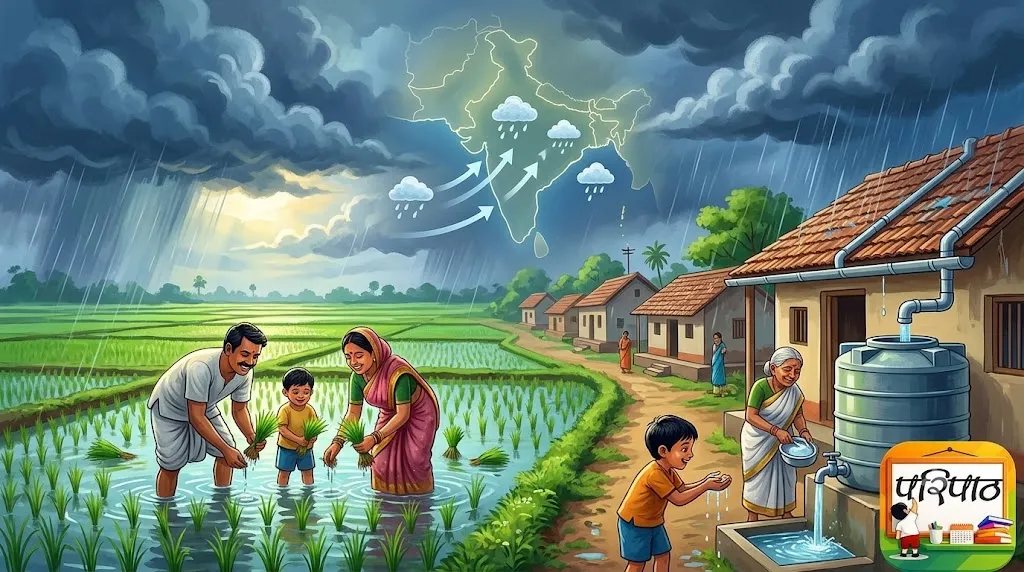
The Southwest Monsoon typically makes its grand entry over Kerala around June 1st. From there, it gradually progresses northward, covering the entire country within approximately 1.5 to 2 months. The period from June to September marks the primary rainy season for most of India.
Retreat:
The monsoon begins its withdrawal from Northwest India by mid-September. By late October, it has typically retreated from most parts of the country. The retreating monsoon period is crucial for some states, especially in the south, which receive significant rainfall during this time.
Factors Influencing Monsoon Variability:
- El Niño: This is a warming of the ocean surface temperature in the central and eastern tropical Pacific Ocean. El Niño events are often associated with weaker monsoons and drought conditions in India.
- La Niña: The opposite of El Niño, La Niña involves the cooling of ocean surface temperatures in the same region. La Niña events are generally linked to stronger monsoons and above-average rainfall in India.
- Indian Ocean Dipole (IOD): This refers to the difference in sea surface temperatures between the western and eastern parts of the Indian Ocean. A 'positive' IOD (warmer western Indian Ocean) is usually favorable for a good Indian monsoon.
Monsoon: The Agricultural Backbone of India
India's economy is predominantly agrarian, with agriculture contributing significantly to its GDP and employing a large portion of its population. A staggering 55% of India's cultivated land is rain-fed, directly dependent on monsoon rainfall. Thus, the performance of the monsoon directly dictates agricultural output, food security, and the nation's economic health.
Kharif Crops: The Monsoon's Bounty
The monsoon season is synonymous with the 'Kharif' cropping season. Farmers eagerly await the monsoon's arrival to sow crops like:
- Rice (Paddy): The staple food for a large part of India, especially the eastern and southern regions.
- Maize (Corn): Used for human consumption, animal feed, and industrial purposes.
- Jowar (Sorghum) and Bajra (Pearl Millet): Drought-resistant coarse cereals grown in drier regions.
- Soybean and Groundnut: Important oilseeds.
- Cotton: A major cash crop.
- Sugarcane: Requires abundant water throughout its growth cycle.
A good monsoon ensures healthy yields of these crops, leading to food abundance and stable prices.
Rabi Crops: Benefiting from Residual Moisture
While Rabi crops (like wheat, gram, mustard, linseed) are sown during winter (post-monsoon), their success is also indirectly linked to the monsoon. A strong monsoon helps replenish groundwater tables and fills reservoirs, providing crucial irrigation water for Rabi crops, especially in areas not directly dependent on surface water.
Economic Implications:
A robust monsoon leads to:
- Increased Agricultural Output: Higher yields of food grains and cash crops.
- Rural Income Growth: Improved farmer incomes, boosting rural purchasing power.
- Inflation Control: Stable food prices due to ample supply.
- Industrial Growth: Positive impact on agro-based industries (e.g., sugar mills, textile factories) and related sectors like transport and storage.
- Exports: Potential for exporting surplus agricultural produce, earning foreign exchange.
Conversely, a weak monsoon or drought can lead to crop failures, food shortages, inflation, economic distress for farmers, and a slowdown in overall economic growth. This highlights why the monsoon is often referred to as India's 'real finance minister.'
Did You Know? Approximately 60% of India's population is directly or indirectly dependent on agriculture for their livelihood. This makes the monsoon's performance a matter of national importance, affecting millions of lives and the overall economic sentiment.
Impact on Daily Life, Environment, and Culture
The monsoon's influence extends far beyond agriculture, permeating every aspect of Indian life, from the environment to health and deeply ingrained cultural practices.
Water Availability:
The monsoon is the primary source of freshwater for India. It replenishes rivers, lakes, reservoirs, and groundwater aquifers. This water is essential for drinking, domestic use, industrial purposes, and hydroelectric power generation. A good monsoon ensures water security for the entire year.
Environmental Renewal and Challenges:
- Biodiversity: The arrival of the monsoon breathes new life into the environment. Forests turn lush green, flowers bloom, and the entire ecosystem rejuvenates. Many species of flora and fauna time their breeding cycles with the monsoon.
- Soil Erosion: Heavy rainfall can lead to severe soil erosion, washing away the fertile topsoil, which is detrimental to agriculture and land health.
- Floods and Droughts: While essential, excessive rainfall can cause devastating floods, leading to loss of life, property damage, and displacement. Conversely, insufficient rainfall results in droughts, causing acute water scarcity and widespread distress.
Health and Hygiene:
The monsoon season often brings with it an increased risk of water-borne and vector-borne diseases like malaria, dengue, cholera, and typhoid, due to stagnant water acting as breeding grounds for mosquitoes and contamination of water sources. Maintaining hygiene and sanitation is paramount during this period.
Cultural and Social Fabric:
The Indian monsoon is deeply woven into the country's cultural tapestry. Many festivals and celebrations, particularly in the months of Ashadh and Shravan (as per the Hindu calendar), coincide with the monsoon's arrival. Festivals like Nag Panchami, Raksha Bandhan, and Teej celebrate fertility, brotherhood, and the bounty of nature. Folk songs, poetry, and art forms often depict the beauty and significance of the monsoon, reflecting people's reverence for this life-giving force.
The monsoon season in India is not just a meteorological event; it is an emotional and spiritual experience. It brings relief from scorching summers, ushers in a period of lush greenery, and revitalizes the collective spirit of the nation.
Water Conservation: Protecting the Monsoon's Precious Gift
While the monsoon brings abundant water, its proper management and conservation are more critical than ever, especially with increasing uncertainties due to climate change. The erratic nature of monsoon rainfall – sometimes too much, sometimes too little – necessitates proactive water conservation strategies.
Importance of Water Conservation:
- Ensuring Year-Round Availability: Storing rainwater can provide a reliable supply for drinking, agriculture, and other uses throughout the year, especially during dry spells.
- Groundwater Recharge: Allowing rainwater to percolate into the ground replenishes groundwater aquifers, which are vital sources for wells and borewells.
- Mitigating Droughts: Effective conservation measures can help communities withstand periods of drought by having stored water reserves.
- Flood Control: Storing excess rainwater can help reduce the impact of floods.
Methods of Water Conservation:
- Rainwater Harvesting: Collecting and storing rainwater from rooftops or other surfaces for future use, or directing it to recharge groundwater. This is particularly effective in urban areas.
- Agricultural Water Management: Implementing practices like contour bunding, farm ponds, check dams, and adopting efficient irrigation techniques such as drip and sprinkler irrigation to minimize water wastage.
- Watershed Development: Integrated management of land, water, and vegetation resources within a watershed to conserve soil and water.
- Restoration of Traditional Water Bodies: Reviving and maintaining ancient stepwells (baolis), ponds, and lakes that historically served as crucial water sources.
- Afforestation: Planting trees helps in soil conservation, reduces runoff, and promotes groundwater recharge.
- Public Awareness: Educating people about the importance of water conservation and encouraging responsible water usage in daily life.
Did You Know?
- Cherrapunji and Mawsynram in Meghalaya, India, are among the wettest places on Earth, receiving an average annual rainfall of over 11,000 millimeters, primarily due to the monsoon.
- The Indian Meteorological Department (IMD), established in 1875, is responsible for monitoring and forecasting the monsoon.
- Roughly 70% of India's hydroelectric power generation is dependent on the monsoon, as it fills the reservoirs that feed power plants.
- The monsoon's arrival is often celebrated with the planting of saplings, symbolizing new life and hope.
- Scientists are increasingly using advanced satellite technology and supercomputers to improve monsoon forecasting, which is vital for agricultural planning.
Conclusion
The Indian Monsoon is a magnificent and complex natural phenomenon that is synonymous with life and prosperity in India. It is a scientific marvel, an economic driver, a cultural influencer, and an environmental rejuvenator. Understanding its mechanics and appreciating its immense significance is crucial for every citizen. As we navigate the challenges of climate change and increasing water scarcity, the onus is on us to conserve this precious gift. By adopting sustainable practices and promoting water conservation, we can ensure that this lifeline continues to nourish India for generations to come. Let us pledge to protect our monsoon, for it is the very essence of our nation's being.