Hello students! Every year, after the scorching heat of summer, a phenomenon arrives that cools our land and spirits, serving as India's lifeline: the Monsoon. Today, July 10, 2026, on the auspicious occasion of Yogini Ekadashi, let's delve deep into this incredible gift of nature – the Monsoon. It's not just about rainfall; it's an integral part of India's culture, economy, and very existence. Let's unravel the scientific mystery, its profound impacts, and its immense significance.
Understanding the Indian Monsoon: India's Lifeline
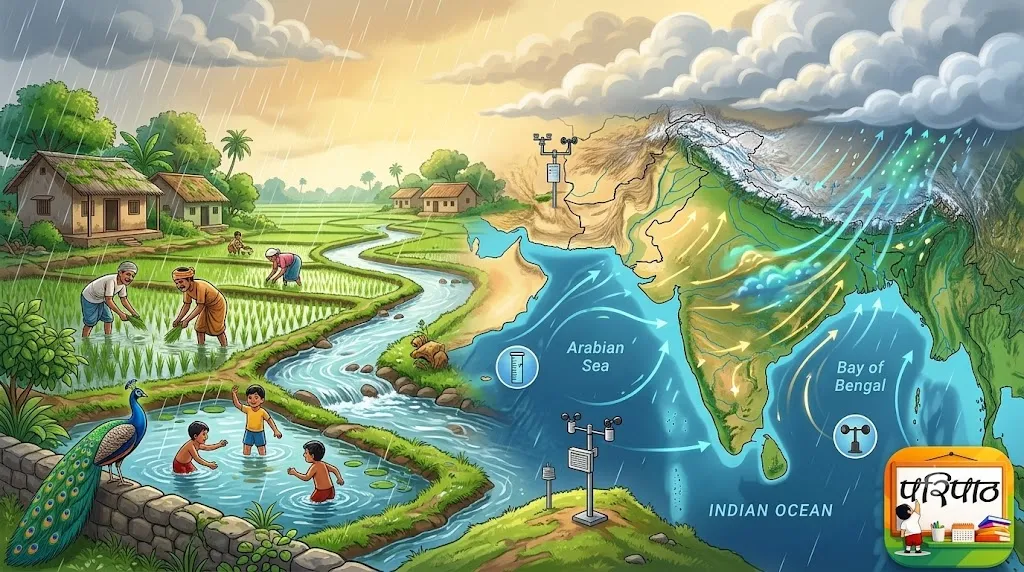
The term 'Monsoon' originates from the Arabic word 'Mausim,' meaning 'season.' Essentially, the monsoon refers to the seasonal reversal of winds. This process occurs due to the differential heating and cooling of land and sea. During summer, land heats up much faster and cools down quicker than water. This temperature difference creates pressure gradients, driving winds and bringing the much-awaited monsoon rains.
Key Characteristics of the Monsoon:
- Seasonal Wind Reversal: Winds blow from the sea to the land in summer and from the land to the sea in winter.
- Variability: Monsoon rainfall can be highly variable – sometimes excessive, sometimes deficient, and often erratic, leading to floods or droughts.
- Regional Diversity: The amount and timing of rainfall vary significantly across different regions of India.
The Science Behind the Monsoon: A Climatic Enigma
While seemingly complex, the monsoon's mechanism is rooted in fundamental scientific principles. The contrast in temperature between land and sea, the Earth's rotation (Coriolis effect), and the country's unique topography (mountains) all play vital roles in shaping this annual event.
1. Differential Heating and Pressure Gradients
- Summer Conditions: During May-June, the Indian subcontinent heats up intensely, creating a vast low-pressure zone over the landmass. In contrast, the Indian Ocean, heating slower, maintains a relatively high-pressure zone.
- Wind Movement: Air naturally flows from high-pressure areas to low-pressure areas. This gradient draws moisture-laden winds from the Indian Ocean towards the subcontinent.
- Intertropical Convergence Zone (ITCZ): This is a low-pressure belt near the equator that shifts northward in summer, forming a 'monsoon trough' that acts as a pathway for the monsoon winds.
2. The Coriolis Effect
- The Earth's rotation deflects moving objects, including winds. This is known as the Coriolis effect.
- Southeast trade winds from the Southern Hemisphere, upon crossing the equator, are deflected to their right due to the Coriolis effect. They then become the Southwest Monsoon winds, blowing towards the Indian subcontinent.
3. Role of Topography: Himalayas and Western Ghats
- Western Ghats: The moisture-laden winds from the Arabian Sea branch of the monsoon are obstructed by the Western Ghats. This causes heavy rainfall on the windward side (western slopes) and a rain shadow effect on the leeward side (eastern slopes).
- Himalayas: The Bay of Bengal branch of the monsoon winds is blocked by the mighty Himalayan ranges. This forces the winds to rise, cool, and shed their moisture, resulting in heavy rainfall across North and Northeast India. The Himalayas prevent these winds from moving further north into Tibet, effectively containing the monsoon within the subcontinent.
Types of Indian Monsoons
India primarily experiences two types of monsoons:
1. The Southwest Monsoon
- Period: June to September.
- Significance: This is the dominant monsoon, accounting for about 75-80% of India's total rainfall.
- Two Branches:
- Arabian Sea Branch: Arrives in Kerala around June 1st and progresses northward through Maharashtra, Gujarat, and Madhya Pradesh.
- Bay of Bengal Branch: Enters India through the northeastern states and moves westward along the Ganga plains.
2. The Northeast Monsoon (Retreating Monsoon)
- Period: October to December.
- Significance: While less widespread, it's crucial for states like Tamil Nadu, coastal Andhra Pradesh, Kerala, and parts of Karnataka.
- Mechanism: During winter, a high-pressure system develops over the land, and a low-pressure system over the Bay of Bengal. Winds blow from land to sea, picking up moisture over the Bay of Bengal and bringing rainfall to the southeastern coast of India.
Monsoon's Impact on Agriculture and Economy
India's economy, especially its agricultural sector, is heavily reliant on the monsoon. It is rightly called the 'lifeblood' of India.
1. Backbone of Agriculture
- Kharif Crops: The monsoon rains are vital for Kharif crops such as rice, jowar, bajra, maize, cotton, soybean, and sugarcane. Over 60% of India's cultivated land is dependent on monsoon rainfall for irrigation.
- Food Security and Production: A good monsoon ensures robust agricultural production, guaranteeing food security for the nation and boosting rural incomes.
- Livestock: Sufficient rainfall is essential for fodder crops and drinking water, which in turn supports the health and productivity of livestock.
2. Economic Cycle Driver
- Gross Domestic Product (GDP): Agriculture contributes significantly to India's GDP. A favorable monsoon leads to increased agricultural output, positively impacting overall GDP growth.
- Rural Economy: Monsoon-driven prosperity enhances the purchasing power of rural populations, leading to increased demand for industrial goods and services.
- Inflation Control: Adequate food grain production helps stabilize food prices, thereby keeping inflation in check.
Environmental Impact: Positive and Challenging
The monsoon has multifaceted environmental impacts, both beneficial and challenging.
Positive Environmental Impacts:
- Water Resource Replenishment: The monsoon recharges rivers, lakes, reservoirs, and groundwater tables, ensuring a supply of drinking water and water for irrigation.
- Rejuvenation of Flora: Rainwater nourishes trees, shrubs, and forests, contributing to lush greenery and helping absorb atmospheric carbon dioxide.
- Biodiversity Enhancement: The monsoon breathes life into countless plant and animal species, fostering rich biodiversity.
- Air Purification: Rain washes away dust and pollutants from the atmosphere, leading to cleaner air.
Challenging Environmental Impacts:
- Floods: Excessive rainfall can cause rivers to overflow, leading to devastating floods that damage crops, homes, and infrastructure. Urban areas often experience waterlogging, disrupting daily life.
- Droughts: Erratic or insufficient rainfall can lead to droughts, causing crop failure, water scarcity, and fodder shortages for livestock.
- Landslides: In hilly and mountainous regions, heavy rainfall can trigger landslides, blocking roads and posing a threat to life and property.
- Disease Outbreaks: Stagnant water during the monsoon season creates breeding grounds for mosquitoes, leading to an increase in water-borne and vector-borne diseases like malaria, dengue, and chikungunya.
Impact on Daily Life and Society
The monsoon profoundly influences our daily lives in numerous ways.
- Water Supply: Our household drinking water, as well as water for agriculture and industries, is largely dependent on the monsoon.
- Health: It's crucial to protect oneself from monsoon-related illnesses. Consuming clean water and maintaining hygiene in our surroundings are essential.
- Transportation: Rains can damage roads, disrupt railway services, and affect air travel, causing significant inconvenience for commuters.
- Recreation: Many people enjoy the monsoon season, relishing hot snacks, tea, and the refreshing downpour. It's a time for cozy indoor activities or enjoying nature's beauty.
Did You Know?
- Mawsynram in Meghalaya, India, holds the record for being the wettest place on Earth, with an average annual rainfall exceeding 11,872 mm.
- Approximately 60% of India's population is directly or indirectly dependent on the monsoon.
- ISRO (Indian Space Research Organisation) satellites like INSAT and Oceansat are crucial for monitoring monsoon movements and providing weather forecasts. On July 10, 2026, ISRO launched five British satellites, which could further aid in future weather observation and climate studies.
- A 'monsoon break' refers to a period when the intensity of monsoon rainfall reduces or stops for some time, typically occurring in July-August.
- Even Indian Navy ships like INS Savitri are prepared to face the challenges at sea during the monsoon season, ensuring the nation's maritime security.
Conclusion
In essence, the monsoon is the soul of India. It is the cornerstone of our nation's agriculture, economy, and environment. Understanding its scientific intricacies, acknowledging its positive and challenging impacts, and preparing for future climate changes are vital for all of us. As students, it's important for you to grasp the significance of this natural phenomenon and actively participate in water conservation initiatives. For the proper management of the monsoon is indeed the key to India's bright future.