
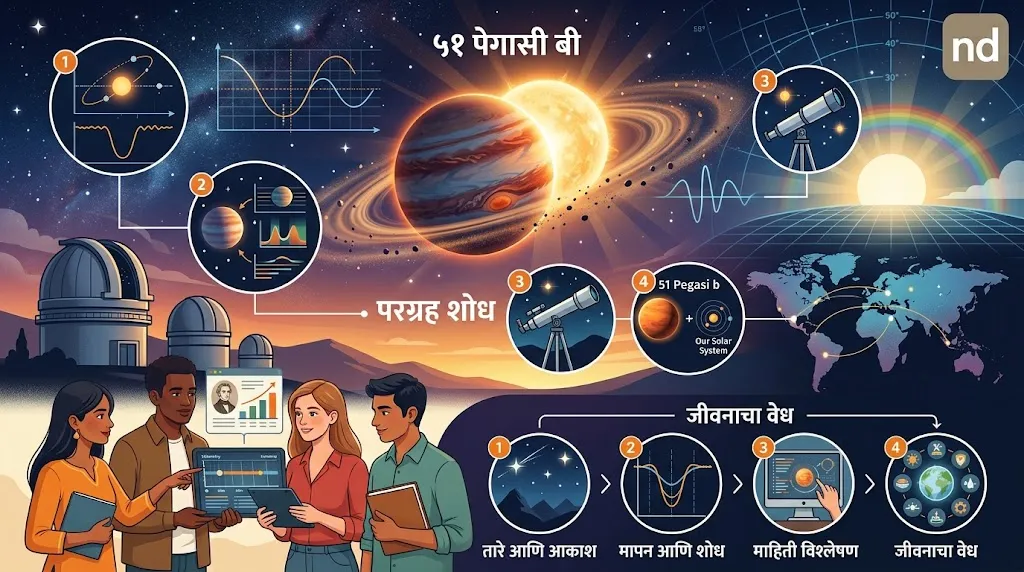
Gazing at the night sky, at the countless twinkling stars, have you ever wondered if there are other planets out there, orbiting those distant suns, perhaps even harboring life? This age-old question, once confined to the realm of science fiction and philosophical debate, took a giant leap towards reality exactly 26 years ago, on October 6, 1995.
On that pivotal day, two Swiss astronomers, Michel Mayor and Didier Queloz, announced the discovery of the first exoplanet orbiting a Sun-like star. This groundbreaking world was named 51 Pegasi b. It wasn't just the discovery of another celestial body; it was a paradigm shift, proving that our solar system was not unique and opening up a new era of exoplanet exploration. This single discovery fueled the realization that billions of exoplanets could exist in our Milky Way galaxy, giving tangible hope to humanity's quest for life beyond Earth.
As we mark the 26th anniversary of this historic event on October 6, 2026, let's embark on an incredible journey. We will explore what exoplanets are, delve into the captivating story of 51 Pegasi b, understand the innovative methods scientists use to detect these distant worlds, and ponder the profound implications these discoveries have for our understanding of the universe and the search for extraterrestrial life.
What Exactly are Exoplanets?
We are familiar with our own solar system, comprising the Sun and its eight planets: Mercury, Venus, Earth, Mars, Jupiter, Saturn, Uranus, and Neptune. However, beyond the confines of our solar system, orbiting other stars, lie countless other planets. These are known as exoplanets, a term derived from 'exo,' meaning 'outside' or 'beyond.'
For centuries, astronomers and philosophers speculated about the existence of planets beyond our Sun. Yet, their immense distance and tiny size made direct observation virtually impossible. Imagine trying to spot a tiny moth circling a distant streetlight – that's the challenge of finding an exoplanet. The overwhelming glare of their host stars effectively masks them.
Exoplanets are also referred to as 'extrasolar planets.' They are bound by gravity to their host stars, just as our planets are bound to the Sun. Some exoplanets might be rocky like Earth, while others could be colossal gas giants akin to Jupiter or Saturn. Some are truly bizarre, existing as diamond worlds, lava worlds, or even rogue planets drifting through space without a star.
To date, thousands of exoplanets have been discovered, with new ones being identified regularly. These discoveries have vastly expanded our knowledge of cosmic diversity and highlighted the unique characteristics of our own solar system.
51 Pegasi b: The Tale of a Historic Discovery
October 6, 1995, is etched in the annals of astronomy as a golden day. Michel Mayor and Didier Queloz, working at the Geneva Observatory in Switzerland, made history by announcing the discovery of an exoplanet orbiting the star 51 Pegasi. The significance of this finding was immense because 51 Pegasi is a star very much like our Sun.
How Was the Discovery Made?
Mayor and Queloz utilized the Radial Velocity Method, also known as Doppler Spectroscopy, to detect 51 Pegasi b. This method relies on observing the subtle 'wobble' of a star. Picture a large person and a small child holding hands and spinning. While the large person doesn't fully orbit the child, they do wobble slightly due to the child's gravitational pull. Similarly, as a planet orbits its star, its gravity exerts a tug on the star, causing the star to wobble ever so slightly.
This wobble is incredibly minute and is detected by analyzing changes in the star's light. When the star moves towards us, its light is slightly shifted towards the blue end of the spectrum (blueshift). When it moves away, its light is shifted towards the red end (redshift). This phenomenon is known as the Doppler Effect. Mayor and Queloz painstakingly detected these minute shifts in 51 Pegasi's light, confirming the presence of an unseen planet – 51 Pegasi b – orbiting it.
Characteristics of 51 Pegasi b
- Type: It is a 'Hot Jupiter.' This means it is a massive gas giant, similar to Jupiter, but it orbits extremely close to its host star.
- Orbit: 51 Pegasi b is located a mere 7 million kilometers (about 4.3 million miles) from its star, compared to Earth's 150 million kilometers (93 million miles) from the Sun. Consequently, it completes an orbit around its star in just 4.2 Earth days!
- Temperature: Due to its extreme proximity to its star, its surface temperature is estimated to be over 1000 degrees Celsius (1800 degrees Fahrenheit), making the existence of life as we know it highly improbable.
This discovery astonished astronomers, who had previously believed that large gas giants could not form so close to their stars. It challenged existing theories of planet formation and spurred new research.
"This discovery was truly revolutionary. It showed us that our solar system is not the only configuration in the universe, and that planets are ubiquitous around stars." - Michel Mayor.
Innovative Methods of Exoplanet Detection
Following the discovery of 51 Pegasi b, a plethora of new and refined methods for detecting exoplanets have been developed. Each method has its own strengths and limitations, and together, they provide us with a comprehensive understanding of these distant worlds.
1. Radial Velocity Method (Doppler Spectroscopy)
As discussed, this method was instrumental in finding 51 Pegasi b. Astronomers measure tiny shifts in the star's light caused by the gravitational tug of an orbiting planet. The periodic blueshifts (star moving towards us) and redshifts (star moving away) in the star's spectrum reveal the planet's mass and orbital period. This method is particularly effective for detecting massive planets, especially those close to their host stars.
2. Transit Method
Currently the most successful method for exoplanet discovery, the transit method involves observing temporary and periodic dips in a star's brightness. When an exoplanet passes directly in front of its star from our perspective (a 'transit'), it blocks a small fraction of the star's light. The amount of dimming depends on the planet's size. This method allows astronomers to determine the planet's diameter and orbital period. If the planet has an atmosphere, light passing through it can be analyzed to identify atmospheric components. NASA's Kepler and Transiting Exoplanet Survey Satellite (TESS) missions have used this method to discover thousands of exoplanets.
3. Direct Imaging
This is arguably the most challenging method because the star's light is incredibly bright, making it exceedingly difficult to directly image its much fainter planets. Imagine trying to spot a firefly next to a powerful searchlight. Direct imaging employs specialized techniques, such as 'coronagraphs,' which block out the star's glare, allowing the fainter light from orbiting planets to be detected. This method is primarily used for large, bright, and widely separated planets and can provide actual images and enable atmospheric studies.
4. Gravitational Microlensing
According to Einstein's theory of relativity, massive objects (like stars) can bend light that passes near them. When a star and its orbiting planet pass in front of a more distant star from our vantage point, their combined gravity can temporarily magnify the light from the background star. This phenomenon is called 'gravitational microlensing.' This method is particularly useful for detecting distant, low-mass planets that are difficult to find with other techniques.
5. Astrometry
Similar to the radial velocity method, astrometry directly measures the tiny side-to-side wobble of a star in the sky caused by the gravitational pull of an orbiting planet. As the planet tugs on its star, the star traces a small circle or ellipse in space. By precisely measuring these minute movements, astronomers can infer the planet's mass and orbit. This method requires extremely precise measurements and is expected to become more effective with future advanced telescopes.
These diverse methods have enabled astronomers to discover a wide variety of exoplanets, from small, rocky worlds like Earth to gas giants far larger than Jupiter. Each discovery adds to our growing understanding of the universe.
The Importance of Exoplanets in the Search for Life
The quest for exoplanets is not merely about finding new worlds; it is fundamentally about addressing one of humanity's most profound questions: Are we alone?
The Habitable Zone (Goldilocks Zone)
In the search for life, astronomers focus on the concept of the 'Habitable Zone', often nicknamed the 'Goldilocks Zone.' This is the region around a star where conditions are just right for liquid water to exist on a planet's surface. Liquid water is considered crucial for life as we know it, acting as a universal solvent for many biochemical reactions. If a planet is too close to its star, water would evaporate; too far, and it would freeze. Thus, planets within the habitable zone are considered the most promising candidates for hosting life.
Many exoplanets have been found within their stars' habitable zones. Examples include Proxima Centauri b, orbiting our closest stellar neighbor, and several planets within the TRAPPIST-1 system. Scientists are studying the atmospheres of these planets to search for components essential for life, such as oxygen, methane, and carbon dioxide.
Biosignatures and the Hunt for Life
To find evidence of life, scientists look for 'Biosignatures' – chemical indicators that suggest biological activity. For instance, Earth's atmosphere has a high concentration of oxygen due to photosynthesis by plants. If unusual levels of gases like oxygen or methane are detected in an exoplanet's atmosphere, it could be a strong indicator of life.
However, the presence of biosignatures alone is not definitive proof. They can also be produced by natural geological processes. Therefore, identifying life is an incredibly complex endeavor. Advanced telescopes like the James Webb Space Telescope (JWST) are instrumental in this pursuit, allowing detailed atmospheric analysis of exoplanets to identify their chemical compositions.
The sheer number of potential exoplanets offers tantalizing hope. The Milky Way galaxy alone is estimated to contain hundreds of billions of stars, and with an average of at least one planet per star, there could be over a hundred billion exoplanets in our galaxy. The probability that some of these are habitable, and perhaps even inhabited, is a driving force behind this research.
Future Discoveries and Challenges
The journey of exoplanet discovery is still in its early stages. Every day, new discoveries and technological advancements bring us closer to unraveling the mysteries of the cosmos.
The James Webb Space Telescope (JWST) and Future Observatories
NASA's James Webb Space Telescope (JWST) has proven to be a game-changer in exoplanet research. Operating in infrared light, JWST can peer through dust clouds and conduct in-depth atmospheric studies of exoplanets. It has already detected carbon dioxide and water vapor in the atmospheres of several exoplanets, injecting new momentum into the search for life.
In the future, NASA and other space agencies are planning numerous new telescopes and missions. The European Space Agency's (ESA) ARIEL (Atmospheric Remote-sensing Infrared Exoplanet Large-survey) telescope is specifically designed to study exoplanet atmospheres. Furthermore, next-generation ground-based observatories, such as the Extremely Large Telescopes (ELTs), are under construction and will significantly enhance our capabilities for direct exoplanet imaging.
Challenges Ahead
Discovering exoplanets and studying life on them is far from easy. Numerous challenges lie ahead:
- Vast Distances: Exoplanets are billions of kilometers away. Reaching them is currently impossible.
- Minute Observations: Directly imaging planets or identifying subtle chemical biosignatures in their atmospheres requires extremely advanced and precise technology.
- Rarity: We still don't fully understand how rare or common truly habitable planets are.
- Resources: These ambitious missions demand immense financial and human resources.
Overcoming these challenges requires international collaboration and novel scientific approaches. However, humanity's innate curiosity and drive to explore will undoubtedly propel us forward.
Conclusion
The discovery of 51 Pegasi b on October 6, 1995, ushered in a new era of astronomical exploration. This single finding not only confirmed the existence of planets beyond our solar system but also compelled us to reconsider our place in the universe. Michel Mayor and Didier Queloz demonstrated that direct observation isn't always necessary to find unseen worlds; observing their subtle gravitational effects can be equally, if not more, powerful.
Today, thousands of exoplanets have been discovered, each providing more clues about the diversity of the cosmos and the potential for life. Innovative techniques like the radial velocity method, transit method, and direct imaging allow us to characterize exoplanet atmospheres and search for vital biosignatures. Advanced observatories like the James Webb Space Telescope are proving to be monumental stepping stones in this journey.
The question of whether we are alone remains unanswered. Yet, the search for exoplanets brings us ever closer to an answer. This quest is not merely scientific; it is a grand voyage that ignites human imagination and curiosity. While the future holds untold discoveries, one thing is certain: the universe harbors many secrets, and humanity will always be eager to unravel them. These unknown worlds beyond our solar system will continue to inspire us for countless incredible discoveries to come.
Did You Know?
- The very first exoplanets were actually discovered in 1992 orbiting a pulsar (PSR B1257+12), but 51 Pegasi b was the first found orbiting a regular, Sun-like star.
- 'Hot Jupiters' are a common type of exoplanet found. These are massive gas giants that orbit extremely close to their host stars, resulting in scorching temperatures.
- Some exoplanets are so bizarre that they are theorized to have rain made of glass, or even be entirely composed of diamonds.
- The Kepler Space Telescope discovered over 2,700 confirmed exoplanets during its nine-year mission, significantly accelerating the pace of discovery.
- One exoplanet, WASP-12b, orbits so close to its star that the star's gravity is slowly tearing it apart, causing its gasses to be siphoned away.
