
Dear students and esteemed parents,
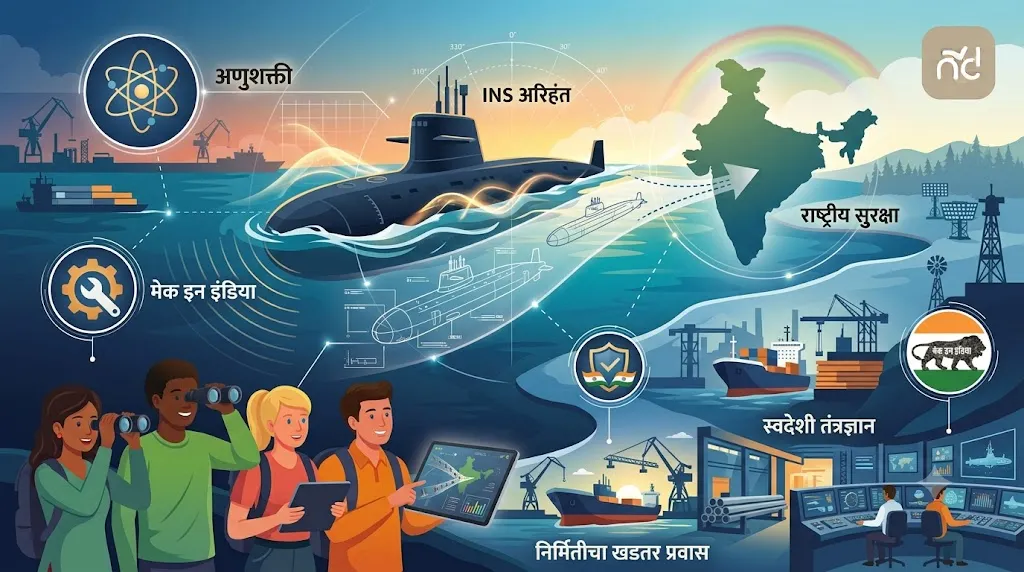
Today, we embark on a journey to explore an extraordinary Indian achievement that stands as a beacon of our nation's scientific and engineering capabilities. This marvel is INS Arihant, India's first indigenous nuclear-powered submarine. The name 'Arihant,' meaning 'destroyer of enemies,' is aptly chosen for this ambitious naval project. More than just a submarine, it is a living embodiment of the 'Make in India' vision, the dream of an Atmanirbhar Bharat (Self-Reliant India), and a testament to our nation's unwavering resolve.
As we reflect on October 6, 2026, let's delve into the past to understand the incredible journey behind the creation of this engineering wonder. Learning how Indian scientists and engineers overcame immense challenges to achieve this success is profoundly inspiring for all of us, especially the younger generation.
INS Arihant: Cornerstone of India's Strategic Deterrence
INS Arihant forms a crucial part of India's Nuclear Triad capability. A nuclear triad refers to the ability to launch nuclear weapons from land, air, and sea. While India adheres to a 'No First Use' policy, having a credible second-strike capability is paramount for national security. INS Arihant provides this vital sea-based nuclear deterrent, offering an impregnable shield to India's defense.
Operating silently beneath the waves, hidden from enemy surveillance, this submarine can conduct long-duration patrols and, if necessary, deliver a decisive retaliatory strike. This capability significantly enhances India's strategic prowess. It not only ensures our security but also solidifies India's position as a strong and responsible nuclear power on the global stage.
The Mega-Project of Indigenous Construction: A Daring Odyssey
The conception, design, and construction of INS Arihant were entirely carried out within India. This project commenced in the 1990s under the 'Advanced Technology Vessel (ATV) Project,' with the objective of developing indigenous nuclear-powered submarines. The project was shrouded in secrecy, involving thousands of Indian scientists, engineers, and technicians.
Designing and building a nuclear-powered submarine is considered one of the most complex engineering feats globally. Such a submarine incorporates numerous state-of-the-art systems, including a nuclear reactor, propulsion system, weapon systems, navigation systems, and life support systems. Integrating all these systems and ensuring their safe and efficient operation presented an enormous challenge.
Developing the Nuclear Reactor: A Complex Engineering Challenge
The most critical and intricate challenge in the construction of INS Arihant was the development of its compact Pressurized Water Reactor (PWR). This reactor had to fit within the confined space of the submarine and operate efficiently under extremely harsh conditions. This demanded cutting-edge technology, specialized materials, and stringent safety standards.
Scientists from India's Bhabha Atomic Research Centre (BARC) and the Defence Research and Development Organisation (DRDO) worked tirelessly to develop this reactor. The reactor grants Arihant the ability to remain submerged for extended periods, as it does not require frequent refueling. This represents a monumental achievement for India's nuclear energy program and indigenous technological capabilities.
Training and Technology Assimilation
In the initial phases of the project, India received some international assistance, particularly from Russia. Indian engineers and naval personnel underwent training in Russia to understand the design and operational aspects of Russian naval submarines. However, in the final design and construction, Indian scientists extensively applied their own intellect and skills. This was not merely a transfer of technology but an assimilation, adaptation, and improvement of that technology to develop indigenous solutions tailored to India's specific needs.
Dr. A.P.J. Abdul Kalam once stated, "Developing indigenous technology is not just crucial for economic self-reliance, but also for national pride." INS Arihant stands as a perfect embodiment of this philosophy.
INS Arihant: A Shining Example of 'Make in India'
The 'Make in India' initiative, launched by Prime Minister Narendra Modi, aims to transform India into a global manufacturing and technology hub. The INS Arihant project serves as an excellent and tangible example of the 'Make in India' concept, having commenced decades before the official launch of the initiative.
This project demonstrated that India is capable of developing any advanced technology on its own strength. It not only saved valuable foreign exchange but also generated employment within the country and boosted numerous industries. The knowledge and experience gained from this project have served as a guiding light for many future defense projects.
Pursuing a Career in STEM
If you aspire to work on projects like INS Arihant, choose the science stream after 10th grade. Pursue a degree in fields like engineering, physics, chemistry, or mathematics. Look for research and development (R&D) opportunities in organizations like DRDO, BARC, ISRO, or the Indian Navy. Gain practical experience through small projects and internships during your academic journey.
Inspiring Students: STEM and Nation-Building
The success story of INS Arihant is a tremendous inspiration for every student in India. This achievement tells us that with proper education, hard work, perseverance, and a desire to contribute to the nation, nothing is impossible. This is particularly inspiring for students who wish to pursue careers in Science, Technology, Engineering, and Mathematics (STEM).
- Science: The development of the nuclear reactor would not have been possible without fundamental research in fields like nuclear physics, chemistry, and metallurgy.
- Technology: Every system within the submarine, be it sensors, weapon systems, or communication systems, is based on cutting-edge technology.
- Engineering: Overcoming challenges in ship design, reactor integration, watertight structures, and numerous other complex engineering problems was crucial.
- Mathematics: Complex calculations, modeling, and simulations were essential at every stage of this project.
If you are considering studying in a STEM field today, you might get the opportunity to contribute to projects like INS Arihant. You can play a vital role in the nation's defense, development, and future. India needs many more 'Arihants' and even larger projects, and for that, the nation critically needs young talent like yours.
Conclusion
INS Arihant is not merely a naval weapon; it is a symbol of India's self-reliance, scientific might, and national determination. Its creation is the fruit of years of tireless effort, intellect, and sacrifice by Indian scientists and engineers. This success has secured India a strong position on the global stage and has greatly inspired our younger generation to pursue careers in STEM fields. Through 'Make in India,' we are not just manufacturing goods; we are building a strong, secure, and self-reliant India.
Did You Know?
- The INS Arihant project was known as the 'Advanced Technology Vessel (ATV)' project, which began in the 1990s.
- The submarine underwent extensive trials in the Bay of Bengal, where it successfully launched missiles.
- Arihant uses an 83 MW nuclear reactor, providing it with the capability to remain submerged for virtually unlimited periods (limited only by food supplies and crew needs).
- The submarine was officially commissioned into the Indian Navy in 2016, completing India's nuclear triad capability.
- INS Arihant can be armed with ballistic missiles with ranges of 750 km (K-15 Sagarika) and 3500 km (K-4).
