Earth's Cosmic Ballet: Axial Tilt and Revolution
We all know that our Earth orbits the Sun, a journey we call 'revolution'. This revolution takes approximately 365 days, marking one complete year. However, merely orbiting the Sun isn't enough to explain the changing seasons. The true secret lies in a crucial astronomical phenomenon: Earth's axial tilt.
Imagine our Earth not standing perfectly upright, but tilted slightly on its axis, like a spinning top leaning to one side. This tilt is approximately 23.5 degrees relative to its orbital plane (the path it takes around the Sun). What's remarkable is that this tilt remains constant as Earth revolves. This means that at different points in its orbit, one hemisphere (half of the Earth) leans more towards the Sun, while the other leans away.
- When a hemisphere tilts towards the Sun: It receives more direct and intense sunlight. This leads to warmer temperatures and longer days, marking the summer season.
- When a hemisphere tilts away from the Sun: It receives indirect and less intense sunlight. This results in cooler temperatures and shorter days, bringing about winter.
It is this consistent axial tilt, combined with Earth's revolution, that orchestrates the beautiful cycle of seasons we experience. Without this tilt, if Earth were perfectly upright, every region would experience roughly the same climate year-round, and seasons as we know them wouldn't exist!
The Balance Points: Understanding Equinoxes
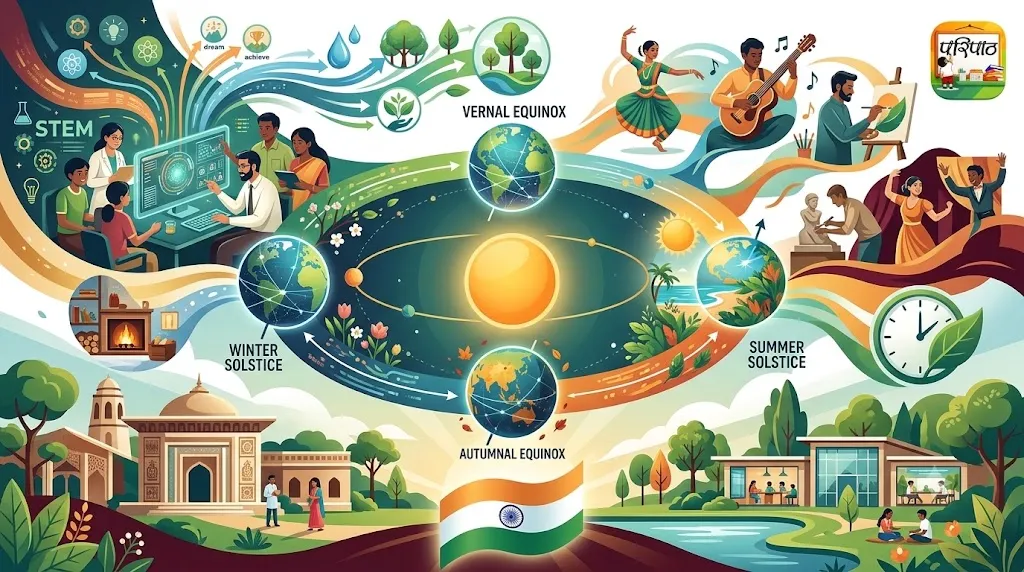
The word 'equinox' comes from Latin, meaning 'equal night'. Twice a year, specific moments occur when neither of Earth's hemispheres is tilted towards or away from the Sun. At these times, the Sun's rays fall directly on the Equator, resulting in nearly equal day and night lengths (approximately 12 hours each) across most parts of the globe. These events are known as equinoxes.
1. Vernal (Spring) Equinox
This equinox typically falls on March 20th or 21st. On this day, the Sun is directly overhead the Equator. Following the Vernal Equinox, the Northern Hemisphere begins to receive more direct sunlight, leading to longer days and the onset of spring. In India, this period marks the gradual increase in temperatures, signaling the approach of summer.
Ever noticed? After March, days progressively get longer, and the heat intensifies. This is a direct consequence of the Vernal Equinox, as the Northern Hemisphere starts leaning more towards the Sun.
2. Autumnal Equinox
This equinox usually occurs on September 22nd or 23rd. Similar to the Vernal Equinox, the Sun is directly overhead the Equator, making day and night lengths approximately equal. After the Autumnal Equinox, the Northern Hemisphere begins to tilt away from the Sun, resulting in shorter days and the arrival of autumn. In India, this period signifies the retreating monsoon and the gradual onset of cooler weather.
Many Indian festivals are intrinsically linked to these seasonal shifts. For instance, festivals like Dussehra and Diwali, celebrated after the Autumnal Equinox, herald the arrival of winter and the changing natural landscape.
Extremes of Light: Decoding Solstices
The term 'solstice' means 'Sun stands still' in Latin. Twice a year, moments arrive when Earth's tilt causes one of its hemispheres to be maximally tilted towards or away from the Sun. This results in the longest day and shortest night in one hemisphere, and vice-versa in the other. These events are called solstices.
1. Summer Solstice
This solstice typically occurs on June 20th or 21st. On this day, the Northern Hemisphere is tilted most directly towards the Sun. Consequently, the Northern Hemisphere experiences the longest day and shortest night of the year. The Sun is directly overhead the Tropic of Cancer.
- Countries in the Northern Hemisphere, like India, experience their longest day.
- This period marks the peak of summer in the Northern Hemisphere.
- Regions along the Tropic of Cancer receive the most intense direct sunlight.
The intense heat of June in India and the anticipation of the monsoon are directly related to the Summer Solstice.
2. Winter Solstice
This solstice usually falls on December 21st or 22nd. On this day, the Northern Hemisphere is tilted farthest away from the Sun, while the Southern Hemisphere is tilted most towards it. As a result, the Northern Hemisphere experiences the shortest day and longest night of the year. The Sun is directly overhead the Tropic of Capricorn.
- Countries in the Northern Hemisphere, including India, experience their shortest day.
- This period brings the coldest temperatures to the Northern Hemisphere.
- Regions along the Tropic of Capricorn receive the most intense direct sunlight.
The biting cold of December and the shorter daylight hours in India are consequences of the Winter Solstice.
Seasons in India: A Unique Perspective
India, situated in the Northern Hemisphere with the Tropic of Cancer passing through its middle, experiences the profound impact of equinoxes and solstices on its seasonal patterns:
- March (Vernal Equinox): Days lengthen, and summer begins to set in, bringing rising temperatures and pre-monsoon showers in some regions.
- June (Summer Solstice): This is often the hottest period in India, with the longest day. It is closely followed by the arrival of the life-giving monsoon, crucial for Indian agriculture.
- September (Autumnal Equinox): Days start to shorten, the monsoon retreats, and cooler, more pleasant weather sets in, marking the transition to autumn.
- December (Winter Solstice): This is the coldest period in India, with the shortest day. Northern India experiences severe cold during this time.
This natural cycle is deeply interwoven with Indian culture, festivals, and the economy, especially agriculture. Our ancestors meticulously observed these changes to establish agricultural calendars and seasonal celebrations.
Did You Know?
- Mars also experiences seasons due to its axial tilt, which is similar to Earth's (around 25 degrees).
- Many ancient monuments around the world, like Stonehenge, are aligned with the solstices, showcasing humanity's long-standing fascination and understanding of these celestial events.
- Regions near the Equator experience roughly 12 hours of daylight throughout the year and do not observe significant seasonal changes.
- At the North and South Poles, the Summer Solstice brings 24 hours of daylight, while the Winter Solstice brings 24 hours of darkness.
- The Sanskrit terms 'Uttarayana' (when the Sun appears to move north) and 'Dakshinayana' (when the Sun appears to move south) are ancient Indian concepts related to the solstices.
Conclusion
Equinoxes and solstices are not just astronomical terms; they are pivotal moments in Earth's grand cosmic dance around the Sun. The combination of Earth's consistent axial tilt and its continuous revolution creates the beautiful and vital cycle of seasons that define our planet. Understanding these scientific reasons enriches our appreciation for nature, our climate, and the intricate movements of our home planet. The next time you feel the warmth of summer or the chill of winter, remember the incredible celestial mechanics at play and marvel at Earth's amazing journey!