The year 1947 heralded a new dawn for India, bringing with it both the joy of independence and the pain of partition. Two new nations, India and Pakistan, emerged on the global map, a division that severed not just land but also emotions and historical ties. During this tumultuous period, over 560 princely states under British paramountcy were given the choice to accede to either India or Pakistan, or to remain independent. Among these, Jammu & Kashmir stood out—a region of immense historical, geographical, and cultural significance. The events of October 1947 in Jammu & Kashmir irrevocably altered the course of Indian history, serving as a powerful reminder of India's sovereignty and national integration.
Independence and the Princely States' Dilemma:
On August 15, 1947, India gained independence, but not before the British government presented the princely states with a critical choice. They could join India, join Pakistan, or declare independence. Most states, guided by their geographical location and demographic composition, opted to join either India or Pakistan. Sardar Vallabhbhai Patel's visionary leadership and astute diplomacy ensured the peaceful integration of the majority of these states into India. However, a few states presented complex challenges, and Jammu & Kashmir was one of the most intricate.
Jammu & Kashmir's Unique Geopolitical Position
Jammu & Kashmir was the largest princely state in British India, sharing borders with India, Pakistan, China, and Afghanistan. With a population of approximately 4 million, it was a Muslim-majority state, though regions like Jammu had significant Hindu and Buddhist populations. Maharaja Hari Singh, a Hindu ruler, governed this diverse state. At the time of partition, the Maharaja initially decided against acceding to either India or Pakistan, preferring to remain independent. He proposed 'Standstill Agreements' with both nations to maintain existing administrative arrangements. While Pakistan promptly accepted, India sought further discussions, leaving J&K's status in limbo.
"Kashmir is the jewel in the crown of India."
- Pandit Jawaharlal Nehru
Maharaja Hari Singh's Predicament and Pakistan's Pressure:
Maharaja Hari Singh harbored ambitions of transforming Kashmir into the 'Switzerland of Asia,' remaining aloof from both newly formed dominions. His neutrality was partly aimed at balancing the diverse communities within his state and preserving its autonomy. However, this neutrality proved unsustainable under mounting pressure.
Escalating Tensions and Blockade
Pakistan, coveting Kashmir due to its Muslim-majority population and strategic location, began to exert pressure on the Maharaja. They imposed an economic blockade, cutting off essential supplies like fuel, salt, and food grains to Kashmir, plunging the state into an economic crisis. Simultaneously, Pakistan instigated unrest along the borders, making governance increasingly difficult for the Maharaja.
The October 1947 Invasion: A Race Against Time:
On October 22, 1947, a horrifying chapter unfolded in Kashmir's history. Pakistan, under the guise of 'Azad Kashmir Force,' unleashed thousands of tribal lashkars (militias) from the North-West Frontier Province into Kashmir. These tribesmen, often with military training and full backing from the Pakistani army, had a singular objective: to seize Srinagar, the capital.
The Brutality of the Tribal Invasion
The invaders entered Kashmir via Muzaffarabad, leaving a trail of destruction in their wake. They plundered villages, set them ablaze, committed heinous atrocities against women, and massacred innocent civilians. Towns like Muzaffarabad, Uri, Baramulla, and Poonch bore the brunt of their savagery. Even European nurses and doctors at St. Joseph's Mission Hospital in Baramulla were not spared. The speed and ferocity of the invasion overwhelmed the small state forces of Kashmir.
- October 22: Tribal raiders launch their offensive on Muzaffarabad.
- October 24: Uri falls to the invaders.
- October 26: Baramulla witnesses widespread massacres and looting, with Srinagar just a few miles away.
The Instrument of Accession: A Defining Moment:
As the invaders rapidly advanced towards Srinagar, Maharaja Hari Singh and his administration found themselves in a desperate situation. With little time left to save the capital, the Maharaja appealed to India for military assistance. India responded swiftly but with a crucial condition: under international law, military intervention in another sovereign state was impermissible without its formal accession. Therefore, for India to provide aid, Jammu & Kashmir had to become an integral part of India.
Signing the Instrument of Accession
On October 26, 1947, Maharaja Hari Singh formally requested India's help and signed the 'Instrument of Accession,' a legal document that integrated Jammu & Kashmir into the Dominion of India. V.P. Menon, representing the Government of India, flew from Delhi to Srinagar to secure the Maharaja's signature. According to this agreement, Jammu & Kashmir ceded control over defense, external affairs, and communications to the Government of India, while retaining autonomy in all other matters.
The Daring Indian Military Intervention
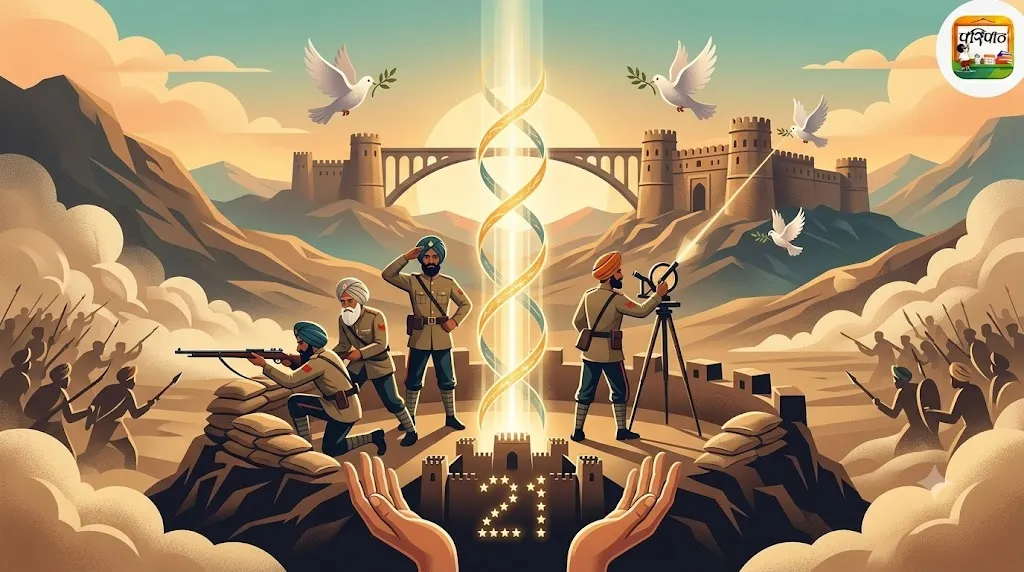
Immediately after the signing, India launched a daring military operation. In the early hours of October 27, 1947, the first contingent of Indian troops was airlifted from Delhi to Srinagar. Under the command of Major General Kulwant Singh, these brave soldiers successfully prevented the invaders from entering Srinagar. The Indian Army fought valiantly under challenging conditions, securing the Srinagar airfield. Subsequently, Indian forces began pushing back the invaders, reclaiming a significant portion of Kashmir. However, some areas remained under the control of the raiders, which are now known as 'Pakistan Occupied Kashmir' (PoK).
The Aftermath and Enduring Significance:
The accession of Jammu & Kashmir in October 1947 was a watershed moment in India's history. This decision made Jammu & Kashmir an inalienable part of India, strengthening the nation's unity and territorial integrity.
A Symbol of National Integration
Kashmir's accession was not merely the integration of a princely state; it symbolized India's commitment to unity in diversity and its unwavering sovereignty. India had embarked on a journey to build a democratic, federal republic, and Kashmir's integration was a vital step in fulfilling that resolve.
The United Nations and its Role
India soon took the issue to the United Nations, which led to a ceasefire but also internationalized the Kashmir dispute. The UN called for a plebiscite, which has never been fully implemented due to Pakistan's failure to withdraw its troops completely from the illegally occupied territories.
Upholding India's Sovereignty: The Legacy of 1947:
The events of October 1947 unequivocally demonstrated India's resolve to protect its territory and its citizens at any cost. Maharaja Hari Singh's timely decision, India's swift and decisive action, and the valor of the Indian Army saved Kashmir and cemented its status as an integral part of India.
Contemporary Relevance
Even today, Jammu & Kashmir remains an inalienable part of India. This historic event solidified the foundations of India's national integration and sovereignty. It serves as a powerful reminder of the immense value of freedom and unity, and the sacrifices required to preserve them.
Did You Know?
- Jammu & Kashmir was not the only princely state that required military action for its integration into India. Junagadh and Hyderabad also necessitated military intervention.
- October 27 is celebrated as 'Infantry Day' by the Indian Army, commemorating the day the first Indian troops landed in Srinagar.
- After signing the Instrument of Accession, Maharaja Hari Singh temporarily handed over the administration of the state to his son, Yuvraj Karan Singh.
- Over 3,000 innocent civilians were reportedly massacred in Baramulla during the Pakistan-backed tribal invasion.
- At the time of accession, Pandit Jawaharlal Nehru was India's Prime Minister, and Sardar Vallabhbhai Patel was the Home Minister.
Conclusion
The story of Jammu & Kashmir's accession in October 1947 is more than just a historical record; it is a saga of courage, determination, and an unwavering commitment to national integration. Maharaja Hari Singh's timely decision, India's immediate and effective assistance, and the unparalleled bravery of the Indian Army saved Kashmir from falling into hostile hands. This event not only made Jammu & Kashmir an integral part of India but also affirmed India's sovereignty. It teaches us that national security and integrity are paramount priorities for any nation, and making the right decisions at the right time is crucial for their preservation.