Hello, young learners!
Today, September 23rd, 2026, holds a special significance for many reasons. While we observe festivals like Vaman Jayanti and Shravan Dwadashi, and commemorate events like International Day of Sign Languages, the launch of the Ayushman Bharat Yojana, and the passing of Dr. Raja Ramanna and Madhavrao Bagal, alongside the birthday of cricketer Ambati Rayudu, there's also a magnificent astronomical event that occurs around this time: the Autumnal Equinox. This is when we experience roughly equal lengths of day and night. But why does this happen? What cosmic secret lies behind this phenomenon? Let’s embark on a journey to explore the wonders of the equinox and understand the unique dance between our Earth and the Sun.
What is the Autumnal Equinox? A Celestial Balancing Act
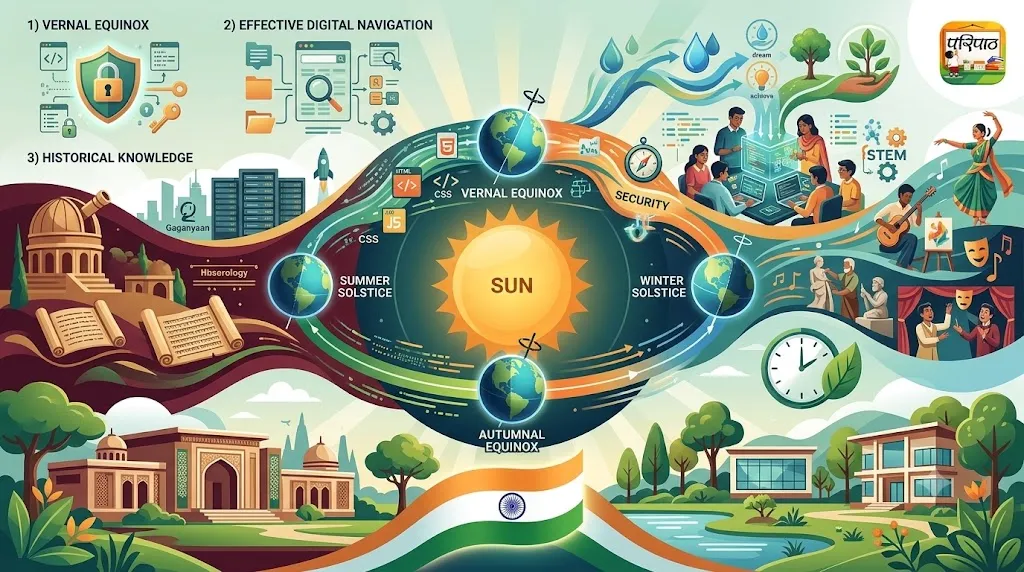
The word 'equinox' comes from two Latin words: 'aequus', meaning 'equal', and 'nox', meaning 'night'. So, literally, it means 'equal night'. This perfectly describes the event: a day when the length of daylight and darkness are almost precisely equal across most parts of the globe. There are two equinoxes each year: the Vernal (or Spring) Equinox, which usually occurs around March 20th or 21st, and the Autumnal (or Fall) Equinox, which typically falls around September 22nd or 23rd. Given today's date, we are right around the Autumnal Equinox.
For the Northern Hemisphere, the Autumnal Equinox marks the traditional beginning of autumn, a season of changing leaves and cooler temperatures. Conversely, for the Southern Hemisphere, it signals the start of spring, a time of blossoming flowers and renewed life. It’s a truly remarkable event that profoundly impacts life and seasons across our planet.
The Sun's Position During an Equinox
During an equinox, the Sun is directly overhead the Earth's equator. Imagine standing on the equator at noon; the Sun would be directly above you. At this precise moment, the Sun's rays strike the Earth perpendicular to its axis. This unique alignment means that both the Northern and Southern Hemispheres receive an almost equal amount of sunlight. This equal distribution of light across the globe leads to the near-equal duration of day and night everywhere (with slight variations due to atmospheric refraction and the definition of sunrise/sunset, but generally, it's a balance).
Earth's Tilt and Orbital Dance: The Architects of Seasons
To truly grasp why day and night become equal during an equinox, we need to understand two fundamental aspects of our planet's movement:
1. Earth's Tilted Axis
Our Earth isn't spinning upright; it's tilted on its axis by approximately 23.5 degrees. Picture a spinning top that's slightly leaning as it twirls. Earth's axis is an imaginary line connecting the North and South Poles, around which our planet rotates (spins). This tilt remains constant, always pointing in the same direction in space (towards Polaris, the North Star).
2. Orbit Around the Sun
Beyond spinning on its axis, Earth also journeys around the Sun in an elliptical orbit. This grand celestial journey takes about 365.25 days, which we call a year. As Earth travels along its orbit, its tilted axis maintains its fixed orientation in space. This means that at different points in its orbit, different parts of Earth are tilted more directly towards or away from the Sun.
How Seasons Are Born
The combination of Earth's axial tilt and its orbit around the Sun is what creates our seasons. When the Northern Hemisphere is tilted towards the Sun, it receives more direct and intense sunlight, leading to summer. At the same time, the Southern Hemisphere is tilted away, experiencing winter. Six months later, as Earth continues its orbit, the situation reverses: the Southern Hemisphere tilts towards the Sun for its summer, and the Northern Hemisphere experiences winter.
Why Do We Experience Equal Day and Night During an Equinox?
Now, let's connect these concepts back to the equinox. Twice a year, as Earth travels in its orbit, it reaches a point where its axis is neither tilted towards nor away from the Sun. In other words, neither the North Pole nor the South Pole is leaning more towards the Sun. This specific orbital position is called the Equinoctial Position.
During an equinox, the Sun's rays hit the Earth parallel to its axis and perpendicular to the equator. This results in the Sun's light being distributed evenly across both hemispheres. Consequently, every location on Earth (barring the extreme polar regions where the concept of day/night differs) experiences approximately 12 hours of daylight and 12 hours of darkness. The Sun rises precisely due east and sets precisely due west on these days, a phenomenon that doesn't occur on any other day of the year.
Autumnal Equinox and the Northern Hemisphere
Around the Autumnal Equinox in September, the Northern Hemisphere transitions from summer to winter. From this day onward, the days in the Northern Hemisphere gradually become shorter, and the nights grow longer, as this hemisphere begins to tilt more away from the Sun. Conversely, in the Southern Hemisphere, days start to lengthen, and nights shorten, as it begins to tilt more towards the Sun.
The Astronomical and Cultural Significance of the Autumnal Equinox
Beyond its astronomical importance, the equinox holds deep natural and cultural significance.
1. Natural Transitions and Seasonal Cycles
The Autumnal Equinox signals the arrival of autumn in the Northern Hemisphere. Leaves begin to change color, the air grows crisp, and nature prepares for winter's slumber. Farmers in many regions harvest their summer crops and prepare their fields for winter planting. In the Southern Hemisphere, it's a time of renewal and growth as spring begins.
2. Ancient Civilizations and Festivals
Many ancient cultures recognized and celebrated the equinoxes and solstices, using them as markers for calendars, agricultural cycles, and religious ceremonies. For instance, in Japan, the Autumnal Equinox is known as 'Shubun-no-hi' and is a national holiday dedicated to honoring ancestors. Ancient structures like the Mayan ruins in Mexico and Stonehenge in Britain show sophisticated astronomical alignments related to the equinoxes, demonstrating the profound understanding and reverence ancient peoples had for these celestial events. Even today, many cultures observe harvest festivals and days of thanksgiving around this time.
Beyond the Science: How Equinoxes Shape Our World
The equinox is not just an astronomical event; it subtly influences our daily lives in various ways.
1. Climate and Weather Patterns
The shift in daylight hours following the equinox leads to noticeable changes in weather. In the Northern Hemisphere, less direct sunlight means temperatures begin to drop, signaling the onset of winter. Migratory birds begin their long journeys, and animals prepare to store food for the colder months.
2. Agriculture and Harvests
In India, the period around the Autumnal Equinox is crucial for agriculture, marking the harvesting of Kharif crops and the preparation for sowing Rabi crops. These seasonal transitions directly impact agricultural productivity, making the equinox a vital marker for farmers.
3. Energy Consumption and Light Availability
As daylight hours shorten, the reliance on artificial lighting in homes and offices increases, affecting energy consumption. For those utilizing solar power, the changing duration of daylight significantly impacts energy generation.
Sparking Curiosity: The Equinox as a Gateway to Astronomy
Events like the equinox inspire us to learn more about our planet and the vast universe. It's not just an astronomical occurrence; it teaches us about Earth's relationship with the Sun, the creation of seasons, and the delicate balance of nature. Through studying such phenomena, humanity developed calendars, navigated the seas, and devised methods to measure time. This knowledge continues to aid us in unlocking the mysteries of new planets, stars, and the cosmos.
Did You Know?
- Meaning of 'Equinox': The word 'equinox' comes from Latin, meaning 'equal night'.
- Twice a Year: Equinoxes occur twice annually – the Vernal (Spring) Equinox in March and the Autumnal (Fall) Equinox in September.
- Sun Over Equator: On the day of an equinox, the Sun is directly overhead the Earth's equator, causing its rays to fall perpendicularly there.
- Polar Balance: During an equinox, both the North and South Poles are equidistant from the Sun, receiving an equal amount of light.
- East-West Sunrise/Sunset: On the equinox, the Sun rises precisely due east and sets precisely due west everywhere on Earth, a unique occurrence throughout the year.
Conclusion
Dear students, the Autumnal Equinox is more than just a date on the calendar; it's a testament to the Earth's magnificent motion and the profound balance of nature. The tilt of our planet's axis and its graceful orbit around the Sun are the fundamental reasons behind the changing seasons and the equal duration of day and night during the equinoxes. This event underscores the importance of natural laws and encourages us to delve deeper into the wonders of astronomy.
Next time you experience the near-equal length of day and night around September 22nd or 23rd, remember the incredible cosmic science behind it. Stay curious, keep exploring the scientific phenomena around us, and continue your journey of knowledge with 'Paripath'!