Hello, students! Have you ever wondered about the most incredible organ in your body? It's your brain! This amazing organ doesn't just control your body's functions; it gives you the extraordinary abilities to think, learn, and remember. Imagine having a supercomputer inside your head, capable of processing vast amounts of information, generating new ideas, and storing every experience of your life! Today, we're going to explore the structure and function of this magnificent brain. We'll also understand how learning, memory, and critical thinking processes occur, and we'll provide simple, science-backed tips to help you maximize your brain's potential. Let's dive into the fascinating world of your brain!
The Brain's Architecture: Your Personal Supercomputer
The human brain is an incredibly complex organ, weighing about 1.5 kilograms, yet it consumes roughly 20% of your body's total energy. Understanding its intricate structure can truly empower you to believe in your own capabilities.
Key Parts of the Brain:
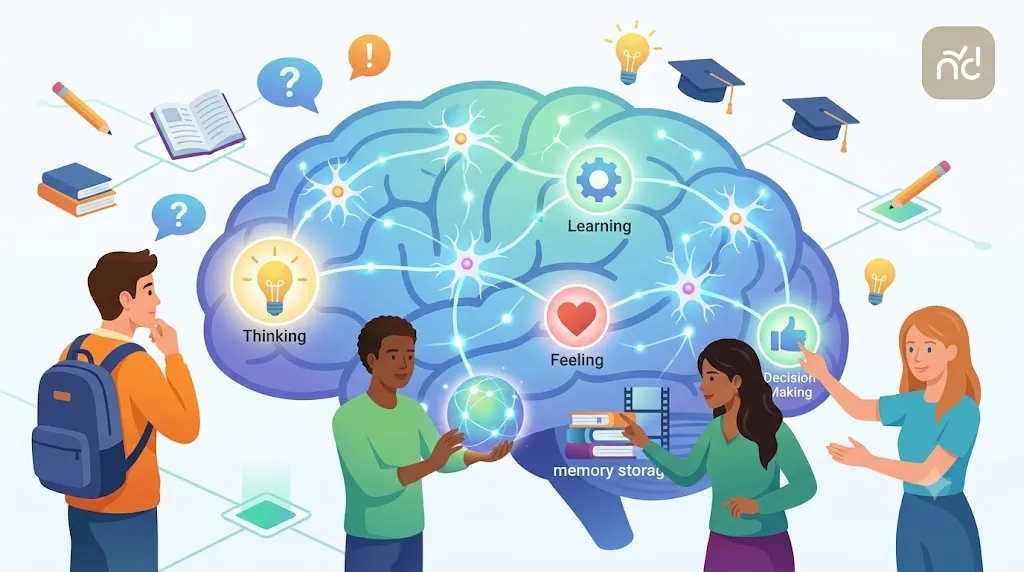
- The Cerebrum: This is the largest part of the brain, divided into two hemispheres (left and right). It controls conscious thoughts, language comprehension, decision-making, emotions, and voluntary movements. The left hemisphere is typically associated with language and logic, while the right is linked to creativity and spatial awareness.
- The Cerebellum: Often called the 'little brain,' this part is located beneath the cerebrum and at the back of the brain. It's crucial for maintaining balance, coordinating movements, and refining fine motor skills (like writing or riding a bicycle).
- The Brainstem: This connects the brain to the spinal cord. It regulates involuntary but vital bodily functions such as breathing, heart rate, blood pressure, and sleep.
Neurons and Synapses: The Information Network
Your brain is made up of billions of tiny cells called neurons. These neurons communicate with each other through electrical and chemical signals. The point where two neurons connect is called a synapse. When you learn or experience something new, new synapses are formed, or existing ones are strengthened. This ability of the brain to change and adapt itself is known as neural plasticity. It's why we can learn new things, develop new skills, and even change old habits.
Did you know? The human brain contains approximately 86 billion neurons, which is more than the number of stars in our galaxy!
How We Learn: The Brain's Information Highway
Learning isn't just about reading books or listening to lectures; it's a complex process where your brain takes in new information, processes it, and stores it. Let's see how this process unfolds:
1. Sensory Input:
We gather information about the world through our senses: sight, hearing, smell, taste, and touch. Everything you read, hear, or experience is fed into your brain.
2. Attention and Focus:
Your brain cannot process thousands of things at once. It decides what information to focus on. The things you pay attention to are registered more effectively in your brain. Concentrating on what your teacher is explaining or what you are reading is crucial. The prefrontal cortex plays a significant role in directing your attention.
3. Working Memory:
When you focus on new information, it's temporarily held in your working memory. This is a short-term storage area where you actively think about and process information. For example, when solving a math problem, you hold numbers and formulas in your working memory.
4. Encoding Information:
For information in working memory to be remembered long-term, it needs to be encoded. Encoding means transforming information into a format that makes it easier for the brain to store and retrieve later. You can use several techniques for this:
- Active Engagement: Instead of just reading, take notes, ask questions, explain concepts to others, or summarize the information. This makes your brain process the information more deeply.
- Giving Meaning: Connect new information to your existing knowledge or experiences. For example, relate historical events to current situations.
- Visualization: Create mental images or pictures of the information.
- Repetition: Review information repeatedly, but make sure it’s not just rote memorization.
Mastering Memory: Strategies for Lasting Retention
Whether for exams or daily life, a good memory is invaluable. Let's explore how your brain forms memories and how you can strengthen them.
Types of Memory:
- Declarative Memory: This includes facts and events. E.g., the capital of India, what movie you watched last night. It has two subtypes:
- Semantic Memory: General knowledge, facts, concepts.
- Episodic Memory: Personal life events and experiences.
- Procedural Memory: Memory for how to do skills and habits. E.g., riding a bicycle, swimming, playing the piano.
The hippocampus, a part of the brain, plays a vital role in forming new declarative memories.
Science-Backed Tips to Enhance Memory:
- Spaced Repetition: Review newly learned material immediately, then after a few hours, then a day, a week, and finally a month. This helps the brain store information long-term. Flashcards are excellent for this.
- Chunking: Break down large pieces of information into smaller, meaningful chunks. For example, when remembering a phone number, break the 10-digit number into 3-4 digit groups.
- Mnemonics: Create songs, rhymes, acronyms, or funny stories to remember information. E.g., 'VIBGYOR' for the colors of the rainbow.
- Visualization and Association: Create mental images of the information you want to remember and associate it with something you already know. The more bizarre and humorous the image, the easier it will be to recall.
- Sleep and Memory: Getting enough sleep is crucial for memory. During sleep, your brain reviews the information learned during the day and consolidates it into long-term memory. Aim for 7-9 hours of sleep per night.
- The Teaching Method (Feynman Technique): Explain what you've learned to someone else. This helps you understand how well you've grasped the information and clarifies your concepts.
Cultivating Critical Thinking: Beyond Rote Learning
Simply gathering information isn't enough; analyzing it, evaluating it, and making decisions based on it is the hallmark of critical thinking. Critical thinking is a crucial skill for your academic success and future life.
What is Critical Thinking?
Critical thinking is the ability to objectively and logically analyze information, identify problems, explore alternatives, and make sound judgments. It involves:
- Analysis: Breaking down information into smaller parts and examining each part in depth.
- Evaluation: Assessing the truthfulness, relevance, and reliability of information.
- Inference: Drawing logical conclusions based on available information.
- Problem Solving: Identifying problems, finding their causes, and devising effective solutions.
How to Develop Critical Thinking Skills:
- Ask Questions: Always ask 'why?', 'how?', 'what if?' before accepting information. Verify its truthfulness.
- Consider Different Perspectives: Understand that there can be multiple viewpoints on a problem or topic. Try to understand others' thoughts, even if they don't align with yours.
- Understand Logical Arguments: Examine the reasoning and evidence behind any statement. Stay away from emotional or biased thinking.
- Practice Problem-Solving: Try to solve math problems, puzzles, or everyday challenges.
- Engage in Discussions and Debates: This gives you an opportunity to present your ideas and listen to others, sharpening your thoughts.
- Evaluate Information Sources: With the abundance of information online today, develop the ability to discern which information is reliable and which is not.
Nurturing Your Brain: Habits for Optimal Learning
Your brain will only function effectively if it's healthy. Here are some essential habits to keep your brain in top condition:
- Nutritious Diet: The brain needs a healthy diet to function properly. Consume foods rich in Omega-3 fatty acids (fish, walnuts), antioxidants (fruits, vegetables), and whole grains. Avoid excessive sugar and processed foods, as they can negatively impact brain function.
- Regular Exercise: Physical activity is not just good for your body, but also vital for your brain. Exercise increases blood flow to the brain, providing more oxygen and nutrients. It also helps in the creation of new neurons.
- Adequate Sleep: As mentioned earlier, sleep is essential for memory consolidation and brain repair. Students need 7-9 hours of sleep per night.
- Stress Management: Chronic stress negatively impacts brain function, especially memory and concentration. Try to reduce stress through meditation, yoga, hobbies, or talking to friends.
- Keep Learning New Things: Learning a new language, playing an instrument, solving puzzles, or acquiring new skills keeps the brain active and enhances its plasticity.
- Take Breaks: Instead of studying for many hours continuously, take 10-15 minute breaks every 45-60 minutes. This refreshes your brain and helps maintain concentration.
Did You Know?
- Your brain is more active at night than during the day, even when you're sleeping.
- The human brain is composed mostly of water, fat, and protein. About 75% of it is water.
- Brain cells (neurons) generally don't divide, but new synapses are formed, and old ones are strengthened.
- The brain itself doesn't feel pain because it lacks pain receptors. This is why brain surgeries can sometimes be performed while the patient is awake.
- The idea that you only use 10% of your brain is a myth. You use almost all of your brain all the time, just different parts are active for different functions.
Conclusion
Dear students, your brain is the most valuable tool you possess. Its potential is immense, and by understanding and utilizing it properly, you can achieve any goal. Learning, remembering, and critical thinking are not just natural processes; they are skills that you can develop through practice and good habits. By using the tips in this article, you can make your learning methods more effective, enhance your memory, and develop your analytical thinking abilities. Remember, every new thing you learn creates new connections in your brain. So, stay curious, ask questions, and make full use of your brain's amazing power. Best wishes for your academic journey!