Hello, students! Welcome to another insightful blog post from 'Paripath'. Today, we're going to embark on a fascinating journey to explore the most incredible organ in your body – the human brain. It's the master control center that allows you to think, learn, feel, and interact with the world around you.
Often referred to as the body's 'command center', the brain is safely nestled within your skull, a marvel of biological engineering. Understanding how it works is not just about science; it's about understanding ourselves better, enhancing our learning capabilities, and improving our overall quality of life.
The Basic Structure of the Brain: An Overview
Weighing approximately 1.3 to 1.4 kilograms, the human brain is composed of roughly 86 billion neurons, specialized cells that transmit information throughout the body. These neurons are the building blocks of all brain activity. The brain is broadly divided into three main parts:
- The Cerebrum: This is the largest part of the brain, occupying the upper and front sections of the skull. It's responsible for higher-level functions such as thought, language, memory, problem-solving, and voluntary movements. The cerebrum is divided into two hemispheres – the left, often associated with logic and language, and the right, linked to creativity and spatial reasoning.
- The Cerebellum: Often called the 'little brain', it's located at the back of the brain, beneath the cerebrum. Its primary roles include maintaining balance, coordinating movements, and regulating muscle tone. Think about riding a bicycle or catching a ball – your cerebellum is hard at work.
- The Brainstem: This is the lowest part of the brain, connecting it to the spinal cord. The brainstem controls essential involuntary functions like breathing, heart rate, blood pressure, and sleep. It keeps your body running without you even having to think about it.
Brain Lobes and Their Functions
The cerebrum is further divided into four main lobes, each with distinct functions:
- Frontal Lobe: Located at the front of the brain, this lobe is crucial for decision-making, problem-solving, planning, personality, and voluntary movement. It's essentially the 'CEO' of your brain, responsible for executive functions.
- Parietal Lobe: Situated behind the frontal lobe, it processes sensory information such as touch, pressure, temperature, and pain. It also plays a vital role in spatial awareness and navigation.
- Temporal Lobe: Found near the ears, this lobe is involved in hearing, memory, emotions, and understanding language. It helps you make sense of sounds and remember past experiences.
- Occipital Lobe: Located at the very back of the brain, the occipital lobe is dedicated to processing visual information. It's what allows you to see and interpret the world around you.
Key Brain Functions: Memory, Learning, Emotions, and Decision-Making
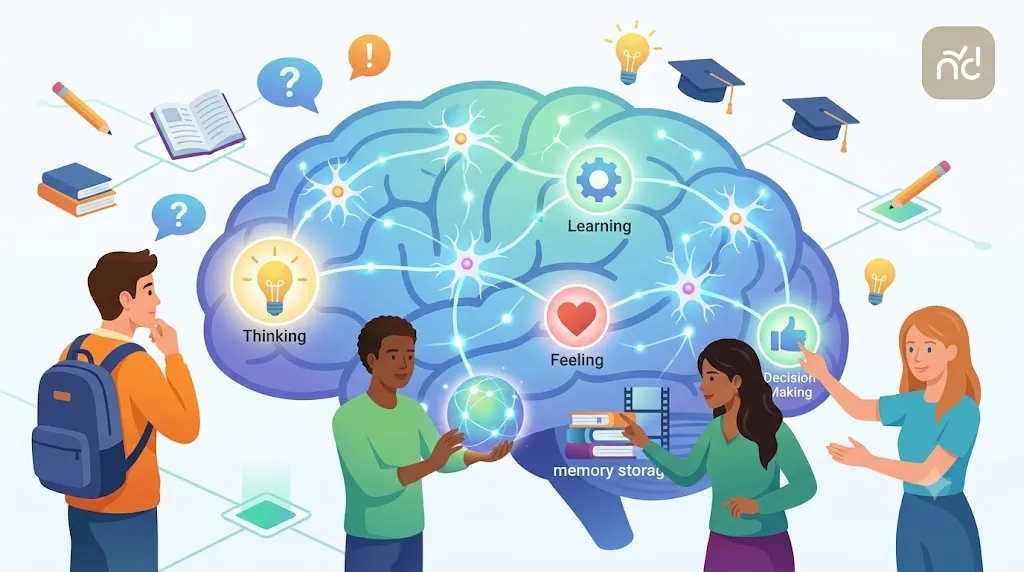
Beyond controlling physical actions, your brain is the seat of your mental capacities.
Memory: Storing Life's Experiences
Memory is the process of encoding, storing, and retrieving information. Our brains have different types of memory:
- Short-Term Memory: This holds a small amount of information for a brief period, like remembering a phone number just long enough to dial it.
- Long-Term Memory: This stores information for extended periods, sometimes for a lifetime. It includes episodic memories (events from your life), semantic memories (facts and knowledge), and procedural memories (skills). The hippocampus, a small structure deep within the brain, is critical for forming new long-term memories.
Consider how you might remember the date Viswanathan Anand won the World Rapid Chess Championship. Such significant events often get etched into our long-term memory due to their importance and the emotional impact they carry.
Learning: Acquiring New Knowledge
Learning is the acquisition of new information, skills, or behaviors. Your brain is a lifelong learner. When you learn something new, the connections (synapses) between neurons in your brain strengthen or new ones are formed. This process is called 'neural plasticity'. It's why consistent practice, like that of a chess grandmaster, builds intricate neural pathways that enable rapid and accurate decision-making.
Emotions: The Root of Our Feelings
Our brain allows us to experience a vast spectrum of emotions – joy, sadness, fear, anger. The amygdala, a small almond-shaped structure, is particularly important in processing emotions, especially fear and anxiety. Our emotions significantly influence our decisions and behaviors.
Decision-Making: Making the Right Choices
The frontal lobe plays a crucial role in decision-making. It helps us analyze different options, weigh potential consequences, and make the best choice. Effective decision-making requires a balance of logic, past experiences, and emotional intelligence.
The Brain and Learning: How Knowledge is Acquired
As students, understanding how your brain learns is a powerful tool. Learning in the brain involves several stages:
- Sensory Input: We gather information through our senses – sight, sound, smell, taste, and touch. This information travels to the brain.
- Processing: The brain then analyzes, categorizes, and gives meaning to this information.
- Storage: Relevant information is stored in various memory systems.
- Retrieval: When needed, the brain retrieves this information from memory.
The more often you encounter, process, and engage with information (by reading, writing, discussing, or practicing), the stronger the neural connections become, making it easier to recall. This is why revision and active learning strategies are so effective.
“The human brain is a magnificent organ. It works from the day you are born until you stand up to speak in public.” - Mark Twain
How to Keep Your Brain Healthy and Optimize Its Function
A healthy brain is fundamental to a healthy body and mind. For students, brain health is paramount, directly impacting academic performance and overall well-being.
1. Adequate Sleep: Your Brain's Recharge Time
While you sleep, your brain is far from inactive. It processes the day's information, consolidates memories, and clears out waste products. Students typically need 7-9 hours of quality sleep per night. Insufficient sleep negatively impacts concentration, memory, and decision-making abilities. Think of the intense focus required by leaders like Madhavrao Scindia; adequate sleep would have been crucial for their cognitive functions and demanding schedules.
2. Proper Nutrition: Fuel for Thought
Your brain consumes about 20% of your body's total energy, despite making up only 2% of your body weight. To function optimally, it needs a nutrient-rich diet. Omega-3 fatty acids (found in fish, walnuts), antioxidants (berries, leafy greens), vitamins (especially B vitamins), and minerals (iron, zinc) are vital for brain health. Avoid processed foods and excessive sugar. A balanced diet enhances brain function and learning capacity.
3. Mental Exercise: Keep Your Brain Active
Just as you exercise your body, you need to exercise your brain. Learning a new language, solving puzzles (like Sudoku or crosswords), reading extensively, or acquiring a new skill (e.g., playing a musical instrument) keeps your brain engaged. These activities strengthen existing neural connections and stimulate the formation of new ones. The annual announcement of the Shanti Swarup Bhatnagar Awards highlights the brilliance of scientists and researchers who constantly challenge their brains, pushing the boundaries of knowledge.
4. Physical Exercise: The Body-Brain Connection
Regular physical activity benefits not only your body but also your brain. Exercise increases blood flow to the brain, delivering more oxygen and nutrients. This can improve memory, reduce stress, and even promote the growth of new brain cells.
5. Stress Management: A Calm Mind, A Sharp Brain
Chronic stress can severely impair brain function, affecting memory, learning, and decision-making. Techniques like meditation, yoga, deep breathing exercises, pursuing hobbies, and maintaining social connections can help manage stress. Events like the Killari (Latur) earthquake put immense psychological strain on people, underscoring the critical importance of stress management for mental well-being.
Did You Know?
- Your brain uses about 20% of the body's total oxygen and 20% of its total calories, even though it accounts for only 2% of your body weight.
- The human brain can perform approximately 10^16 (ten thousand trillion) actions per second, making it faster than any supercomputer in the world.
- Information travels at speeds of up to 268 miles per hour (431 km/h) in the human brain.
- When awake, your brain generates about 10 to 23 watts of power, enough to light a small bulb.
- The brain itself has no pain receptors, meaning it cannot feel pain. This is why brain surgeries can sometimes be performed while the patient is awake!
Conclusion
Students, your brain is an extraordinary gift. It empowers you to learn, experience, feel, and comprehend the world. Understanding its intricate structure and functions is a significant step towards harnessing its full potential. By adopting a healthy lifestyle – ensuring adequate sleep, consuming nutritious food, engaging in mental and physical exercise, and managing stress effectively – you can enhance your brain's performance. This will not only lead to academic success but also contribute to a richer, happier, and more fulfilling life.
Take care of your brain, continually challenge it with new learning experiences, and unlock its amazing capabilities. Paripath is committed to fostering your intellectual growth. See you next time with another inspiring topic!