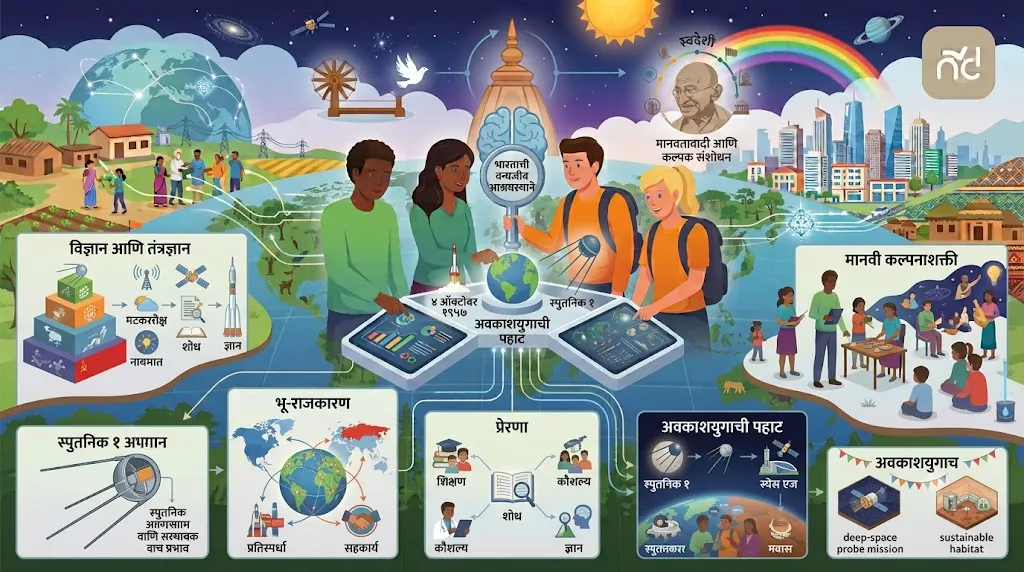
October 4th marks a pivotal day in human history. On this very day in 1957, the Soviet Union successfully launched the world's first artificial satellite, 'Sputnik 1', into Earth's orbit. This singular event ushered in a new era for humanity – the 'Space Age'. Sputnik 1 was not just a metallic sphere; it was a symbol of human ingenuity, daring, and indomitable will that left an indelible mark on science, technology, and geopolitics. It ignited the Space Race and inspired countless scientists, engineers, and students across the globe.
In this blog post, we will delve into the historical significance of Sputnik 1. We'll explore what a satellite is, its various uses, how Sputnik 1 was launched, and its immediate and long-term consequences for the world.
Understanding Satellites: Concept and Uses
To truly grasp the beginning of the Space Age, it's essential to understand what a 'satellite' is. A satellite is any natural or man-made object that orbits a larger celestial body, such as a planet, in a fixed path. Earth's Moon is a natural satellite, while Sputnik 1 was the first artificial, man-made satellite.
How Do Artificial Satellites Work?
Artificial satellites are launched into space by powerful rockets. Once they escape Earth's gravitational pull and reach a specific altitude, they are given a precise velocity to orbit the Earth. This speed is carefully calculated so that even though the satellite is constantly being pulled towards Earth by gravity, it continuously falls around the Earth without hitting its surface, maintaining a stable path known as an 'orbit'.
Key Uses of Artificial Satellites:
- Communication: Satellites are crucial for television broadcasts, radio signals, internet connectivity, and mobile phone services. They relay information signals across vast distances globally.
- Weather Forecasting: Weather satellites monitor cloud movements, storms, and other atmospheric changes, enabling accurate weather predictions and disaster warnings.
- Navigation: The Global Positioning System (GPS) relies on a network of satellites, helping us navigate using maps and providing precise location data for vehicles, ships, and aircraft.
- Scientific Research: Satellites are used to study Earth, the solar system, and distant galaxies, providing invaluable data about the universe.
- Earth Observation: They are vital for monitoring agriculture, forest management, urban planning, and natural disasters, offering insights into our planet's changing environment.
- Security and Defense: Many nations use satellites for border surveillance, intelligence gathering, and military communication, enhancing national security.
The Birth of Sputnik 1: Against the Backdrop of the Cold War
The launch of Sputnik 1 was not merely a scientific achievement; it was a potent symbol of the intense rivalry between the United States and the Soviet Union during the Cold War. Following World War II, these two superpowers engaged in a fierce competition for scientific, technological, and military supremacy.
Both nations had begun developing Intercontinental Ballistic Missiles (ICBMs), capable of carrying nuclear warheads over vast distances. The ability to launch a satellite demonstrated that a country possessed the rocket technology to deliver a payload thousands of miles away. Thus, sending a satellite into space was not just a display of scientific advancement but also a show of military might.
In the 1950s, while the US was working on its own satellite program called 'Vanguard', the Soviet Union secretly pushed ahead with its 'Sputnik' program. Under the leadership of Soviet chief designer Sergei Korolev, they clandestinely developed the powerful 'R-7' rocket, which would carry Sputnik 1 into orbit.
Tip: The Space Race was a direct consequence of the Cold War. Both the USA and USSR aimed to prove their ideological superiority through technological achievements in space. This competition, while politically charged, led to rapid advancements in science and engineering for both nations.
That Moment in History: October 4, 1957
On October 4, 1957, from the Baikonur Cosmodrome in Kazakhstan, the R-7 rocket successfully launched Sputnik 1 into space. Sputnik 1 was a polished metal sphere, approximately 58 centimeters (22.8 inches) in diameter, weighing 83.6 kilograms (184 pounds). It was equipped with four long antennas that transmitted simple 'beep-beep' radio signals back to Earth.
These signals stunned the world. The 'beep-beep' sound, audible on shortwave radios globally, confirmed that humanity had entered space. Sputnik 1 orbited Earth about 1,440 times over 92 days, with each orbit taking approximately 96 minutes.
This event sent shockwaves through the United States and the rest of the world. No one had anticipated that the Soviet Union was so far ahead in technology. The launch of Sputnik 1 was not just a scientific triumph; it was the beginning of a new era where humanity began to look beyond the confines of Earth.
Immediate and Long-term Impact on the World
The consequences of Sputnik 1's launch were both immediate and far-reaching. This single event revolutionized several fields.
1. Scientific and Technological Impact:
- Catalyst for Space Research: Sputnik 1 opened the doors to extensive space research. It provided new data about Earth's upper atmosphere, the ionosphere, solar storms, radiation belts, and the behavior of satellites in orbit.
- Miniaturization Technology: The need to send lightweight, compact equipment into space spurred immense advancements in the miniaturization of electronics, leading to smaller, more powerful devices we use today.
- Advancements in Rocketry: Sputnik underscored the critical importance of rocket technology, accelerating efforts to develop more powerful and efficient rockets.
2. Geopolitical Impact: The 'Sputnik Crisis' and the Space Race:
For the United States, Sputnik's success led to what became known as the 'Sputnik Crisis'. The event shocked the American government and public, creating fears that the Soviet Union was technologically superior, particularly in military capabilities.
- Formation of NASA: In response to this crisis, the US established the 'National Aeronautics and Space Administration' (NASA) in 1958. NASA was created to consolidate and lead America's space program, directly competing with the Soviet Union.
- Increased Funding for Science Education: The Sputnik shock prompted a massive investment in science, mathematics, and engineering education in the US. These subjects gained greater prominence in schools and universities, and significant funding was allocated for research.
- Beginning of the Space Race: Sputnik 1 formally initiated the 'Space Race' between the US and the Soviet Union. In this race, both nations pursued ambitious goals like sending the first human into space (Yuri Gagarin, 1961), landing the first human on the Moon (Neil Armstrong, 1969), and developing space stations.
3. Inspiration and Human Imagination:
Sputnik 1 inspired not only scientists but also ordinary people worldwide. It fueled curiosity about the vastness of space and the immense potential of human capability. Many young people dreamed of pursuing careers in science and engineering.
Sputnik proved that humans could achieve what seemed impossible. It laid the foundation for future grand projects like the Moon landings, Mars missions, and the International Space Station.
The Dawn of the Space Age and Future Progress
Sputnik 1 was just the beginning. In the decades that followed, humanity achieved numerous milestones in space:
- In 1961, Yuri Gagarin of the Soviet Union made history by becoming the first human in space.
- In 1969, Neil Armstrong of the American Apollo 11 mission became the first person to walk on the Moon.
- Today, hundreds of satellites orbit Earth, assisting us with weather forecasting, communication, navigation, and scientific research.
- India, through its organization 'ISRO', has also made tremendous strides in space exploration, including successful missions like Chandrayaan and Mangalyaan.
Sputnik 1 demonstrated that if humanity sets its mind to something, nothing is impossible. The modern world we live in today, with its abundance of information and technology at our fingertips, owes a great deal to Sputnik 1. This small satellite changed the course of the world and gave human history a new direction.
Did You Know?
- The name 'Sputnik' means 'fellow traveler' or 'companion' in Russian.
- Sputnik 1's batteries lasted for three weeks, after which its signals ceased. However, it continued to orbit until January 1958, when it re-entered Earth's atmosphere and burned up.
- Sputnik 1 was built in just 90 days.
- Its launch coincided with the International Geophysical Year (IGY) 1957-1958, an international scientific endeavor to study Earth and space.
- Just one month after Sputnik 1, the Soviet Union launched Sputnik 2, carrying a dog named Laika, who became the first living creature in orbit.