
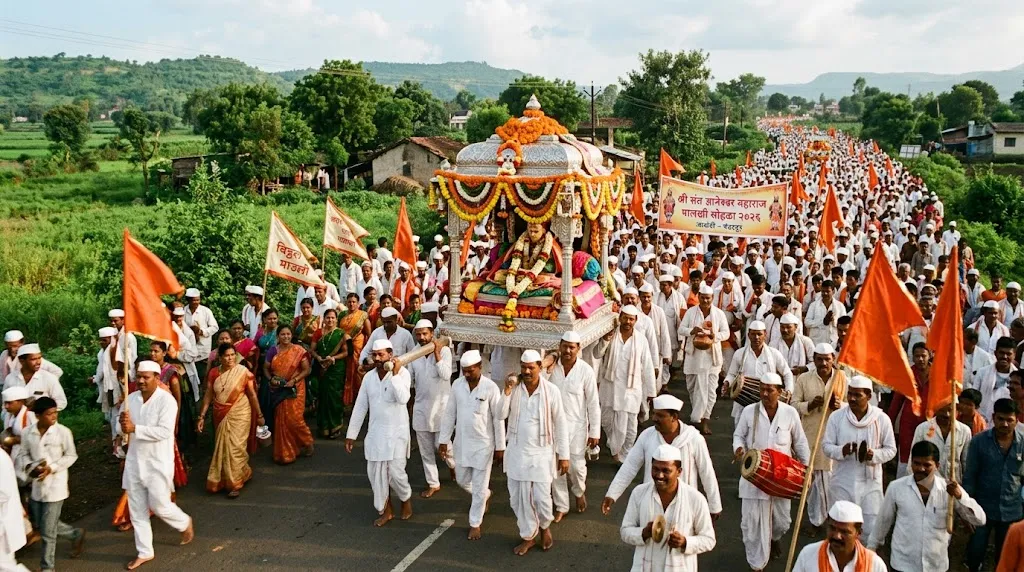
Shri Sant Dnyaneshwar Maharaj Palkhi Sohala 2026: A Grand Pilgrimage of Devotion, Culture, and Unity
Get ready for one of India's most magnificent and spiritually charged events! The Shri Sant Dnyaneshwar Maharaj Palkhi Sohala 2026 is scheduled to begin its sacred journey on Wednesday, July 8, 2026, from Alandi. This centuries-old tradition is not just a pilgrimage; it's a vibrant living testament to Maharashtra's rich cultural tapestry, a beacon of devotion, and a powerful symbol of unity that brings together millions of people from all walks of life.
For students like you, understanding the Palkhi Sohala offers a unique window into India's profound spiritual heritage, its diverse cultural expressions, and the timeless values of community and perseverance. In this blog post, we will delve deep into the significance of this holy Wari (pilgrimage), explore its meticulous planning, and discover the invaluable lessons it holds for us all.
What is the Shri Sant Dnyaneshwar Maharaj Palkhi Sohala?
Imagine millions of people walking together, chanting hymns, singing devotional songs, and carrying a beautifully adorned palanquin (Palkhi) that holds the symbolic ' पादुका' (holy sandals) of a revered saint. This is the essence of the Palkhi Sohala. It's an annual foot pilgrimage from Alandi, near Pune, to Pandharpur, in Solapur district, culminating on the auspicious day of Ashadhi Ekadashi.
Who was Sant Dnyaneshwar Maharaj?
Sant Dnyaneshwar, also known as Dnyandev, was a 13th-century Marathi saint, poet, philosopher, and yogi of the Nath tradition. He is considered one of the most influential figures in the Bhakti movement of Maharashtra. Born in Alandi, his life was marked by spiritual brilliance and profound wisdom even at a young age.
- The Dnyaneshwari: At just 16 years old, Sant Dnyaneshwar composed the 'Dnyaneshwari', a Marathi commentary on the Bhagavad Gita. This masterpiece made complex philosophical ideas accessible to common people, fostering spiritual awakening across society.
- Harbinger of Bhakti: He championed the path of devotion (Bhakti Marg) and emphasized the equality of all individuals before God, regardless of caste or social status.
- Eternal Samadhi: Sant Dnyaneshwar took Samadhi (entered a state of meditative absorption and left his mortal body) at a very young age in Alandi, which is why Alandi holds immense spiritual significance for his followers.
The Palkhi Sohala is essentially a tribute to his legacy, a way for devotees to follow in his spiritual footsteps and connect with the divine.
A Journey of Unwavering Faith and Devotion (Bhakti)
The heart of the Palkhi Sohala beats with immense devotion. Millions of pilgrims, known as Warkaris, undertake this arduous journey with unwavering faith in Lord Vitthal (a form of Krishna) and Sant Dnyaneshwar Maharaj. Their journey is a profound act of spiritual surrender and love.
The Spiritual Atmosphere
From the moment the Palkhi departs Alandi, the air is thick with spiritual energy. Warkaris, often dressed in traditional attire, walk barefoot or in simple sandals, their faces radiating joy and piety. The journey is punctuated by:
- Chanting and Bhajans: Throughout the day, groups of Warkaris sing devotional songs (Bhajans) and chant the name of Vitthal – "Jai Hari Vitthal!" or " ज्ञानोबा माऊली तुकाराम!" (Dnyanoba Mauli Tukaram!).
- Kirtans: Evening halts often feature Kirtans, a form of spiritual discourse accompanied by music, where stories of saints and teachings of the Bhakti movement are shared.
- Abhangs: These are Marathi devotional poems composed by saints like Dnyaneshwar and Tukaram, sung with deep emotion.
- Ringan: A spectacular sight where Warkaris run in a circle around the Palkhi, symbolizing the joyous dance of devotion. This is often performed in open fields along the route.
- Fugadi: Traditional folk dances performed by women, adding to the festive atmosphere.
“The Wari is not just a walk; it’s a spiritual marathon where every step is a prayer, and every breath is an offering. It teaches us the power of collective devotion.”
A Tapestry of Rich Culture (Sanskriti)
Beyond its spiritual core, the Palkhi Sohala is a vibrant showcase of Maharashtra's traditional culture. It's a moving museum of customs, arts, and community practices that have been preserved and passed down through generations.
Traditional Elements
- Attire: Many Warkaris wear traditional clothes – men in white dhotis and kurtas, often with a 'Gandhi topi' or a saffron turban; women in traditional sarees.
- Musical Instruments: The procession is accompanied by the rhythmic sounds of traditional instruments like the Veena (a string instrument), Taal (cymbals), and Mrudung (a percussion instrument), creating a hypnotic symphony.
- Dindis: Warkaris organize themselves into groups called Dindis, each with its own flag, unique traditions, and often a specific role in the procession. These Dindis are like small communities within the larger pilgrimage.
- Folk Arts: Along the route, you might witness impromptu performances of folk dances, dramas, and recitations, keeping ancient traditions alive.
- Culinary Traditions: The Wari also showcases traditional Maharashtrian cuisine, with simple, wholesome food being prepared and shared amongst pilgrims.
The Palkhi Sohala acts as a powerful cultural unifier, reinforcing the shared identity and heritage of Marathi people. It’s a living example of how traditions can evolve yet retain their essence over centuries.
The Unifying Power of Togetherness (Ekta)
Perhaps one of the most remarkable aspects of the Palkhi Sohala is its incredible display of unity. Millions of people, from diverse backgrounds, castes, economic statuses, and age groups, walk together as one family, driven by a common purpose.
Lessons in Harmony and Cooperation
- Transcending Barriers: On the Wari, social distinctions melt away. A farmer walks alongside a doctor, a student alongside a senior citizen. Everyone is a 'Warkari', united in their devotion.
- Selfless Service (Seva): The spirit of Seva (selfless service) is paramount. People volunteer to provide food, water, medical aid, and shelter to fellow pilgrims. Locals along the route open their homes and hearts to offer hospitality.
- Collective Responsibility: The sheer scale of the Wari requires immense collective responsibility. Warkaris often organize themselves efficiently, managing their own needs and supporting others without formal oversight.
- Mutual Respect: Despite the large numbers, there is an atmosphere of profound respect and camaraderie. People help each other, share burdens, and celebrate together.
“The Wari is a practical lesson in civics – demonstrating how a large community can function harmoniously through shared values, discipline, and selfless service.”
The Route and Key Milestones for 2026
The Shri Sant Dnyaneshwar Maharaj Palkhi Sohala typically covers a distance of about 250 kilometers over approximately 18-21 days. While the exact daily halts for 2026 will be announced closer to the date, the general itinerary remains consistent:
- Departure from Alandi (July 8, 2026): The journey begins with elaborate rituals and a grand procession from the Samadhi Mandir in Alandi.
- Pune Halt: The Palkhi traditionally halts in Pune for a day or two, receiving a grand welcome from the city's residents.
- Major Halts: The procession continues through towns like Saswad, Jejuri, Valha, Lonand, Phaltan, Baramati, Natepute, Malshiras, Velapur, Shegaon, and Wakhari, with designated overnight stops (Dindis). Each halt has its own significance, often involving specific rituals and community gatherings.
- Ringan Ceremonies: Key locations along the route host the famous Ringan ceremonies, where horses carrying the holy flag and symbolic devotees run in circles, creating a spectacular and emotionally charged display.
- Arrival in Pandharpur (Ashadhi Ekadashi): The culmination of the journey is the arrival in Pandharpur, usually on the day of Ashadhi Ekadashi. This day is considered extremely sacred, and millions gather to catch a glimpse of Lord Vitthal and Rukmini at the famous Vitthal-Rukmini Temple.
The journey is meticulously planned, with designated rest stops, food distribution points, and medical aid stations to ensure the well-being of the millions of pilgrims.
The Meticulous Planning of a Grand Event
Managing a moving population of millions for over two weeks is a monumental task. The success of the Palkhi Sohala is a testament to incredible organization and coordination:
- Trusts and Organizations: The Sant Dnyaneshwar Maharaj Sansthan Committee in Alandi and various Dindi organizations play a central role in planning and executing the pilgrimage.
- Government Support: State and local administrations, including the police, health department, and public works department, provide extensive support for security, traffic management, sanitation, and medical emergencies.
- Volunteer Networks: Thousands of volunteers, often locals from towns along the route, dedicate their time and resources to serve the Warkaris.
- Infrastructure: Temporary shelters, public toilets, water supply points, and food distribution centers are set up along the entire route.
This massive logistical undertaking showcases the power of collective effort and efficient management, offering valuable insights into large-scale event organization.
Invaluable Lessons for Students from the Wari
The Palkhi Sohala is a living classroom, offering a multitude of lessons that are highly relevant to students today:
- Discipline and Perseverance: Walking hundreds of kilometers, enduring physical challenges, and maintaining a schedule requires immense discipline and perseverance. It teaches us the importance of setting goals and working steadily towards them.
- Teamwork and Community Spirit: The Dindis exemplify perfect teamwork. Everyone contributes, supports each other, and moves forward as a cohesive unit. This fosters a strong sense of community and mutual reliance.
- Cultural Appreciation and Heritage: The Wari is a direct connection to our roots. It teaches us to appreciate and preserve our unique cultural traditions, languages, and historical narratives.
- Simple Living, High Thinking: Warkaris often live simply during the pilgrimage, focusing on spiritual and community values rather than material comforts. This can inspire us to find joy in simplicity and prioritize inner growth.
- Empathy and Service (Seva): Witnessing and participating in selfless service teaches empathy, compassion, and the joy of giving back to society without expecting anything in return.
- Environmental Consciousness: While a challenge with such large numbers, efforts are increasingly made to manage waste and maintain cleanliness. This highlights the importance of environmental responsibility, even in large gatherings.
Did You Know? Interesting Facts About the Wari
- The Two Main Palkhis: While Sant Dnyaneshwar Maharaj's Palkhi starts from Alandi, another equally significant Palkhi, that of Sant Tukaram Maharaj, commences from Dehu. Both converge in Pandharpur.
- Origin of the Palkhi: The tradition of carrying Sant Dnyaneshwar's Palkhi began in 1685, initiated by Haibatbaba Arphalkar, a devotee of Sant Tukaram.
- The Palkhi Itself: The Palkhi is a beautifully decorated palanquin, symbolizing the moving presence of the saint. It's carried by dedicated Warkaris throughout the journey.
- Pandharpur - The 'Dakshin Kashi': Pandharpur is often referred to as 'Dakshin Kashi' (Kashi of the South) due to its immense religious significance. Lord Vitthal is worshipped here as the 'God of the common people'.
- The Wari is Non-Stop: While there are designated halts, the spirit of the Wari is continuous. The chanting, singing, and walking are almost non-stop for many days.
- A Global Phenomenon: In recent years, people from other countries have also joined the Wari, drawn by its unique spiritual and cultural experience.
How Students Can Connect with the Wari
Even if you can't physically join the Palkhi Sohala, there are many ways to connect with its spirit and learn from it:
- Research and Learn: Read more about Sant Dnyaneshwar Maharaj, Sant Tukaram Maharaj, and other Marathi saints. Explore the history and philosophy of the Bhakti movement.
- Watch Documentaries: Many documentaries and videos are available online that capture the essence and grandeur of the Wari.
- Visit Alandi or Pandharpur: If you have the opportunity, visit these sacred towns to experience their spiritual atmosphere firsthand.
- Engage with Local Traditions: Learn about similar cultural or religious traditions in your own region. Understanding local heritage enriches your perspective.
- Practice Seva: Participate in local community service initiatives. Experience the joy and fulfillment that comes from selfless giving.
Conclusion
The Shri Sant Dnyaneshwar Maharaj Palkhi Sohala 2026 is more than just an annual event; it is a profound journey that embodies the very soul of Maharashtra and, indeed, India. It's a powerful reminder of the enduring strength of faith, the beauty of our cultural heritage, and the unifying power of collective spirit.
As students, by understanding and appreciating such unique traditions, you not only connect with your roots but also imbibe invaluable lessons in discipline, community, perseverance, and selfless service. Let the spirit of the Wari inspire you to walk your own path with devotion, respect, and unity, contributing positively to the rich tapestry of our nation.
Jai Hari Vitthal! Dnyanoba Mauli Tukaram!
