
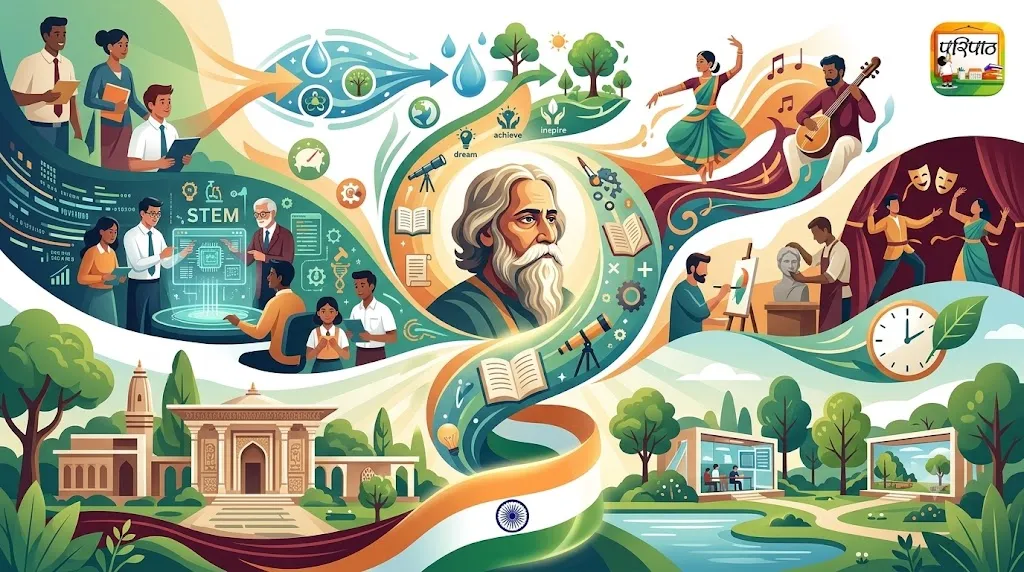
Rabindranath Tagore, affectionately known as Gurudev, was an extraordinary figure whose influence transcended the boundaries of poetry, literature, music, and philosophy. A Nobel laureate in Literature, his genius also extended to the realm of education, where he emerged as a visionary reformer. Dissatisfied with the conventional, colonial education system prevalent in India, Tagore embarked on a mission to redefine learning, advocating for a holistic approach that nurtured the mind, body, and spirit in unison with nature.
Tagore’s philosophy was revolutionary for its time, challenging the very foundations of rote memorization and rigid curricula. He believed that true education should unlock an individual's innate potential, foster creativity, and cultivate a deep connection with the world around them. His most significant experiment in this regard was Santiniketan, an institution that embodied his ideals of freedom, joy, and comprehensive development. As we delve into his educational philosophy, we discover insights that remain profoundly relevant to contemporary pedagogical practices.
Beyond Rote Learning: Tagore's Educational Philosophy
Tagore was a vocal critic of the education system imposed by the British, which he perceived as sterile, mechanistic, and designed to produce clerks rather than independent thinkers. He himself found formal schooling stifling and uninspiring, preferring to learn through personal exploration and interaction with the world. His own experience fueled his conviction that education should not be a passive reception of facts but an active process of discovery and creation.
“The highest education is that which does not merely give us information but makes our life in harmony with all existence.” - Rabindranath Tagore
For Tagore, the ultimate goal of education was to develop a 'complete human being' – an individual who is intellectually sharp, emotionally mature, morally upright, physically robust, and spiritually aware. He emphasized the importance of allowing children to learn at their own pace, encouraging their natural curiosity, and fostering a sense of wonder. He strongly advocated for education in one's mother tongue, believing it to be crucial for genuine understanding and the development of original thought.
Tagore envisioned a teacher as more than just an instructor; a guide, a friend, and an inspirer who facilitates learning rather than imposing it. Students should be encouraged to question, experiment, and learn from their mistakes, fostering independence and critical thinking. This progressive vision laid the groundwork for many ideas that are considered cutting-edge in today's educational discourse.
Santiniketan: A School Under the Sky in Harmony with Nature
To translate his educational ideals into practice, Tagore established 'Santiniketan' (meaning 'Abode of Peace') in Bolpur, West Bengal, in 1901. Away from the bustling urban environment of Kolkata, Santiniketan was conceived as a haven where learning could flourish in the lap of nature.
The most distinctive feature of Santiniketan was its open-air classrooms. Students would sit under trees, learning amidst the sounds of birds and the gentle breeze, truly making nature their primary textbook. Tagore believed that nature was the greatest teacher, fostering sensitivity, observation skills, and an environmental consciousness in children. This direct engagement with the natural world was central to his pedagogical approach.
- Open-Air Learning: Classes were often held outdoors, allowing students to connect with their surroundings and learn from direct observation of flora and fauna.
- Seasonal Festivals: The academic calendar at Santiniketan was intertwined with the rhythms of nature. Festivals celebrating the changing seasons (like Vasantotsav or tree-planting ceremonies) were integral to the curriculum, teaching students about ecological cycles and cultural traditions.
- Practical Work: Students participated in agricultural activities, gardening, and other manual labor. This not only instilled in them the dignity of labor but also connected them to the earth and the process of creation.
Santiniketan was more than just a school; it was a living community where teachers and students lived, worked, and learned together. Students had the freedom to choose subjects based on their interests and progress at their own pace. This model demonstrated that education could be profoundly effective when rooted in experience and a harmonious relationship with the environment.
Cultivating Creativity: The Arts as Core Curriculum
Another cornerstone of Tagore's educational philosophy was the paramount importance of arts and creativity. He viewed art as the natural expression of the human soul, an integral part of human existence that should not be separated from learning. While traditional education often relegated the arts to an extracurricular activity, Tagore placed them at the very heart of the curriculum.
At Santiniketan, music, dance, drama, painting, and various handicrafts were not optional subjects but essential components of a child's development. Students were encouraged to engage in singing, playing instruments, dancing, acting, and painting. Tagore himself was a prolific poet, composer, and playwright, and he believed that through the arts, children could develop their imagination, express their emotions, and enhance their sensitivity. Art, in his view, made individuals more humane, beautiful, and empathetic.
Tagore believed that every child possesses an innate artistic potential that flourishes when given the right environment and encouragement. Santiniketan regularly hosted art exhibitions, musical performances, and theatrical productions, providing students with platforms to showcase their talents and appreciate the creativity of others. This not only built confidence and teamwork but also cultivated an aesthetic sensibility. Artistic education, for Tagore, was not just about producing artists, but about fostering problem-solving skills and innovative thinking.
The 'Complete Human Being': A Holistic Approach to Development
Tagore's ultimate goal for education was the creation of a 'complete human being.' This individual would not only be intellectually enlightened but also physically strong, emotionally balanced, morally upright, and spiritually aware. His Visva-Bharati University (which evolved from Santiniketan in 1921) embodied this concept, founded on the motto 'Yatra Visvam Bhavatyekam Nidham' (where the whole world meets in one nest), emphasizing global fraternity and universal human values.
Tagore stressed the delicate balance between freedom and responsibility in education. Students were granted the liberty to make their own choices, learn from their mistakes, and pursue their paths of growth. This fostered self-reliance and confidence. Simultaneously, they were instilled with a strong sense of responsibility towards society and nature.
- Moral and Spiritual Development: Students were taught values such as truth, love, empathy, and compassion. Prayers, meditation, and a deep connection with nature fostered spiritual growth.
- Physical Development: Sports, yoga, and manual labor were integral to ensuring students were physically robust. Tagore believed that a healthy body was essential for a healthy mind.
- Social Responsibility: Students were nurtured as integral members of society. They participated in community work, learning cooperation and contributing to the well-being of others.
- Global Citizenship: Through Visva-Bharati, Tagore sought to bring together people from diverse cultures and intellectual traditions. He believed students should have respect for and knowledge of not only their own culture but also those of the wider world.
For Tagore, education was not merely about personal gain; it was about preparing individuals to be part of the larger human family and to contribute to the welfare of the world. Thus, his educational model was a means to cultivate a well-rounded, balanced, and socially responsible individual.
Tagore's Legacy in Modern Education: Enduring Relevance
In the 21st century, as educational systems grapple with complex challenges, Rabindranath Tagore's ideas resonate more profoundly than ever. Many aspects of his holistic education concept are mirrored in contemporary educational reforms and best practices:
- Experiential Learning: Tagore's emphasis on 'learning by doing,' evident in Santiniketan's farming, handicrafts, and artistic activities, is a precursor to modern project-based learning, field trips, and practical experiments.
- Interdisciplinary Approach: Tagore resisted the compartmentalization of knowledge, integrating science, arts, music, and social studies. Today, the movement to combine STEM with Arts (STEAM) reflects a similar holistic approach to learning.
- Emotional Intelligence and Social-Emotional Learning (SEL): Tagore prioritized the emotional and social development of students, believing that empathy, cooperation, leadership, and communication skills are as crucial as intellectual abilities. Modern education increasingly recognizes the importance of 'soft skills' and emotional intelligence for success in life and career.
- Environmental Education: Tagore's vision of learning in harmony with nature directly aligns with today's urgent need for environmental education and sustainable development. As climate change and ecological concerns escalate, instilling respect and responsibility towards nature in students is paramount.
- Teacher as Facilitator: Tagore viewed the teacher not as a mere dispenser of information but as a friend, guide, and inspirator. This aligns with modern pedagogical trends where teachers are seen as facilitators who empower students to take ownership of their learning journey.
In an age of information overload, teaching students to interpret, critically analyze, and creatively apply knowledge is far more valuable than simply accumulating facts. Tagore's insights offer a guiding light in this direction, reminding us that education should empower individuals to navigate the complexities of life with wisdom and compassion.
Did You Know?
- Rabindranath Tagore was the first non-European to win the Nobel Prize in Literature in 1913 for his collection of poems, 'Gitanjali'.
- He is the only person in the world to have composed the national anthems for two different countries: 'Jana Gana Mana' for India and 'Amar Shonar Bangla' for Bangladesh.
- Mahatma Gandhi bestowed the title 'Gurudev' upon Rabindranath Tagore, and in return, Tagore referred to Gandhi as 'Mahatma'.
- Tagore started painting seriously at the age of sixty, producing over 2,500 works, many of which were exhibited internationally.
- Santiniketan was initially established by Tagore's father, Debendranath Tagore, as an ashram (hermitage) in 1863 before Rabindranath transformed it into an experimental school.
Conclusion
Rabindranath Tagore's educational philosophy was not merely a theoretical construct but a comprehensive vision for human development. He demonstrated that education is not just about the exchange of bookish knowledge but a dynamic process that fosters holistic growth, creativity, and a deep connection with the natural world. The ideal of the 'complete human being' that he championed through Santiniketan and Visva-Bharati remains an inspiring blueprint for our modern educational systems.
In today's fast-paced and competitive world, it is crucial to equip students not only with academic knowledge but also with strong ethical values, emotional resilience, and a sense of social responsibility. Drawing inspiration from Tagore's timeless wisdom, we can reform our educational practices to nurture individuals who are not only successful but also sensitive, creative, and responsible citizens. His dream was for education to connect children to the world, teach them to love, to create, and to make the world a more beautiful place. Realizing this dream would be the truest tribute to his legacy.
