
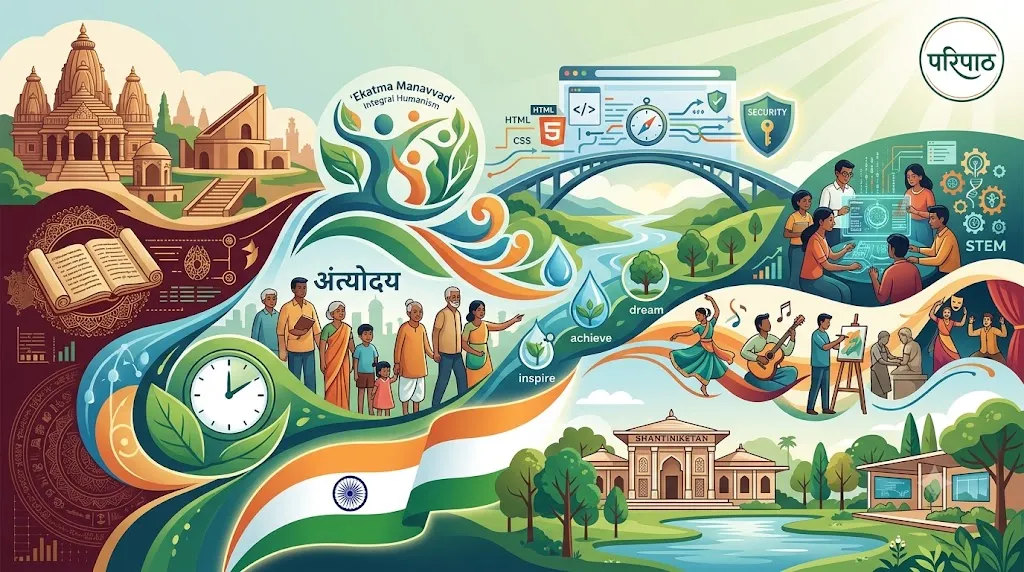
Introduction: A Visionary for Holistic Development
Dear students and esteemed educators,
Today, September 25th, is a day of multifaceted significance. While many of us are bidding farewell to Lord Ganesha on Anant Chaturdashi with zeal and devotion, this date also holds importance for several historical events and the remembrance of great personalities. Most notably, it is celebrated as 'Antyodaya Diwas', commemorating the birth anniversary of a profound thinker: Pandit Deendayal Upadhyaya.
Pandit Deendayal Upadhyaya was not just a political leader; he was a brilliant philosopher, economist, social reformer, and a visionary. He gifted India with two powerful concepts: 'Integral Humanism' and 'Antyodaya', which continue to guide the nation's social, economic, and cultural development. Coincidentally, major government initiatives like 'Make in India' and 'Saubhagya Yojana' were also launched on this very day, aligning with his Antyodaya philosophy. Today is also the death anniversary of legendary singer S. P. Balasubrahmanyam and World Pharmacist Day.
In this article, we will embark on a journey to explore the life of Pandit Deendayal Upadhyaya, delve into his philosophy of 'Integral Humanism', and understand the essence of 'Antyodaya'. We will examine how these ideas remain profoundly relevant in today's world and how they can inspire us all, especially the youth, to contribute to a better India.
Pandit Deendayal Upadhyaya: A Life Dedicated to Nation-Building
Born on September 25, 1916, in the village of Nagla Chandrabhan near Mathura, Pandit Deendayal Upadhyaya's early life was marked by immense hardship. He lost his father at the tender age of three and his mother when he was just seven. He was subsequently raised by his maternal uncle. Despite these challenges, he displayed exceptional intelligence and sensitivity from a young age, consistently excelling in his studies and earning numerous scholarships throughout his academic career. He graduated with a B.A. from Sanatan Dharma College in Kanpur.
During his student years, he came into contact with the Rashtriya Swayamsevak Sangh (RSS) and became a volunteer in 1937. He was deeply influenced by the thoughts of Dr. Keshav Baliram Hedgewar, the founder of the RSS. In 1942, he left his M.A. studies to become a full-time 'Pracharak' (propagator) for the RSS. He worked extensively in Uttar Pradesh, energizing the Sangh's activities and inspiring many young people to dedicate themselves to national service.
In 1951, when Dr. Syama Prasad Mookerjee founded the Bharatiya Jana Sangh, Pandit Deendayal Upadhyaya was appointed its first General Secretary. He served in this capacity for 14 years, laying a strong organizational foundation for the party. His effective leadership and organizational skills helped the Jana Sangh establish its identity across the country in a short span of time. In 1967, he became the President of the Jana Sangh, but tragically, he passed away prematurely and mysteriously on February 11, 1968, just 43 days after assuming the presidency. His demise left a significant void in Indian politics.
Integral Humanism: The Philosophy of Wholeness
Pandit Deendayal Upadhyaya's most significant ideological contribution is the philosophy of 'Integral Humanism'. He expounded this comprehensive philosophy during the Jana Sangh's convention in Mumbai in 1965. He proposed Integral Humanism as an alternative to both Western materialism (Capitalism) and Communism, which he believed were incomplete in their understanding of human existence.
According to Integral Humanism, a human being is not merely a body or a mind, but an indivisible whole composed of four essential elements: body (Deh), mind (Man), intellect (Buddhi), and soul (Atma). He asserted that true human development can only occur when all these four components are developed in a balanced and integrated manner.
- Body (Deh): Fulfilling physical needs, promoting health, and developing physical capabilities.
- Mind (Man): Mental well-being, emotional development, fostering creativity, and thought processes.
- Intellect (Buddhi): Acquiring knowledge, developing reasoning power, decision-making abilities, and wisdom.
- Soul (Atma): Spiritual upliftment, ethical conduct, human values, and a sense of altruism.
Upadhyaya argued that Western ideologies often focus solely on material needs, while communism emphasizes only economic equality. Both, he believed, concentrate on only one aspect of human existence, leading to imbalances in human life. Integral Humanism, however, considers the holistic development of an individual. It emphasizes harmony between the individual, society, nation, and nature. Rooted in Indian culture and traditions, this philosophy encourages individuals to transcend self-interest and work for the greater good of society and the nation.
“The objective of Integral Humanism is to create a society where every individual gets the opportunity to develop their full potential and considers themselves an integral part of society, actively contributing to national life.”
Antyodaya: Uplifting the Last Person
A crucial aspect of Pandit Deendayal Upadhyaya's philosophy is 'Antyodaya'. The word 'Antyodaya' literally means 'upliftment of the last person' or 'rise of the weakest'. While it shares similarities with Mahatma Gandhi's 'Sarvodaya' (upliftment of all), Antyodaya specifically focuses on the development of the most marginalized, impoverished, and vulnerable sections of society.
Upadhyaya envisioned a society where the benefits of development would first reach the lowest strata of society. In his view, true national progress could only be achieved when the lives of the poorest and weakest individuals were improved. This extended beyond mere economic advancement, emphasizing social justice, access to healthcare, education, and the opportunity for everyone to live a life of dignity.
Many government schemes implemented in India today draw inspiration from the concept of 'Antyodaya'. For instance:
- National Food Security Act: Providing subsidized food grains to poor families.
- Ayushman Bharat Yojana: Offering health coverage to underprivileged families.
- Pradhan Mantri Awas Yojana: Aiming to provide affordable housing for all.
- Pradhan Mantri Jan Dhan Yojana: Promoting financial inclusion by extending banking services to everyone.
Today, September 25th, is also the launch anniversary of the 'Saubhagya Yojana' and the 'Make in India' campaign. The 'Saubhagya Yojana' (Pradhan Mantri Sahaj Bijli Har Ghar Yojana), launched in 2017, aimed to provide electricity to every household. This scheme is fully aligned with the Antyodaya philosophy, as electricity has become a fundamental necessity, and extending it to every home is a crucial step towards inclusive development.
Similarly, the 'Make in India' campaign (launched in 2014) focuses on boosting domestic manufacturing and creating employment opportunities. This initiative promotes local industries and generates jobs for many, benefiting economically weaker sections of society. This too is a significant step towards Antyodaya. Antyodaya is not just about economic upliftment; it is a symbol of social justice and dignity.
Relevance of Integral Humanism for Modern India
In the 21st century, where the world is rapidly changing, Pandit Deendayal Upadhyaya's ideas appear even more pertinent. The influence of globalization and materialism often leads to a neglect of human values and the natural environment. In such times, Integral Humanism offers a path to balanced and sustainable development.
- Holistic Development: Integral Humanism does not merely focus on economic growth but also emphasizes the mental, intellectual, and spiritual development of the individual. This fosters a healthy and ethical society.
- Environmental Balance: Upadhyaya stressed harmony with nature. Given today's global warming and environmental challenges, his ideas underscore the importance of sustainable development.
- Social Harmony: Integral Humanism views all human beings as equal, irrespective of caste, creed, gender, or any other distinction. Social harmony and unity are integral parts of Integral Humanism, which are extremely vital in today's often divided society.
- National Identity and Self-Respect: He advocated for a development model rooted in Indian culture and values, rather than blindly imitating Western ideologies. This preserves national identity and self-respect.
- Education and Values: He believed that education should not merely impart information but also instill ethical values, social responsibility, and a sense of nationhood in students.
Inspiration and Practice for Students
Pandit Deendayal Upadhyaya's thoughts are immensely inspiring for students like you. How can you incorporate his ideas into your lives?
- All-Round Development: Participate actively not just in academics, but also in sports, arts, music, and social activities. Develop your physical, mental, and intellectual capabilities.
- Empathy and Service: Help those in need around you. 'Antyodaya' means thinking of the last person in society. Consider if you can help someone in your school, locality, or family.
- Environmental Care: Plant trees, conserve water, reduce waste. Harmonizing with nature is a key tenet of Integral Humanism.
- Ethical Values: Practice honesty, integrity, hard work, and discipline. These values will help you succeed in life.
- National Integration: Recognize the importance of your country, its culture, and traditions. Unity in diversity is a hallmark of India.
Conclusion
Pandit Deendayal Upadhyaya was a visionary leader who presented a unique development model rooted in the deep-seated values of Indian culture. His 'Integral Humanism' teaches us about the holistic development of an individual, and 'Antyodaya' advocates for the right of every member of society to live with dignity. His ideas remain as fresh and relevant today as they were then, inspiring us to build a strong, prosperous, and ethical India.
To build a bright future for our nation, let us all resolve to imbibe and practice the great thoughts of Pandit Deendayal Upadhyaya in our lives. Together, let us work towards creating an integrated and inclusive India!
Did You Know?
- Pandit Deendayal Upadhyaya wrote a play titled 'Chandragupta Maurya' and translated books like 'Samrat Chandragupta' and 'Jagadguru Shankaracharya' into Hindi.
- He edited nationalist magazines such as 'Rashtra Dharma', 'Panchjanya', and 'Swadesh', through which he disseminated his ideas to the public.
- In his memory, the Government of India has launched several schemes, universities, and awards, such as Deendayal Antyodaya Yojana and Deendayal Upadhyaya Gram Jyoti Yojana.
- September 25th is celebrated as 'Antyodaya Diwas' because it marks Pandit Deendayal Upadhyaya's birth anniversary. The 'Make in India' and 'Saubhagya' schemes were also launched on this day.
- Pandit Deendayal Upadhyaya authored an important book titled 'Arthashastra Aur Dharma' (Economics and Dharma), in which he explained how to reconcile economic development with ethical values.
