
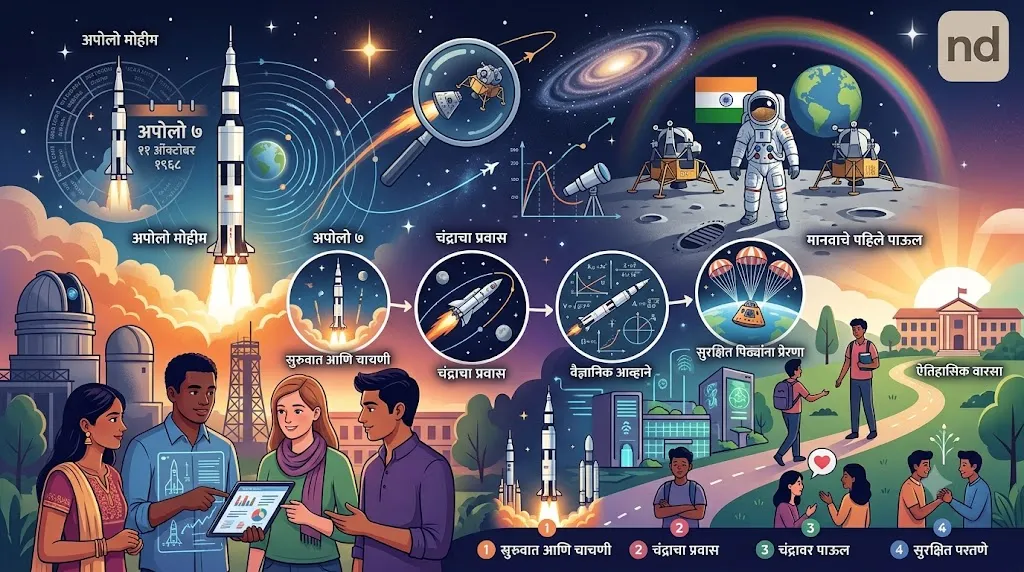
Today, October 11, 2026, marks the auspicious beginning of Sharadiya Navratri and Ghatasthapana, symbolizing new beginnings, divine strength, and creation. On this very day, 58 years ago, a new chapter in human history began with the successful launch of Apollo 7 on October 11, 1968. This mission was a critical precursor to America's ambitious goal of landing humans on the Moon. It also coincides with the International Day of the Girl Child, a day to encourage girls in education and progress, highlighting the importance of STEM fields for achieving grand dreams like the Apollo missions. In this special 'Paripath' blog, we will explore the incredible saga of the Apollo Program, focusing on the significance of Apollo 7, the challenges faced, the courage of its astronauts, and its enduring legacy.
The Genesis of Apollo: Seeding a Daring Dream
During the Cold War, the United States and the Soviet Union were locked in an intense rivalry for supremacy in space, known as the 'Space Race'. The Soviet Union had taken an early lead with the launch of the Sputnik satellite and sending the first human, Yuri Gagarin, into space. In response, the US set an audacious goal. On May 25, 1961, President John F. Kennedy made a historic declaration to the American Congress: "I believe that this nation should commit itself to achieving the goal, before this decade is out, of landing a man on the Moon and returning him safely to the Earth." This was an incredibly ambitious, almost impossible-sounding objective, especially since, at the time, the US had only sent an astronaut into space for a mere 15 minutes.
"I believe that this nation should commit itself to achieving the goal, before this decade is out, of landing a man on the Moon and returning him safely to the Earth." - President John F. Kennedy, May 25, 1961.
This declaration galvanized NASA and American industry. The mission, dubbed 'Project Apollo', aimed to fulfill Kennedy's challenge. However, the path was fraught with difficulties. Numerous technical hurdles, immense financial investment, and, most critically, the risk to human life made this endeavor exceptionally challenging.
Apollo 7: The Crucial Stepping Stone to the Moon
The Apollo program had a tragic beginning. On January 27, 1967, a fire during a launch rehearsal for Apollo 1 tragically killed three astronauts: Gus Grissom, Ed White, and Roger Chaffee. This devastating incident forced NASA to halt human spaceflights for 21 months and make significant changes to the Apollo program's safety systems and design.
Against this backdrop, the launch of Apollo 7 on October 11, 1968, was not just another flight; it was a testament to NASA's resilience and the resurgence of the American space program. The primary objective of the Apollo 7 mission was to conduct a comprehensive test of the Command/Service Module (CSM) – the spacecraft designed to carry astronauts into space and back to Earth – in Earth's orbit. The crew of Apollo 7 consisted of three astronauts: Walter Schirra, Donn Eisele, and Walter Cunningham.
- Mission Objectives:
- To verify the operational capabilities of the redesigned Block II Command and Service Module in Earth orbit.
- To test the propulsion, life support, and communication systems.
- To study the effects of space travel on astronaut health and performance.
- To ensure that all systems necessary for a lunar journey were safe and reliable.
The mission orbited Earth for 11 days. The astronauts meticulously tested all subsystems within the CSM. They performed engine firings, practiced docking procedures, and maintained continuous communication with Mission Control on Earth. During this mission, the astronauts also conducted the world's first live television broadcast from space, offering people a glimpse into life beyond Earth. Apollo 7 was an unprecedented success. It proved that the redesigned CSM was safe and ready for a journey to the Moon. This success paved the way for Apollo 8 to orbit the Moon and, ultimately, for Apollo 11 to land on its surface.
Conquering the Cosmos: Engineering Marvels and Scientific Breakthroughs
The Apollo Program was not just a triumph of astronaut courage but also a testament to human ingenuity and engineering prowess. The mission overcame numerous unprecedented challenges:
- The Saturn V Rocket: This was the most powerful rocket ever built by humans. Standing 363 feet tall and weighing 6.2 million pounds, it had the capability to carry the immense fuel and equipment required for a journey to the Moon and back. Thousands of engineers worked tirelessly on its design and construction.
- Command/Service Module (CSM) and Lunar Module (LM): The CSM was the primary spacecraft for travel from Earth to the Moon and back, while the LM was designed for landing on the lunar surface and rejoining the CSM. Both modules were incredibly complex, and ensuring their functionality, safety, and reliability was a monumental challenge.
- Navigation and Guidance Systems: Accurately navigating from Earth to the Moon and back was a major hurdle. To overcome this, highly advanced computer systems and onboard navigation capabilities for astronauts were developed.
- Life Support Systems: To sustain astronauts for many days in space, systems for oxygen, water, food, and temperature regulation were essential. Managing carbon dioxide and other waste products from their bodies posed a significant scientific challenge.
- Communication Systems: Communicating with Mission Control on Earth from millions of miles away on the Moon required powerful radio antennas and highly advanced communication technology.
- Heat Shield Protection: As the spacecraft re-entered Earth's atmosphere at tremendous speeds, friction generated extreme heat. A special heat-resistant shield was developed to protect the astronauts and the spacecraft from this intense heat.
Thousands of scientists, engineers, and technicians worked for years to overcome each of these challenges. Their collective efforts made the Apollo Program a success.
The Human Element: Courage, Sacrifice, and Exploration
Behind the success of the Apollo missions lay the immense courage, sacrifice, and indomitable spirit of the astronauts. They knew they were embarking on an extremely dangerous journey where even a minor error could be fatal. Even after the Apollo 1 tragedy, they did not lose their morale. The crew of Apollo 7 – Walter Schirra, Donn Eisele, and Walter Cunningham – displayed not only technical skill but also mental fortitude. During their 11-day space journey, they faced colds and other minor issues, yet they completed their tasks with utmost professionalism. Their courage and dedication were the true successes of the Apollo mission.
Neil Armstrong, Buzz Aldrin, and Michael Collins, the astronauts of Apollo 11, became immortalized in history. On July 20, 1969, Neil Armstrong took humanity's first step on the Moon and declared, "That's one small step for man, one giant leap for mankind." This moment inspired billions of people worldwide.
Beyond the Moon: Apollo's Lasting Impact
The Apollo Program not only succeeded in landing humans on the Moon and returning them safely but also left a rich legacy for humanity. This mission led to unprecedented progress in many areas:
- Scientific Advancement: Lunar rock samples brought back provided crucial information about the Moon's formation and the history of the solar system. This gave new direction to geology and astronomy.
- Technological Innovation: Computer technology, telecommunications, medical devices, firefighting equipment, shock-absorbing boots, food preservation methods, and many everyday items were developed or significantly advanced through the Apollo program. Many gadgets and technologies we use today are indirectly part of the research from this mission.
- Educational Inspiration: The Apollo missions inspired millions of students worldwide to pursue careers in Science, Technology, Engineering, and Mathematics (STEM). Many scientists and engineers decided to enter these fields because of the Apollo program.
- International Collaboration: Although the mission began in the backdrop of the Cold War, it laid a strong foundation for future international space cooperation. The concept of projects like the International Space Station (ISS) gained momentum after Apollo's success.
- Manifestation of Human Potential: The Apollo program proved that with human intelligence, determination, and cooperation, nothing is impossible. It became a symbol that if humanity sets a goal and strives relentlessly for it, it can be achieved.
Today, countries like India are also making significant strides in space exploration. Through missions like Chandrayaan, Mangalyaan, and Gaganyaan, India is demonstrating its capabilities to the world. The legacy of the Apollo mission continues to inspire all these efforts.
Conclusion
The Apollo Program is a golden chapter in human history. The journey from President Kennedy's daring declaration to Neil Armstrong's first steps on the Moon was filled with numerous challenges. Critical preparatory missions like Apollo 7 paved the way for landing humans on the Moon. Thousands worked tirelessly to overcome the scientific and engineering hurdles, while the astronauts, with their courage and sacrifice, showed humanity a new horizon. The legacy of the Apollo mission is still with us, inspiring us to dream big, overcome challenges, and achieve what seems impossible through science. Events related to today, such as Dr. Ambedkar Smarak and International Day of the Girl Child, teach us the importance of continuous effort for progress and equal opportunities. Apollo opened the doors to space for future generations, and its impact will resonate for eternity.
Did You Know?
- When Apollo 11's Lunar Module landed on the Moon, it had only about 30 seconds of fuel remaining! Neil Armstrong skillfully landed it in a safe spot.
- The Apollo 11 astronauts planted an American flag on the Moon, but it was mounted on a special rod to make it appear as if it were waving in the wind, as there is no atmosphere or wind on the Moon.
- After returning to Earth, the Apollo 11 crew was quarantined for 21 days to ensure no unknown microorganisms from the Moon were brought back.
- The sound of the Saturn V rocket used in the Apollo program was so immense that it could be heard for miles, and its launch caused the Earth to shake.
- During the Apollo 12 mission, astronauts intentionally crashed a part of the Saturn V rocket (the S-IVB stage) onto the lunar surface, creating an artificial 'Moonquake'. This was used to study the Moon's internal structure.
