Introduction: The Enduring Fascination with Mars
For millennia, humanity has gazed at the night sky, captivated by the twinkling stars and distant planets. Among them, Mars, the enigmatic 'Red Planet,' has always held a special place in our imagination. Is there life on Mars? Does it harbor water? These questions have driven our curiosity and fueled the relentless pursuit of space exploration.
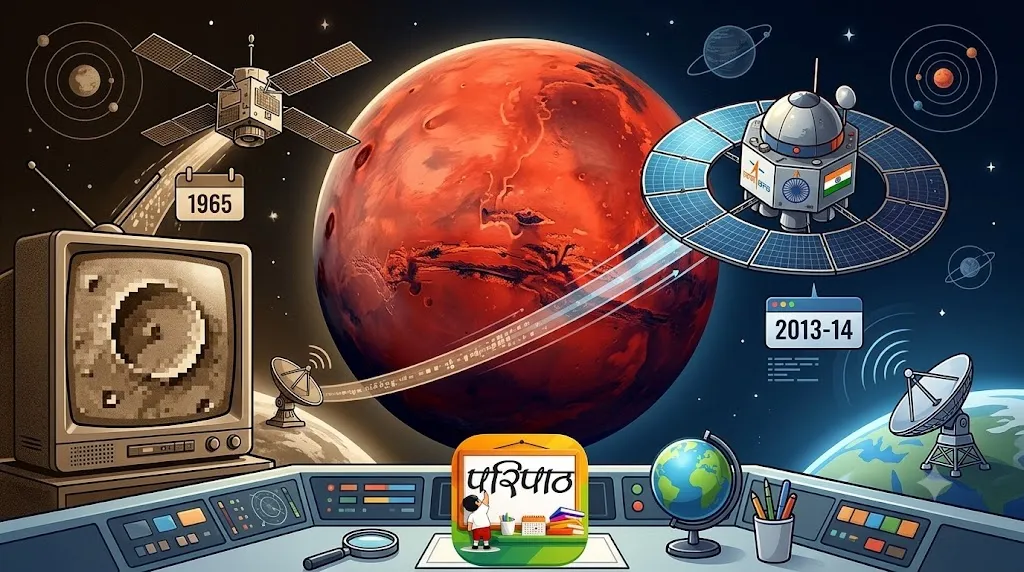
Today, July 14, 2026, we commemorate a pivotal moment in history that redefined our understanding of Mars. Exactly 61 years ago, on July 14, 1965, NASA's Mariner 4 spacecraft achieved an extraordinary feat: it sent back the first close-up images of Mars, offering humanity its first intimate look at the dusty, cratered world. This was not just a scientific triumph; it was a testament to human ingenuity, technological prowess, and an unyielding thirst for knowledge, laying the groundwork for countless future missions, including India's own historic Mars Orbiter Mission (MOM), affectionately known as Mangalyaan.
In this blog post, we will delve into the groundbreaking journey of Mariner 4, its initial discoveries, and how it dramatically reshaped our perception of Mars. We will also explore how this pioneering mission paved the way for subsequent planetary exploration, ultimately leading to India's remarkable contribution to space science with Mangalyaan. Join us as we embark on this incredible journey to the Red Planet!
Mariner 4: Humanity's First Close-Up of Mars
The Space Race and a Pioneering Mission
The 1950s and 1960s were defined by the intense 'Space Race' between the United States and the Soviet Union. Both superpowers vied for supremacy in space exploration, each striving to outdo the other. Following the Soviet Union's launch of Sputnik 1 in 1957, the U.S. rapidly accelerated its space program. It was in this competitive environment that the 'Mariner' series of missions was conceived, aimed at exploring our planetary neighbors. Mariner 4 stood out as the fourth in this series and the first successful mission to Mars.
On November 28, 1964, Mariner 4 was launched aboard an Atlas-Agena D rocket from Cape Canaveral, Florida. The spacecraft carried a modest payload: a television camera, a magnetometer, and other scientific instruments designed to gather data on Mars' surface and atmosphere.
A Seven-and-a-Half-Month Voyage and a Historic Encounter
Mariner 4's journey to Mars was anything but straightforward. After a grueling 7.5-month voyage spanning approximately 325 million miles (about 523 million kilometers), Mariner 4 finally reached Mars on July 14, 1965. At its closest approach, in the early hours of July 15th IST, the spacecraft flew within 9,846 kilometers (6,118 miles) of the Martian surface. During this historic flyby, Mariner 4 captured 22 images of Mars and began transmitting them back to Earth.
The process of transmitting these images was painstakingly slow. Due to the extremely low data transmission rate (a mere 8.33 bits per second!), each image took approximately 10 to 12 hours to reach Earth. Initially, scientists printed these images as black-and-white numerical printouts, meticulously coloring them by hand to visualize the Martian surface for the very first time.
"Mariner 4 painted a picture of Mars that was radically different from anything we had imagined. It revealed a cold, dry, and heavily cratered world, eerily similar to our own Moon."
Mariner 4's Groundbreaking Discoveries
The images and data sent back by Mariner 4 shattered many preconceived notions about Mars and unveiled some crucial insights:
- Cratered Surface: The images revealed a lunar-like surface, heavily pockmarked with large impact craters. This suggested very little geological activity on Mars over billions of years.
- Thin Atmosphere: Mariner 4 demonstrated that Mars' atmosphere was incredibly thin, about 100 times thinner than Earth's. This meant that a dense atmosphere, essential for sustaining life as we know it, was absent.
- Low Probability of Liquid Water: The thin atmosphere and low pressure indicated that liquid water was unlikely to exist on the Martian surface.
- Weak Magnetic Field: The spacecraft detected a very weak magnetic field around Mars, roughly 0.1% that of Earth's, which meant the planet was poorly protected from harmful solar winds.
These discoveries put an end to many romanticized ideas about Mars, but at the same time, they paved the way for more precise and targeted future investigations.
Laying the Foundation for Future Space Exploration
A Legacy of Martian Missions
While Mariner 4's initial portrayal of Mars might have seemed somewhat bleak, it undeniably laid a robust foundation for future research. The mission underscored the necessity for more extensive and in-depth studies of the Red Planet. Inspired by Mariner 4's success, NASA subsequently launched Mariner 6 and 7 (1969), and crucially, Mariner 9 (1971).
- Mariner 9: This was the first spacecraft to successfully orbit another planet (Mars). It mapped over 90% of the Martian surface, revealing astonishing geological features like massive volcanoes, vast canyons (such as Valles Marineris), and polar ice caps. Mariner 9 proved that there was much more to Mars than the cratered landscape Mariner 4 had initially shown.
Technological Advancements and the Search for Life
The Mariner missions spurred significant advancements in spacecraft design, communication systems, and scientific instrumentation. These were followed by the groundbreaking Viking missions (1975), which successfully landed on Mars and performed direct analysis of the surface. Subsequent missions like Mars Pathfinder, Mars Global Surveyor, Mars Odyssey, Mars Reconnaissance Orbiter, and the currently active rovers like Curiosity and Perseverance, along with the InSight lander, have continually expanded our understanding of Mars.
The ultimate goal of all these missions remains the search for evidence of past or present life on Mars. While Mariner 4 initially suggested a low probability for life, it undeniably initiated this long-term quest.
India's Martian Dream: The Mars Orbiter Mission (MOM) - Mangalyaan
ISRO's Historic Leap
When America launched Mariner 4, India was still in its nascent stages of space exploration. However, over the past few decades, the Indian Space Research Organisation (ISRO) has emerged as a global leader in space technology. One of the most inspiring and historic moments in India's space journey is the Mars Orbiter Mission (MOM), affectionately known as Mangalyaan.
On November 5, 2013, Mangalyaan was successfully launched aboard a Polar Satellite Launch Vehicle (PSLV-C25) from the Satish Dhawan Space Centre in Sriharikota, Andhra Pradesh. This mission was exceptional in several ways:
- First Attempt Success: No nation had successfully reached Mars orbit on its very first attempt. India achieved this remarkable feat!
- First Asian Nation: With this success, India became the first Asian nation to send a spacecraft to Mars.
- Incredibly Low Cost: The total cost of Mangalyaan was approximately 450 crore rupees (about 74 million USD), which was less than the production budget of many Hollywood movies. This stood as a global example of 'Frugal Engineering' – achieving high technology at a minimal cost.
Mangalyaan's Objectives and Scientific Contributions
After a journey of approximately 300 days, Mangalyaan successfully entered Mars' orbit on September 24, 2014. The spacecraft carried five scientific instruments (payloads) to study Mars' atmosphere, surface, and geological features:
- Methane Sensor for Mars (MSM): To detect the presence of methane gas in the Martian atmosphere, a potential biosignature.
- Thermal Infrared Imaging Spectrometer (TIS): To study the thermal emission and mineral composition of the Martian surface.
- Mars Color Camera (MCC): To capture high-resolution color images of the Martian surface and atmospheric phenomena.
- Lyman Alpha Photometer (LAP): To measure the relative abundance of deuterium and hydrogen in the upper atmosphere, crucial for understanding water loss.
- Mars Exospheric Neutral Composition Analyser (MENCA): To study the composition of the Martian exosphere.
Mangalyaan sent back numerous significant images, including those of Martian surface features, dust storms, and polar ice caps. It provided valuable data on the distribution of methane in the Martian atmosphere and contributed to studies on how planets lose water. The playful phrase 'Chai-Mangal' (tea and Mars) epitomized how India, with limited resources, managed to achieve a feat that many wealthier nations had struggled with.
Mariner 4 to Mangalyaan: A Chain of Great Journeys
Despite more than fifty years separating them, Mariner 4 and Mangalyaan are integral parts of the same grand scientific journey. Mariner 4 provided the first blurry, yet crucial, images of Mars, igniting further human curiosity. It demonstrated that Mars was not just a distant red dot, but a complex planet deserving of in-depth study.
The data from Mariner 4 served as a foundation upon which subsequent missions were meticulously planned. It laid the technological groundwork that eventually enabled nations like India to develop more efficient and cost-effective missions. Mangalyaan stands as a prime example of Mariner 4's enduring legacy. Where Mariner 4 offered the first glimpse, Mangalyaan put India on the global space map and inspired future generations.
Both missions collectively prove that science is not the endeavor of a single generation or a single nation, but rather the fruit of collective human perseverance and effort. Each new discovery becomes a stepping stone for the next, ensuring that the chain of knowledge remains unbroken.
The Future of Mars Exploration and Inspiring Students
The Next Generation's Dream: Martian Colonization?
Building on the paths forged by Mariner 4 and Mangalyaan, numerous nations and private entities are now pushing the boundaries of Mars exploration. NASA's Perseverance rover is currently searching for signs of ancient life on Mars. The Artemis program envisions returning humans to the Moon as a stepping stone for future missions to Mars. Private companies like Elon Musk's SpaceX harbor ambitious goals of establishing human colonies on the Red Planet.
India is also planning its Mars Orbiter Mission 2 (MOM-2), which promises to carry even more advanced scientific instruments for a deeper study of Mars. Following the success of Chandrayaan-3, India's space capabilities have been further strengthened, positioning us for even greater achievements on Mars in the future.
A Call to Students: You are the Future Space Explorers!
Today, as we reflect on Mariner 4's historic achievement and Mangalyaan's inspiring success, it is crucial to remember that the future of space exploration rests in your hands, dear students!
You are the scientists, engineers, astronauts, and researchers of tomorrow. Your curiosity, your ability to ask questions, and your eagerness to learn new things will shape you into the successful space explorers of the future. Embrace Science, Technology, Engineering, and Mathematics (STEM). Study these subjects, conduct experiments, and dare to dream big. Perhaps, one of you will be the one to take the first human steps on Mars or discover extraterrestrial life.
Space is limitless, and it awaits your exploration and discovery. Mariner 4 and Mangalyaan have demonstrated that with human determination and intellect, nothing is impossible. Let's become a part of this inspiring journey and give wings to our dreams!
Conclusion
On July 14, 1965, Mariner 4 etched a milestone in space history by sending back the first close-up images of Mars. This mission revolutionized our understanding of the Red Planet and laid the foundation for all subsequent Martian explorations. Inspired by Mariner 4's pioneering steps, India, in 2014, achieved a global record with its Mars Orbiter Mission (MOM), successfully entering Mars' orbit on its very first attempt. Both Mariner 4 and Mangalyaan symbolize human curiosity, scientific progress, and boundless possibilities. Their stories serve to inspire future generations, especially students, to pursue science and research, and to continue unraveling the mysteries of our captivating red neighbor.
Did You Know?
- A year on Mars is 687 Earth days long, almost double that of Earth.
- The gravity on Mars is only about 37% of Earth's, meaning you could jump three times higher there!
- The distinct red color of Mars comes from the iron oxide (rust) on its surface.
- India's Chandrayaan-3 mission was also launched on July 14, 2023, another significant coincidence in space exploration history.
- The New Horizons spacecraft flew past Pluto on July 14, 2015 (the 50th anniversary of Mariner 4's flyby), marking another incredible coincidence in space history.