Greetings, dear students and esteemed readers!
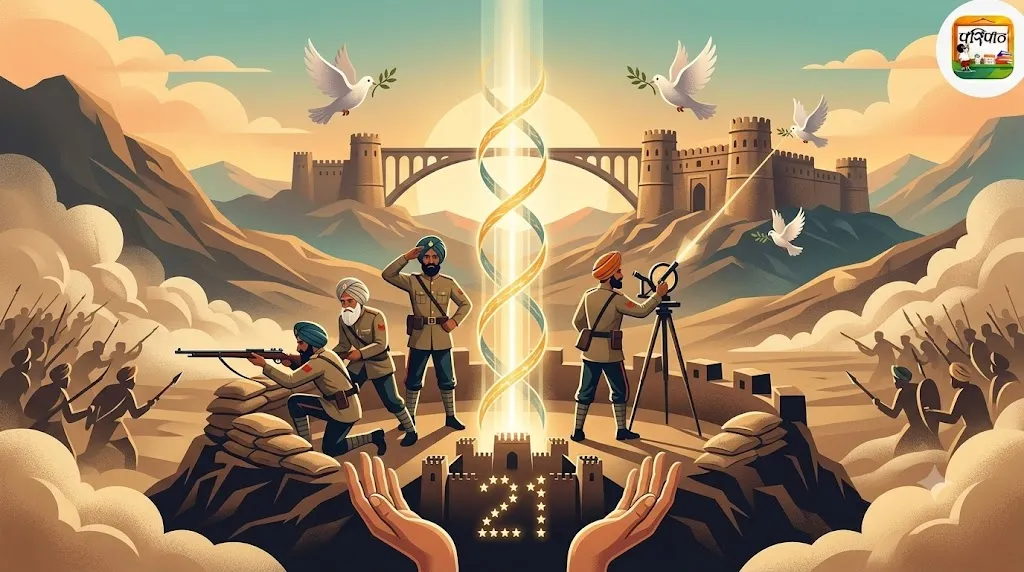
As we read this article on July 27, 2026, yesterday (July 26th) marked a profoundly significant national observance – Kargil Vijay Diwas. This day is not just another date on the calendar; it is a vibrant testament to the indomitable courage, unparalleled sacrifice, and unwavering devotion of the Indian Armed Forces. In the Kargil War of 1999, our brave soldiers not only defended India's borders but also showcased the might and resolve of the Indian military to the world.
Through this article, we will explore the background of the Kargil War, the thrilling saga of 'Operation Vijay,' the valor and sacrifice of our heroes, the lessons learned from this conflict, and the inspiration students can draw from it. Let us delve into the glorious pages of our nation's history.
The Genesis of the Kargil War: A Betrayal on the LoC
In early 1999, an atmosphere of peace talks prevailed between India and Pakistan, fostering hopes for improved relations. However, Pakistan, in a deceitful act, stabbed India in the back. Between January and May 1999, Pakistani forces, disguised as Kashmiri militants, infiltrated across the Line of Control (LoC) and occupied several key Indian outposts and peaks in the Kargil, Dras, Batalik, and Mushkoh sectors. This was a pre-meditated plan aimed at severing India's link to the Siachen Glacier and cutting off the Srinagar-Leh National Highway (NH-1D), thereby isolating Ladakh from the rest of India.
These outposts were situated at altitudes ranging from 14,000 to 18,000 feet above sea level, characterized by extremely rugged terrain and harsh weather conditions. During winters, these posts are typically vacated due to heavy snowfall and reoccupied in the spring. Exploiting this seasonal pattern, Pakistani forces seized control of these vacant positions. Initially, Indian intelligence was unaware, but reports from local shepherds in early May prompted the Indian Army to take serious notice.
"The greatest treason is to do the right thing for the wrong reason." - Thomas Becket (Though not directly about war, it reflects the moral complexity of betrayal.)
This infiltration came as a significant shock to India. Pakistan had violated international norms and peace agreements. India now faced a formidable challenge: to dislodge the intruders from its territory, that too, under extremely adverse conditions.
'Operation Vijay': A Saga of Valour and Resolve
Once the Pakistani infiltration was confirmed, India decided to retaliate immediately. On May 26, 1999, the Indian Army announced the commencement of 'Operation Vijay.' The primary objective of this operation was to evict the intruders from Indian soil. This war was unlike any conventional conflict, as the enemy held fortified positions on high peaks, firing down upon the Indian forces below. This presented an exceptionally difficult and perilous situation.
'Operation Safed Sagar': The Air Force's Crucial Role
Before the ground troops could advance, the Indian Air Force launched 'Operation Safed Sagar.' In this operation, fighter jets like the MiG-21, MiG-27, and Mirage-2000 conducted bombing raids on enemy positions. Despite the risks of low oxygen at high altitudes and enemy anti-aircraft fire, Indian pilots displayed incredible bravery. These air strikes significantly disrupted enemy supply lines and communication, paving the way for the ground forces' advance.
The Strategy to Reclaim Peaks
In Operation Vijay, the Indian Army devised a highly strategic and daring plan. The enemy had occupied crucial and strategically vital peaks such as Tololing and Tiger Hill in the Dras sector, and Jubar and Kukarthang in the Batalik sector. Reclaiming these peaks was a monumental challenge for the Indian Army.
- Tololing and Tiger Hill: These two peaks were extremely important for the Indian Army, as the enemy had a clear line of sight over the NH-1D highway from these positions. Indian soldiers, under the cover of darkness and a hail of bullets, scaled these peaks using ropes. After days of fierce combat, the Indian Army recaptured Tololing, which opened the path to winning Tiger Hill. The battle for Tiger Hill was one of the most thrilling and decisive engagements of the Kargil War.
- Batalik Sector: In this sector, Indian soldiers fought relentlessly to reclaim posts like Jubar and Kukarthang. The fighting in this area was equally intense and demanding.
To capture each post, Indian soldiers had to put everything on the line. Death loomed with every step, but their determination to fight for their country was unyielding. In a war that lasted approximately two months, the Indian Army, with its indomitable courage and supreme sacrifice, forced the enemy to retreat. On July 26, 1999, India declared 'Operation Vijay' a success, marking India's victory in the Kargil War.
The Unparalleled Courage and Sacrifice of Indian Soldiers: Inspiring Personalities
India achieved victory in the Kargil War, but it came at the cost of many brave soldiers sacrificing their lives. Their stories of valor and sacrifice are an inspiration to every Indian. Let us remember some of these valiant warriors:
Captain Vikram Batra (Param Vir Chakra)
Captain Vikram Batra is a name etched forever in the hearts of every Indian. 'Yeh Dil Maange More!' (This heart desires more!) was his victorious battle cry. He played a crucial role in capturing Tololing and Point 5140. He displayed extraordinary bravery while reclaiming Point 4875 but was martyred fighting the enemy. His leadership inspired many soldiers.
Captain Manoj Kumar Pandey (Param Vir Chakra)
Captain Manoj Kumar Pandey of 1/11 Gorkha Rifles led his troops in the fierce battles of Point 5070, Jubar Top, and Khalubar in the Batalik sector. He repeatedly advanced under heavy enemy fire, destroying enemy bunkers. He was severely injured while capturing Khalubar Top, but he continued fighting until his last breath, securing victory for his unit.
Grenadier Yogendra Singh Yadav (Param Vir Chakra)
Grenadier Yogendra Singh Yadav of 18 Grenadiers was the youngest recipient of the Param Vir Chakra in the Kargil War. During the extremely difficult ascent of Tiger Hill, he scaled a cliff face using a rope and single-handedly engaged three enemy bunkers. Despite sustaining multiple bullet wounds, he continued fighting, enabling his platoon to advance. His courage was incredible.
Rifleman Sanjay Kumar (Param Vir Chakra)
Rifleman Sanjay Kumar of 13 Jammu and Kashmir Rifles played a vital role in recapturing 'Flat Top' near Point 4875. Under intense enemy fire, he advanced, destroyed enemy bunkers, and forced the enemy to flee. He was also awarded the Param Vir Chakra.
Numerous Other Heroes
Apart from these, countless other brave soldiers like Major Rajesh Adhikari, Lieutenant Anuj Nayyar, Lieutenant Colonel Viswanathan, Major Padmapani Acharya, Captain Saurabh Kalia, and many more laid down their lives. Their sagas of valor are inscribed in golden letters in our history. Their families, too, bore the grief and pride of their children's, husbands', and fathers' sacrifices. It is because of their sacrifice that we are safe today.
Lessons from the Kargil War: National Security and Unity
The Kargil War imparted several crucial lessons to India. Understanding these lessons is essential for today's generation.
The Importance of National Security
This war once again underscored the paramount importance of defending our borders. For any nation's development and progress, robust national security is indispensable. It is because our soldiers guard the borders 24/7, 365 days a year, that we can live safely in our homes.
Military Preparedness and Modernization
The Kargil War motivated the Indian Army to be better prepared for future challenges. Emphasis was placed on strengthening intelligence agencies, adopting modern weaponry and technology, and providing specialized training to soldiers for fighting in adverse conditions.
The Significance of National Unity
During this war, the entire nation stood united. From Kashmir to Kanyakumari, every Indian supported our soldiers. Unity in diversity is a hallmark of India, and in times of crisis, this characteristic becomes even more pronounced. The Kargil War demonstrated the importance of setting aside caste, religious, or regional differences and coming together for the national interest.
Contribution of the Armed Forces to Peace and Security
Our armed forces not only fight wars but also make significant contributions to maintaining peace and security. Whether it's natural disasters, internal security, or international peacekeeping missions, the Indian Army is always at the forefront.
Inspiration for Students: Patriotism and Duty
Kargil Vijay Diwas is not merely a day to pay homage to our heroes; it is a day that instills a sense of patriotism and duty in all of us, especially students.
What is Patriotism?
Patriotism is not just about fighting on the border. Patriotism means loving your country, respecting its culture, and desiring to do something good for the nation. Being a good citizen, fulfilling your duties, contributing to the nation's development through education – all of this is patriotism.
Your Duty as Students
As students, your first and foremost duty is to study diligently. By acquiring good education, you can serve the nation as doctors, engineers, scientists, teachers, or in any other field. Finding solutions to our country's problems, maintaining social harmony, and protecting the environment are also part of your duty.
Drawing inspiration from the sacrifice and courage of our soldiers, we must all strive to build a strong and prosperous India. When we remember our nation's history and the sacrifices of our soldiers, a unique energy ignites within us.
Did You Know?
- The Kargil War was the first war fought by India after it officially declared itself a nuclear power.
- The Indian Army employed the Bofors Howitzers effectively, proving their capability in high-altitude warfare.
- 'Operation Vijay' was named to signify the unwavering determination to achieve victory.
- Approximately 527 Indian soldiers were martyred, and over 1,300 were wounded during the Kargil War.
- The capture of Tiger Hill was a crucial turning point, involving fierce hand-to-hand combat in extremely challenging conditions.
Conclusion
Kargil Vijay Diwas is not just a day to commemorate a historical event; it is a day that imparts lessons of national pride, patriotism, and sacrifice to all of us. The courage and sacrifice displayed by the Indian soldiers in the 1999 Kargil War will forever remain a source of inspiration. Heroes like Captain Vikram Batra, Captain Manoj Kumar Pandey, and Grenadier Yogendra Singh Yadav, through their ultimate sacrifice, taught us that nothing is more important than the nation's honor and security.
Dear students, you are the future of our nation. Inspired by the valor of our soldiers, you too should dream of achieving great things for your country. Through education, honesty, and hard work, you can build a strong and prosperous India. Let us all, on this Kargil Vijay Diwas, pay homage to our brave heroes and pledge to work for our nation, drawing inspiration from their sacrifice. Jai Hind! Jai Bharat!