Hello students and respected educators!
Today, September 10th, marks several significant events in history – the inauguration of the Large Hadron Collider, World Suicide Prevention Day, Switzerland's entry into the United Nations, the death anniversary of Ranjit Desai, and Steffi Graf's Grand Slam success. As we reflect on these diverse happenings, and the festivals of Pithori Amavasya, Pola, Bail Pola, and Kushagrahani Amavasya, let us turn our attention to an extraordinary woman who, through sheer determination and courage, challenged the prevailing norms of her time and carved a new path for women in India. Her name is Kadambini Ganguly – India's first female doctor!
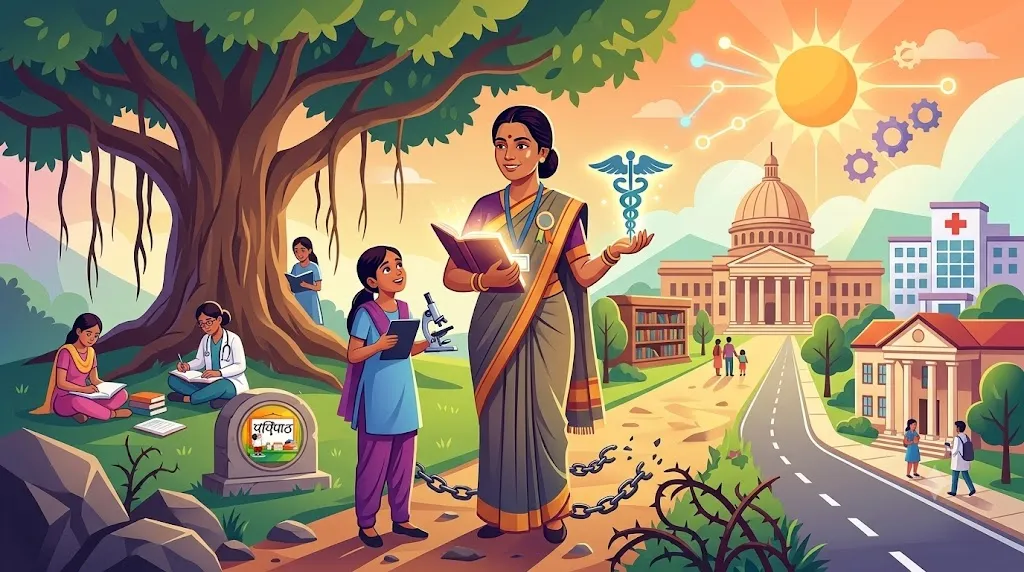
In the 19th century, during British colonial rule, women in India faced immense restrictions. They were largely confined to their homes, denied access to education, and excluded from public life. The idea of a woman pursuing a profession, especially one as challenging as medicine, was almost unthinkable. Yet, against all odds, Kadambini Ganguly not only pursued medical education but became the first woman to qualify as a doctor in India. Her story is not just about personal achievement; it's a powerful narrative of resilience, perseverance, and the triumph of the human spirit against societal oppression.
Join us as we delve into the inspiring life of this remarkable pioneer.
Early Life and the Spark of Education: A Glimmer of Hope
Kadambini Ganguly was born in 1861 (some records state 1862) in Bhagalpur, Bihar, then part of British India. Her father, Brajkishore Basu, was a prominent member of the Brahmo Samaj, a reformist movement that advocated for social equality and women's education. Growing up in a household influenced by such progressive ideals was a rare privilege for a girl in those times. She was instilled with the value of education and a sense of social justice from a young age.
Kadambini received her initial schooling in Bhagalpur before being enrolled in 'Bang Mahila Vidyalaya' in Dhaka, a school specifically established for girls. This laid the foundation for her higher education. From childhood, Kadambini displayed exceptional intelligence and a keen interest in learning. She possessed an insatiable thirst for knowledge and actively participated in every aspect of her studies. This innate curiosity and desire to contribute to society would later fuel her resolve to overcome numerous challenges.
Her father's liberal outlook and the progressive ethos of the Brahmo Samaj were instrumental in providing Kadambini with educational opportunities that were denied to countless other girls of her generation. This proved to be a pivotal turning point in her life.
Pioneering Academics: The Path to Graduation
Kadambini's educational journey continued at Bethune School in Calcutta, which was a significant center for women's education. It was here that her extraordinary academic abilities truly shone. In 1878, she successfully passed the entrance examination, then known as the 'Entrance Examination,' a remarkable feat given the limited opportunities for girls to even appear for such tests. This success earned her admission to Bethune College, the first women's college affiliated with the University of Calcutta.
In 1883, Kadambini Ganguly, along with Chandramukhi Basu, made history by becoming the first two female graduates from the University of Calcutta. They both earned their Bachelor of Arts (BA) degrees. This was not merely a personal achievement but a monumental moment for India, ushering in a new era for women's education. Their success inspired many other girls to pursue education and played a crucial role in shifting societal perceptions about the capabilities of women.
Throughout her academic pursuits, Kadambini received unwavering support from her husband, Dwarkanath Ganguly. A social reformer himself, Dwarkanath stood by her at every step, providing the encouragement she needed to forge ahead.
Even after graduating, Kadambini's ambition soared higher. She harbored a strong desire to pursue medical education, a field exclusively dominated by men at the time. The very thought of a woman becoming a doctor was considered radical and disruptive to the social order. Yet, Kadambini was determined to follow her dream, no matter the obstacles.
Challenges and Triumphs in Medical Education: Breaking the Mold
After completing her graduation, Kadambini decided to seek admission to the Calcutta Medical College. This decision was incredibly audacious for its time. In 1884, she was granted admission to this prestigious institution. However, her journey was far from easy. As the sole female student in the medical college, she frequently encountered ridicule, skepticism, and outright discrimination.
Some professors and fellow students openly opposed her presence in the classrooms, believing that women were not suited for medical studies. Kadambini often faced immense psychological pressure. But she refused to give up. Her resolve and her fervent desire to serve humanity through medicine were so strong that she decided to overcome every hurdle. She dedicated herself to her studies with even greater rigor, eventually impressing everyone with her intellect and dedication.
Interestingly, one of the professors who initially opposed her, Dr. Raja Raman, later became a staunch supporter and encouraged her after recognizing her exceptional abilities.
In 1886, Kadambini Ganguly achieved another historic milestone by earning the 'Graduate of the Medical College of Bengal' (GMCB) degree. This qualification, equivalent to the Licentiate of Medical College (LMC) at the time, officially authorized her to practice medicine. Thus, she became India's first female doctor. This achievement was not just a personal victory but a source of immense pride for every woman in India, opening doors that were previously shut.
But Kadambini's quest for knowledge did not stop there. She yearned to further enhance her medical expertise. In 1893, she traveled to the United Kingdom for advanced studies. She obtained licentiate qualifications from prestigious institutions in Edinburgh and Glasgow, including the Licentiate of the Royal College of Physicians and Surgeons of Edinburgh (LRCP), the Licentiate of the Royal College of Surgeons of Glasgow (LRCS), and the Licentiate of the Faculty of Physicians and Surgeons of Glasgow (LFPS). These qualifications further solidified her medical knowledge and skills.
Service as a Doctor and Social Activism: A Life of Dedication
Upon her return to India after her advanced studies abroad, Kadambini Ganguly began her practice at the Lady Dufferin Hospital in Calcutta. She made significant contributions, particularly in the field of women's health. In an era where many women hesitated to seek treatment from male doctors, leading to neglect of their health issues, the presence of female doctors like Kadambini was revolutionary. She provided crucial medical care to countless women, including many poor and needy patients, often offering free treatment.
Beyond her medical profession, Kadambini was an active social worker and political activist. In 1889, she was one of the first six women to attend the session of the Indian National Congress. She actively championed women's rights, particularly advocating for their right to vote. While working at Dufferin Hospital, she also raised her voice against the poor working conditions of female laborers, fighting for their rights and welfare.
Kadambini Ganguly's life was a testament to selfless service and unwavering dedication. She utilized her medical knowledge for the betterment of society, and her contributions extended beyond the medical realm, actively participating in social and political reforms that helped shape a new direction for society.
Legacy and Inspiration: A Guiding Light
Kadambini Ganguly passed away in 1923, but her legacy continues to inspire us today. She faced numerous obstacles throughout her life but never gave up. Her life offers several invaluable lessons:
- Determination and Resolve: Her unwavering commitment to pursue medical education, despite all opposition, demonstrates the power of a strong will.
- Overcoming Adversity: She confronted societal restrictions, discrimination, and psychological pressure with immense self-confidence and hard work.
- Pursuing Dreams: In an age when women were often confined to their homes, she dared to dream of becoming a doctor and achieved it. This teaches us that no dream is too big if we are willing to strive for it.
- Social Contribution: Beyond personal success, she made significant contributions to society, especially in women's health and rights.
Even today, many students, especially girls, who consider careers in medicine or other fields traditionally dominated by men, find immense inspiration in Kadambini Ganguly's name. It is largely due to pioneers like her that countless women today are leading doctors, engineers, scientists, and professionals in various fields.
On the occasion of Pola and Pithori Amavasya...
Today marks Pithori Amavasya and Pola. Pola is a festival where farmers express gratitude towards their bullocks, decorating them and performing rituals. This festival teaches us to show respect and gratitude towards those who toil. Kadambini Ganguly, too, toiled selflessly for society, bringing a new dawn into the lives of women. Her story inspires us not just to become doctors, but to become better human beings and contribute positively to society.
Did You Know?
- Kadambini Ganguly was one of the first two female graduates (along with Chandramukhi Basu) and the first female doctor in India.
- Her husband, Dwarkanath Ganguly, was a renowned social reformer who worked extensively for women's education and widow remarriage.
- Kadambini was a mother of eight children, yet she continued her medical practice and social activism.
- She was the first woman to address a session of the Indian National Congress in 1889.
- She also treated members of the royal family of Nepal.
Conclusion
Kadambini Ganguly's life is a symbol of courage, sacrifice, and unwavering determination. She opened the doors of the medical profession for women at a time when it was unimaginable. Her story teaches us that no obstacle is greater than your dreams. With sheer grit and hard work, you can achieve any height. The 'Paripath' family salutes her great work and unforgettable contribution!
Dear students, just like Kadambini Ganguly, set your goals in life, strive tirelessly towards them, and endeavor to do something good for society. Your dreams will surely lead you to the pinnacle of success!