
Introduction: A World on the Brink of Hunger
Today, we often take for granted the abundance of food available in our markets – fresh fruits, vegetables, and grains are readily accessible. But in the 19th century, the world faced a starkly different reality. A rapidly growing population, coupled with traditional and often inefficient farming methods, led to widespread food shortages and the constant threat of famine. It was a time when humanity desperately needed a breakthrough to sustain itself.
Into this challenging era stepped an extraordinary chemist, Justus von Liebig. Often hailed as the 'Father of Fertilizer,' Liebig's pioneering work in agricultural chemistry laid the foundation for modern farming practices, transforming how we grow food and ultimately saving millions from starvation. His scientific discoveries not only revolutionized agriculture but also underscored the profound impact science can have on everyday life. Let's delve into the life and groundbreaking contributions of this remarkable scientist.
Justus von Liebig: A Prodigy of Chemistry
Born on May 12, 1803, in Darmstadt, Germany, Justus von Liebig's fascination with chemistry began early. His father was a drysalter and dealer in chemicals, providing young Liebig with an environment rich in chemical observations and experiments. This early exposure ignited his scientific curiosity and set him on a path of discovery.
At the age of sixteen, Liebig enrolled at the University of Bonn to study chemistry, later transferring to the University of Erlangen, where he earned his doctorate. His exceptional talent caught the attention of prominent figures, leading him to work with the renowned French chemist Joseph Louis Gay-Lussac in Paris. Under Gay-Lussac's mentorship, Liebig conducted significant research in organic chemistry, sharpening his analytical skills and scientific approach.
In 1824, at just 21 years old, Liebig was appointed Professor of Chemistry at the University of Giessen. There, he established what is considered the world's first modern teaching laboratory, where students were not just lectured but actively engaged in hands-on experimentation. This innovative approach trained a generation of future scientists and cemented Giessen's reputation as a hub for chemical research. Liebig's contributions spanned various fields, including organic chemistry, agricultural chemistry, and even physiology.
Challenging Old Beliefs: The Mineral Theory of Plant Nutrition
For centuries, the prevailing belief about how plants obtained their nourishment was the 'Humus Theory.' This theory suggested that plants directly absorbed complex organic compounds (humus) from decaying matter in the soil to grow. Farmers relied on organic manures, believing them to be the primary source of plant sustenance.
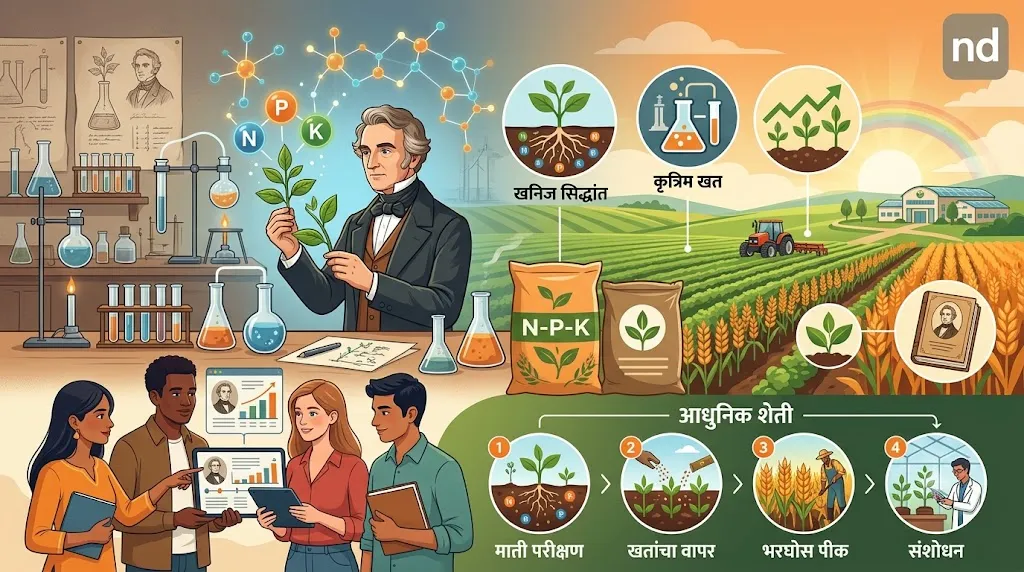
However, Liebig, through meticulous experimentation and chemical analysis, began to challenge this long-held view. In 1840, he published his seminal work, 'Die organische Chemie in ihrer Anwendung auf Agricultur und Physiologie' (Organic Chemistry in its Application to Agriculture and Physiology), often referred to as the 'Bible of agricultural chemistry.' In this book, he introduced his revolutionary 'Mineral Theory of Plant Nutrition.'
Liebig asserted that plants do not primarily feed on organic humus but rather absorb specific inorganic minerals from the soil. He identified key elements like nitrogen (N), phosphorus (P), and potassium (K) as essential for plant growth. He demonstrated that if these minerals were deficient in the soil, plant growth would be stunted. He also correctly identified that plants obtain carbon from atmospheric carbon dioxide (CO2) and hydrogen and oxygen from water (H2O).
“The soil is a storehouse, where all the substances necessary for the nutrition of plants are contained; but if they are not present in the proper proportions, the growth of the plant cannot be perfected.” – Justus von Liebig
Liebig's work conclusively disproved the Humus Theory and fundamentally altered the understanding of plant physiology. He showed that continuous cropping depleted the soil of these vital minerals, leading to a decline in fertility. The logical solution, he proposed, was to replenish these minerals artificially. This insight became the cornerstone for the development of artificial fertilizers.
From Theory to Practice: The Birth of Artificial Fertilizers
Liebig's Mineral Theory was not just a scientific abstraction; he was determined to translate his findings into practical applications that could benefit agriculture directly. His work paved the way for the creation of synthetic fertilizers, marking a pivotal moment in human history.
He advocated for the chemical analysis of soil to determine nutrient deficiencies and then proposed the use of specific chemical compounds to correct these imbalances. His most significant practical contribution was the development of superphosphate. By treating bones (a source of calcium phosphate) with sulfuric acid, he made the phosphorus more soluble and thus more readily available for plants to absorb. This marked the creation of the first artificial fertilizer and immediately demonstrated its potential to boost crop yields dramatically.
While Liebig correctly identified the crucial role of nitrogen, he initially struggled to find an efficient way to produce artificial nitrogen fertilizers on a large scale. However, he strongly recommended crop rotation with nitrogen-fixing plants (like legumes) to naturally replenish soil nitrogen. His efforts laid the groundwork for future advancements, leading to the later development of nitrogenous fertilizers like ammonium sulfate and urea.
Liebig's innovations transformed farming from a traditional, experience-based practice into a scientific and technological endeavor. Farmers could now, with the help of science, actively manage and enhance soil fertility, making it possible to produce more food from less land and feed a burgeoning global population.
Transforming Global Agriculture: Feeding a Growing Planet
The widespread adoption of Liebig's ideas and the subsequent development of artificial fertilizers triggered what is often termed the 'Second Agricultural Revolution.' The impacts were profound and far-reaching:
- Dramatic Increase in Crop Yields: Fertilizers led to unprecedented increases in the productivity of crops like wheat, maize, and rice. A single plot of land could now yield significantly more than before.
- Support for Population Growth: The increased availability of food was critical in supporting the rapid population growth of the 19th and 20th centuries, helping many nations overcome chronic food shortages and famine.
- Urbanization and Industrialization: With fewer people needed to produce more food, a significant portion of the workforce migrated from rural areas to cities, fueling urbanization and providing labor for the burgeoning industrial revolution.
- Economic Boost: Enhanced agricultural productivity stimulated national economies, increased food exports, and transformed farming into a major industry.
- Foundation for Scientific Agriculture: Liebig's work established the scientific principles underlying modern agriculture, promoting practices like soil testing, precise nutrient application, and crop rotation.
It is no exaggeration to say that Liebig's discoveries literally saved the world from widespread starvation, laying the groundwork for the modern, industrialized agricultural system we know today.
Liebig's Enduring Legacy: Modern Farming and Our Food
Justus von Liebig passed away in 1873, but his legacy continues to thrive. His mineral theory and the concept of artificial fertilizers remain the bedrock of modern agriculture. A vast majority of the world's food production today relies on the principles he established and the fertilizers he pioneered. The food on our plates, from the bread we eat to the vegetables we enjoy, is, in an indirect yet fundamental way, a testament to Liebig's scientific vision.
Contemporary farming practices, including soil analysis, targeted nutrient application, and the use of NPK (Nitrogen, Phosphorus, Potassium) fertilizers, are all rooted in Liebig's foundational work. While science has advanced significantly with the development of micronutrients, bio-fertilizers, and smart farming technologies, the core understanding of plant nutrition still traces back to Liebig.
His work stands as a powerful example of how scientific inquiry can be harnessed to solve pressing human problems. Liebig not only revolutionized chemistry but also made invaluable contributions to agricultural science, nutrition, and public health. In an age where climate change and population growth once again bring food security to the forefront, the foresight and importance of Liebig's contributions are more relevant than ever.
Did You Know?
- Justus von Liebig established the world's first modern chemistry teaching laboratory at the University of Giessen, where students learned through hands-on experimentation.
- He developed a method for producing 'meat extract,' which later became famous as 'Liebig's Extract of Meat Company,' providing nutritious broth and soup bases.
- Liebig was ennobled as a 'Baron' in 1845 for his scientific achievements, adding 'von' to his name.
- He also contributed to the development of baking powder and early infant formula.
- One of his most famous students, August Wilhelm von Hofmann, went on to found the Royal College of Chemistry in London, which is now part of Imperial College London.
Conclusion
Justus von Liebig was more than just a chemist; he was a visionary humanitarian. His 'mineral theory' transformed our understanding of plant nutrition, and his pioneering work in artificial fertilizers sparked an agricultural revolution. His contributions fed millions, supported global population growth, and laid the essential groundwork for modern farming. The food we consume daily is a direct beneficiary of Liebig's scientific genius. His life and work serve as an inspiring testament to the power of science and its capacity to contribute to human welfare, illustrating how scientific advancements are deeply intertwined with our everyday lives.
